
Publications /
Opinion

Back
Global Value Chains: The Missing Link in Sub-Saharan Africa’s Trade Integration
Authors
Roger Nord
September 18, 2015

Sub-Saharan Africa’s trade flows increased sharply, multiplying by a factor of five over the past 20 years. Is this boom built on commodities only?  My answer is no ! Many countries have increased their integration in global value chains. But, it is also clear that sub-Saharan Africa still has some way to go.

Increased trade boosts for growth

Over the last two decades, the export-to-GDP ratio in sub-Saharan Africa increased from 20½ percent in 1995 to 27½ percent in 2013. This occurred to a great extent thanks to a rising demand for raw materials over that period, but not only, as some non-commodity exporters in the region also recorded impressive progress. In the process, the destination of sub-Saharan African exports changed substantially, with the development of new partnerships with emerging markets such as Brazil, China, and India—China is now the most important single trade partner for sub-Saharan Africa.

Our analysis finds that increased trade integration has had a strong influence on growth in sub-Saharan Africa. Average real GDP per capita growth increased from 2.9 percent in the 1990s, to 4.3 percent in the 2000s. Of that 1.4 percentage point increase, about half was accounted for by higher trade integration.

Still substantial untapped potential

Yet, despite this strong growth, the region’s trade has barely kept up with the expansion of the global trade network over the last 20 years. Of course, this partly reflects lower income levels, generally longer distances, and the specific challenges facing landlocked countries. But even after accounting for those factors, trade flows emanating from sub-Saharan Africa are found to be only half of the magnitude experienced elsewhere, with intra-regional trade only 15–20 percent of what is observed within South and East Asia or Europe.

Global Value Chains: Where are you?

One key dimension of globalization in recent decades has been the development of global value chains—large supply chains in which value is added at each stage of production before crossing borders to be passed on to the next stage. At the global level, deeper integration into global value chains has been accompanied by a rise in income levels over time, most evident in Asia and in Eastern Europe, where countries have successfully plugged themselves into downstream supply chain networks such as processing and assembly trade with imported inputs.

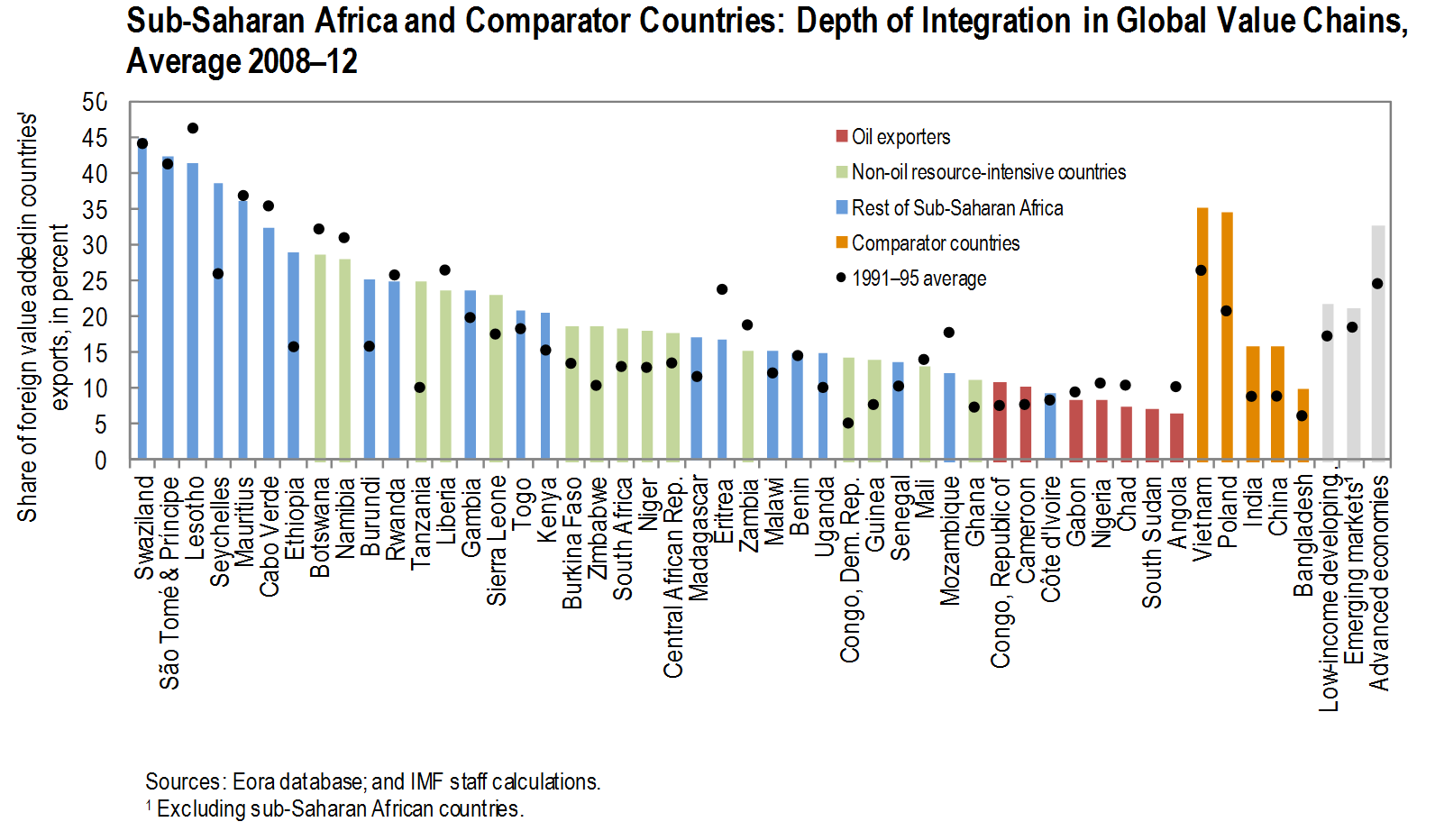
Figure 1 shows that most countries in sub-Saharan Africa have increased their integration in global value chains, as measured by the share of foreign value added in a country’s exports. But while there a substantial degree of heterogeneity across the region, it is also clear that sub-Saharan Africa still has some way to go.
PCNS


How to seize the opportunity?

How to accelerate the region’s integration into global value chains? The experience of five countries—Tanzania, Ethiopia, Seychelles, South Africa and Kenya—is instructive. These countries stand out, having seen their integration rise over two decades by a magnitude similar to the most successful countries in other regions, such as Poland or Vietnam.

We invite you to read the full OpEd by Roger Nord on Ideas For Development (ID4D) Blog

RELATED CONTENT

  • October 15, 2026
    The Policy Center for the New South, in partnership with The Asian Network, is organizing a webinar titled “Emerging Powers and the Remaking of Global Order” to examine the growing role of emerging powers and the Global South at a time of profound transformation in the international sys...
  • October 14, 2026
    في ظل التوترات الجيوسياسية المتصاعدة، تتغير طرق التجارة العالمية وتتبدل معها موازين الممرات الاستراتيجية. تفتح هذه الحلقة من «حديث الثلاثاء» النقاش حول التقاء المسارات البحرية والبرية داخل هذه الممرات، والعوامل التي تتحكم في طبيعة السلع التي تعبرها. وتبحث كذلك في ما يمكن للمغرب أن يجنيه...
  • Authors
    Florent Parmentier
    October 12, 2026
    Cet article soutient que le Chief Geopolitical Officer (CGO) doit être repensé à partir de l’expérience des entreprises africaines. Dans un environnement multipolaire et fragmenté, leur principal défi n’est pas seulement la gestion des risques, mais la préservation de plusieurs options stratégiques simultanément selon une logique de hedging. Trois modèles de CGO sont à distinguer : l’intermédiation (Office chérifien des Phosphates (OCP), Tanger Med), l’intégration régionale (Ethiopi ...
  • Authors
    Paul Isbell
    October 9, 2026
    In the first seven Policy Briefs of this ongoing series of analysis on Pan-Atlanticism: The Atlantic Basin in a Multipolar-Transnational World, we developed the argument that the strategic significance of the Atlantic Basin is on the rise for a range of international actors (states, regions and non-state agents) and from distinct political or ideological perspectives. In addition, in the most recently published Policy Brief -- “The U.S. and the Current International Reconfiguration: ...
  • October 09, 2026
    Can Nigeria’s Dangote refinery help strengthen Africa’s energy security amid disruptions to global supply routes? This discussion considers how expanding local refining capacity can reduc ...
  • Authors
    Marie-Noelle Nwokolo
    October 6, 2026
    The author of this opinion, Marie-Noelle Nwokolo, is a 2024 alumna of the Atlantic Dialogues Emerging Leaders Program.In September 1978, delegations from 138 countries gathered in Buenos Aires, Argentina, around a powerful idea: developing countries had knowledge, experience and capabilities worth sharing with one another. The Buenos Aires Plan of Action gave institutional form to what we now call South-South Cooperation, part of a wider post-colonial effort by developing ...
  • September 25, 2026
    Dans cet épisode d’Africafé, Amadou Diop analyse les défis de sécurité maritime auxquels font face les pays de l’Afrique atlantique, de la piraterie aux trafics transfrontaliers. Il souligne la nécessité de mutualiser les moyens et de partager l’information entre États. L’échange aborde...
  • Authors
    Luladay Berhanu Mengistie
    Guillaume Gérout Suominen
    September 21, 2026
    The African Union Summit of February 2026 instructed the African Continental Free Trade Area (AfCFTA) Council of Ministers to negotiate a Protocol on Industrial Policy and Development. This work, handled without adequate preparation, is likely to reproduce the weaknesses it is meant to remedy. This paper is a conceptual mapping exercise, written to raise the preparatory questions before drafting begins, rather than to prescribe outcomes.It proceeds in five sections:1. It works towar ...





