Publications /
Book / Report

Back
Africa Economic Symposium (AES) 3nd edition - SUMMARY REPORT
Authors
General rapporteur Mahmoud Arbouch
September 2, 2025

The Africa Economic Symposium (AES) has firmly established itself as one of the flagship annual events of the Policy Center for the New South, alongside the Atlantic Dialogues and the African Peace and Security Annual Conference (APSACO). Now in its third edition, AES continues to provide a unique platform for economists, policymakers, and academics from across the continent and beyond to exchange perspectives on the pressing macroeconomic and structural challenges facing Africa. Its mission remains to foster rigorous, evidence-based debates that inform policymaking and support long-term strategies for Africa’s development in an era of uncertainty. 

The 2025 edition, convened under the theme “Bold Moves amid Global Shifts,” explored the difficult policy trade-offs confronting African governments as they navigate a volatile global environment. The continent’s recovery from COVID-19 has been uneven, while debt pressures, supply chain disruptions, and geopolitical tensions weigh heavily on fiscal and economic resilience. Structural challenges such as persistent unemployment, low productivity, and the exclusion of Africa’s youth continue to hinder inclusive growth, even as policymakers are called upon to adapt to deep systemic uncertainty. 

The symposium underscored that many African states are increasingly resorting to short-term stabilization measures—such as accumulating reserves and postponing reforms—that may provide immediate security but risk delaying the structural transformation urgently needed. Against this backdrop, AES 2025 called for a careful balance between fiscal prudence, social investment, and the pursuit of sustainable growth, placing emphasis on reforming governance, improving macroeconomic management, and accelerating structural change. 

The discussions highlighted the urgent need to rethink Africa’s economic strategies in a shifting global order. From debt sustainability and the role of central banks to the promise of financial innovation, digital inclusion, and new instruments such as central bank digital currencies, the symposium emphasized that policy choices must align with long-term transformation goals. The debates also explored the opportunities and challenges of regional integration, trade connectivity, and development finance, all of which are essential levers for Africa’s resilience and prosperity. 

As in previous editions, the Annual Report on African Economies was launched alongside the symposium, offering an in-depth analysis of the continent’s macroeconomic dynamics and structural transformation pathways. More than just a publication, the report reflects the collective intellectual effort of leading scholars and practitioners, providing evidence-based insights to guide decision- makers. Together, the symposium and the report reinforced the Policy Center for the New South’s commitment to fostering forward-looking economic thinking that moves beyond short-term headlines to tackle Africa’s enduring challenges.


RELATED CONTENT

  • February 22, 2016
    If one opens the newspapers nowadays, Brazil will come out as a melting opportunity. The country is currently facing its largest economic crisis, mostly resulting from a negative political environment where the current Administration has been deeply swollen by Brazil´s largest corruption scandal, the so-called Lava Jato (Car Wash) Operations, whose investigations have brought to light the fact that billions of US$ dollars were being used for campaign financing, illicit enrichment an ...
  • February 8, 2016
    Brazil is in a good position to serve as a bridge to Africa and to reignite more cooperation between both sides of the South Atlantic. Brazil has increased its presence in Africa in recent years in terms of trade, investment, development cooperation, and political alliances with the goal to secure a greater say for the global South in the new world order that has been under construction since the of the Cold War. This has been pursued through financial support and proactive economic ...
  • Authors
    February 1, 2016
    Industrial policy is a controversial, even taboo, subject in policy circles. Yet it is widely practiced by advanced and developing countries alike2 . This note tries to make sense of this paradox. It argues that industrial policy can be a useful weapon in the development policy arsenal. However, the effectiveness of industrial policy is more circumscribed than many of its practitioners think, and there are significant risks associated with getting it wrong, especially in a poor gove ...
  • January 27, 2016
    This podcast is performed by Prakash Loungani. He is Senior Fellow at Policy Center for the New South and Advisor in the Research Department of the International Monetary Fund, was interv ...
  • Authors
    Russel Dinh
    January 27, 2016
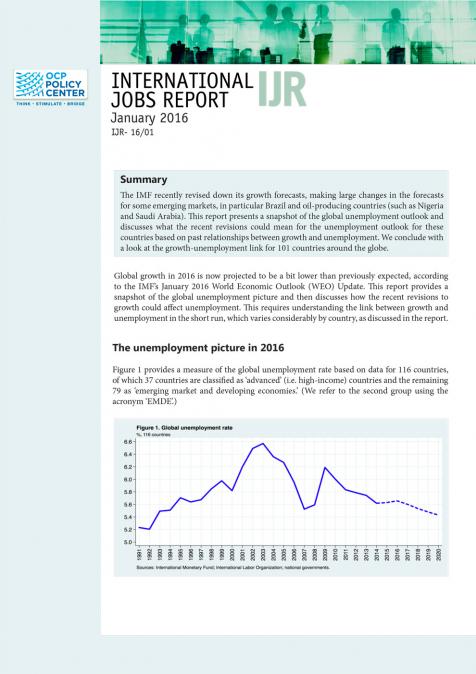
    The IMF recently revised down its growth forecasts, making large changes in the forecasts for some emerging markets, in particular Brazil and oil-producing countries (such as Nigeria and Saudi Arabia). This report presents a snapshot of the global unemployment outlook and discusses what the recent revisions could mean for the unemployment outlook for these countries based on past relationships between growth and unemployment. We conclude with a look at the growth-unemployment link f ...
  • Authors
    January 12, 2016
    Q: The U.S. Federal Reserve on Dec. 16 raised interest rates, ending what Fed Chairwoman Janet Yellen called an “extraordinary seven-year period” during which policymakers kept the federal funds rate near zero in an effort to support the economy. How will the Fed’s action affect Latin American economies, many of which are struggling with anemic growth and low prices for their commodity exports? How will the interest rate hike affect Latin American countries’ ability to pay off ...
  • Authors
    Nisrine Ouazzani
    January 6, 2016
    The economic growth of the African continent and its positioning as an emerging force is a reality no longer questioned. Optimism surrounding the Africa rising narrative is supported by a growing young workforce, an expanding middle class, new discoveries of natural resources and minerals, relative political stability and infrastructure developments. Economic and international financial actors now recognize the potential that the continent represents for the world economy, consider ...
  • Authors
    December 23, 2015
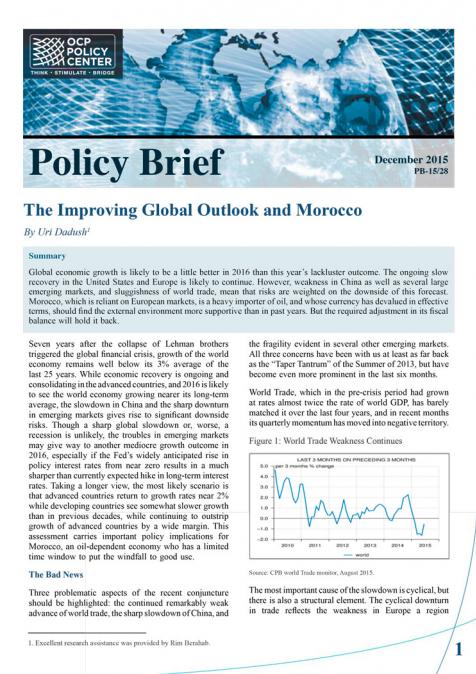
    Global economic growth is likely to be a little better in 2016 than this year’s lackluster outcome. The ongoing slow recovery in the United States and Europe is likely to continue. However, weakness in China as well as several large emerging markets, and sluggishness of world trade, mean that risks are weighted on the downside of this forecast. Morocco, which is reliant on European markets, is a heavy importer of oil, and whose currency has devalued in effective terms, should find t ...