Publications /
Book / Report

Back
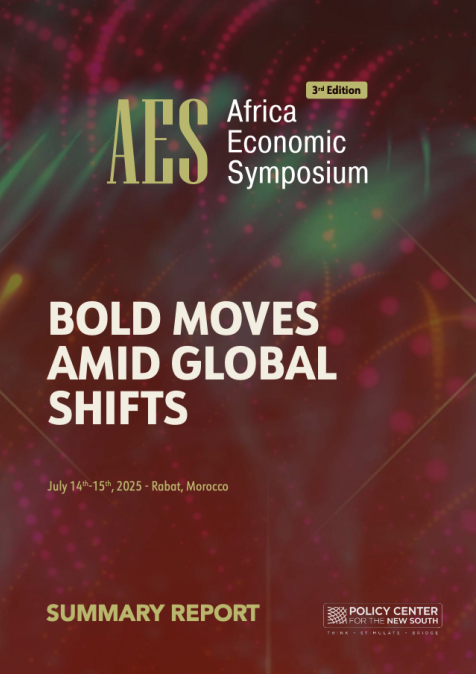
Africa Economic Symposium (AES) 3nd edition - SUMMARY REPORT
Authors
General rapporteur Mahmoud Arbouch
September 2, 2025

The Africa Economic Symposium (AES) has firmly established itself as one of the flagship annual events of the Policy Center for the New South, alongside the Atlantic Dialogues and the African Peace and Security Annual Conference (APSACO). Now in its third edition, AES continues to provide a unique platform for economists, policymakers, and academics from across the continent and beyond to exchange perspectives on the pressing macroeconomic and structural challenges facing Africa. Its mission remains to foster rigorous, evidence-based debates that inform policymaking and support long-term strategies for Africa’s development in an era of uncertainty. 

The 2025 edition, convened under the theme “Bold Moves amid Global Shifts,” explored the difficult policy trade-offs confronting African governments as they navigate a volatile global environment. The continent’s recovery from COVID-19 has been uneven, while debt pressures, supply chain disruptions, and geopolitical tensions weigh heavily on fiscal and economic resilience. Structural challenges such as persistent unemployment, low productivity, and the exclusion of Africa’s youth continue to hinder inclusive growth, even as policymakers are called upon to adapt to deep systemic uncertainty. 

The symposium underscored that many African states are increasingly resorting to short-term stabilization measures—such as accumulating reserves and postponing reforms—that may provide immediate security but risk delaying the structural transformation urgently needed. Against this backdrop, AES 2025 called for a careful balance between fiscal prudence, social investment, and the pursuit of sustainable growth, placing emphasis on reforming governance, improving macroeconomic management, and accelerating structural change. 

The discussions highlighted the urgent need to rethink Africa’s economic strategies in a shifting global order. From debt sustainability and the role of central banks to the promise of financial innovation, digital inclusion, and new instruments such as central bank digital currencies, the symposium emphasized that policy choices must align with long-term transformation goals. The debates also explored the opportunities and challenges of regional integration, trade connectivity, and development finance, all of which are essential levers for Africa’s resilience and prosperity. 

As in previous editions, the Annual Report on African Economies was launched alongside the symposium, offering an in-depth analysis of the continent’s macroeconomic dynamics and structural transformation pathways. More than just a publication, the report reflects the collective intellectual effort of leading scholars and practitioners, providing evidence-based insights to guide decision- makers. Together, the symposium and the report reinforced the Policy Center for the New South’s commitment to fostering forward-looking economic thinking that moves beyond short-term headlines to tackle Africa’s enduring challenges.
RELATED CONTENT

  • June 24, 2020
    La réputation, concept majeur s’il en est, est un indicateur de l’estime accordée à une personne physique mais aussi à une entreprise ou encore à une entité étatique. Constituée d’une somme de perceptions, elle est la résultante globale de l’ensemble d’images, d’appréciations des actions et comportements de celles-ci. Ainsi, la bonne réputation d’un gouvernement est déterminée et mesurée par son aptitude à faire face aux épreuves que traverse le pays, à affronter les bouleversements ...
  • Authors
    June 22, 2020
    COVID-19 brought the global economy to a sudden stop, causing shocks to supply and demand. Starting in January 2020, country after country suffered outbreaks of the new coronavirus, with each facing epidemiological shocks that led to economic and financial shocks as a consequence. How quickly and to what extent will national economies recover after the pandemic has passed? This will depend on success in containing the coronavirus and on exit strategies, as well as on the effectivene ...
  • Authors
    June 16, 2020
    La nature indispensable du transport aérien dans la conduite de la diplomatie et des affaires, la croissance de l’économie et le développement du commerce, fait que ce secteur est aujourd’hui sous le feu des projecteurs. Bien que ce ne soit pas la première crise traversée par le secteur aérien, elle reste sans conteste celle qui a engendré le plus de dégâts en un laps de temps relativement court. Il est vrai que les industries de l’aérien et du tourisme ont toutes deux déjà été mise ...
  • June 12, 2020
    Le Laboratoire d’Economie Appliquée ( LEA) de la Faculté des Sciences Juridiques Economiques et Sociales Rabat - AGDAL en partenariat avec le Policy Center for the New South, a le plaisir de vous inviter à participer à la table ronde organisée sous le thème «Les politiques économiques d...
  • Authors
    June 12, 2020
    The United States has suffered more COVID-19 casualties than any other country and continues to report large numbers of new cases and deaths, and – as evident recently in stock markets – investors remain extremely sensitive to the epidemic’s shifting trends. As every state reopens, including most recently the New York epicenter, the fates of the American economy and of the global economy depend on whether the United States has put the worst of the epidemic behind it, or whether it w ...
  • Authors
    June 11, 2020
    When the cruise ship the MS Braemar in March had coronavirus cases confirmed on board, it struggled to find somewhere to dock. The Americans turned it away, as did the Bahamas. But another nation, just 200 miles off the U.S. coast, accepted the desperate Braemar. Cuba allowed it to berth in Puerto Mariel, 40 kilometers west of the capital, Havana. Within a day, in cooperation with the British government, Cuban medical teams accompanied more than 680 passengers to Havana airport and ...
  • Authors
    June 10, 2020
    Three features of the post-pandemic global economy can already be anticipated: the worldwide rise in public and private debt levels, accelerated digitization, and a partial reversal of globalization. The first arises from the public sector's role as the ultimate insurer against catastrophes, government policies to smooth pandemic curves and the coronavirus recession. These will leave a legacy of massive public-sector debt worldwide (as discussed in a previous post. Lower tax re ...
  • June 10, 2020
    Ce travail vient explorer une nouvelle piste qui pourrait contribuer à une levée de confinement efficace. Il s’agit d’un phénomène que l’on appelle « effet coupe du monde ». Nous définissons, d’abord, ce phénomène, montrons son existence et son éventuel effet amplificateur au regard de la progression de la pandémie, en termes du nombre de cas infectés au pic et la durée encourue avant son atteinte. Partant de scénarios hypothétiques, en ce qui concerne les conditions initiales à la ...
  • June 10, 2020
    We explore a new avenue that could contribute to an effective de-confinement in the context of COVID-19. This phenomenon is known as the ‘World Cup Effect’. We first define this phenomenon and highlight its existence and its possible amplifying effect with regard to the spread of the pandemic, in light of the number of infected cases recorded at the pandemic’s peak, and the duration before reaching its highest level. Based on hypothetical scenarios in terms of the initial conditions ...