Publications /
Book / Report

Back
Accelerating Growth and Job Creation in a Rapidly Changing and Integrated World
July 14, 2021

This book aims to address job creation in Morocco in the context of a new export-driven growth model. Prior to the COVID-19 pandemic, the unemployment situation in Morocco was serious, particularly among young people. Morocco’s competitive edge in the global market had been eroding, especially in labor-intensive, low-wage industries that typically create large numbers of jobs. The COVID-19 pandemic has created further setbacks to the economy in 2020 and beyond, including a collapse in economic growth and worsening unemployment.

At the same time, fundamental transformations in the international environment in recent decades have had profound implications for what Morocco can produce and export to the world to create jobs. These factors include fierce competition from low-income and lower middle-income Asian and Sub-Saharan African countries in labor-intensive manufactured goods; widespread presence of global supply chains which dictate what local firms can or cannot manufacture for Morocco’s medium- and high-tech sectors; accelerating digitization and automation which have led to the displacement of workers by machines in industries as simple as footwear and as sophisticated as automobiles and aircraft assembly.

RELATED CONTENT

  • Authors
    Christos Daoulas
    August 22, 2019
    This note approaches the relationship between natural wealth and economic growth, using the case of Sub-Sahara African economies as an illustration. Delving into recent World Bank reports, it highlights how a sustained positive correlation between natural capital and GDP growth happens through the transformation of the former into other forms of assets: produced capital, human capital and other intangible assets. Governance features and the quality of macroeconomic policies are of t ...
  • Authors
    August 13, 2018
    The Brazilian economy pays a price in terms of productivity foregone because of its lack of trade openness. A trade opening process would bring an adjustment impact that could nonetheless be mitigated with public policies that facilitate labor mobility and job migration. Benefits from trade opening would also hinge on policy improvements in complementary areas, such as infrastructure investments, business environment and others. The Brazilian economy would benefit from opening trad ...
  • Authors
    August 13, 2018
    Depuis la fin de l’année 2017, le président Donald Trump mène plusieurs batailles commerciales, contre différents partenaires, sous prétextes de sauver des emplois industriels américains et de réduire le déficit commercial des États-Unis. S’il est difficile de se prononcer sur les effets des combats commerciaux amorcés par le président Trump, l’importance des opposants et des échanges pour l’économie mondiale en fait une source de risque pour la croissance, les emplois et les prix à ...
  • December 15, 2017
    Moderator: Adama Gaye, CEO, Newforce Africa - Philippe Chalmin, Professor, Economic History, Paris Dauphine University - Uri Dadush, Senior Fellow, OCP Policy Center - Jean Hervé Lorenzi, President, Cercle des Economistes - Paulo Portas, Former Minister of Foreign Affairs, Portugal - Is...
  • Authors
    Edité par
    Idriss El Abbassi
    Lahcen Oulhaj
    Aziz Ragbi
    November 28, 2016
    Le présent ouvrage se propose d’apporter quelques éléments d’appui supplémentaires aux policy-makers pour une meilleure identification des défaillances des marchés au Maroc et une mise en place d’une stratégie de diversification et une politique industrielle efficientes, sans toutefois tomber dans la situation inverse où une stratégie mal définie et des outils mal choisis peuvent se traduire par une défaillance des politiques publiques. L’appréhension des difficultés qu’éprouve l’é ...
  • Authors
    Prakash Loungani
    November 9, 2016
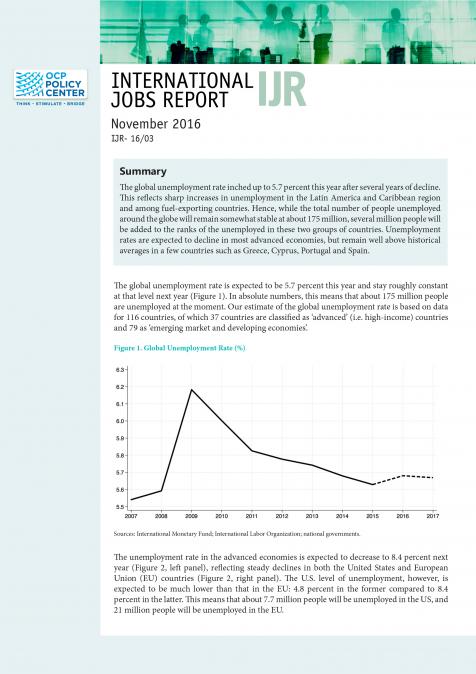
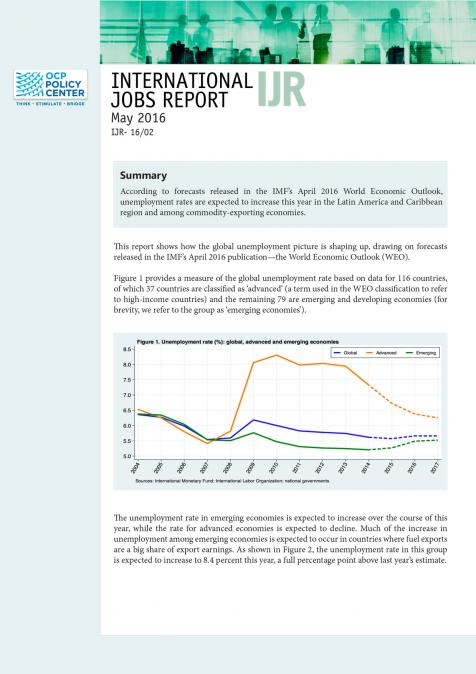
    The global unemployment rate inched up to 5.7 percent this year after several years of decline. This reflects sharp increases in unemployment in the Latin America and Caribbean region and among fuel-exporting countries. Hence, while the total number of people unemployed around the globe will remain somewhat stable at about 175 million, several million people will be added to the ranks of the unemployed in these two groups of countries. Unemployment rates are expected to decline in m ...
  • Authors
    July 21, 2016
    The pace of global growth has tapered off since the crisis and the ensuing rebound. The concept of ‘secular stagnation’ was first used in 1938 by Alvin Hanson in reference to the American economy during the Great Depression. It refers to a situation where growth is slow over a protracted period, underemployment prevails and inflation is low. In such situations, the propensity to save tends to increase as a result of uncertainty and pessimism, and liquidity – which depends on interba ...
  • Authors
    Russel Dinh
    January 27, 2016
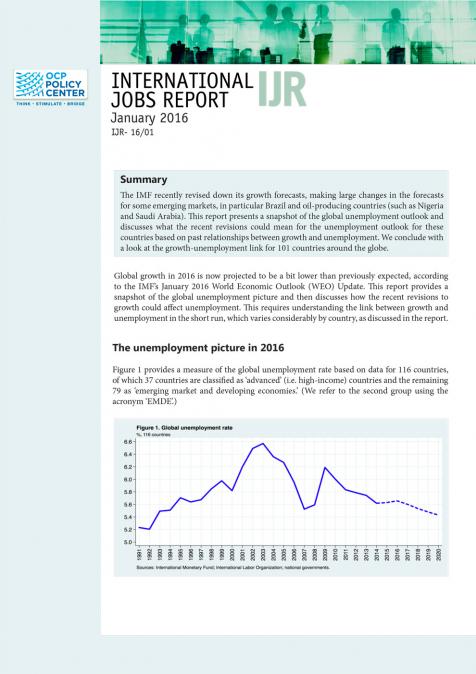
    The IMF recently revised down its growth forecasts, making large changes in the forecasts for some emerging markets, in particular Brazil and oil-producing countries (such as Nigeria and Saudi Arabia). This report presents a snapshot of the global unemployment outlook and discusses what the recent revisions could mean for the unemployment outlook for these countries based on past relationships between growth and unemployment. We conclude with a look at the growth-unemployment link f ...