Podcasts

Back

Presentation of the Research Paper: MOROCCO-BRAZIL ECONOMIC RELATIONS: Current situation and strategies for a deeper relationship

14
June 2017
Sandra Polónia Rios

This podcast, performed by Sandra Polónia Rios (Director, CINDES), presents the outputs of the recent Research Paper produced in the framework of the Policy Center for the New South partnership, on the current economic situation and strategies for a deeper relationship between Morocco and Brazil. The research paper aims to provide technical elements to support a revision of the current state of the art and to devise a strategy to improve and to deepen the bilateral economic relations. Departing from the current situation, this research paper presents a roadmap to improve and to deepen the bilateral economic relations, with a focus on the negotiations of trade and investment agreements.

RELATED CONTENT

  • Authors
    September 3, 2026
    “A band-aid on a bullet hole!” That’s how Charlie McElligott, a cross-asset strategist at Nomura, described the maneuver carried out by United States Treasury Secretary Scott Bessent on August 19. The U.S. Treasury Department announced that from September 9 to November 4, it would double the volume of long-term bond buybacks, going from $2 billion to at least $4 billion per operation, with a focus on maturities of between 10 and 30 years. ...
  • August 31, 2026
    Selon la dernière enquête nationale disponible, 57 % des femmes marocaines âgées de 15 à 74 ans, soit environ 7,6 millions de personnes, ont déclaré avoir subi au moins un acte de violence au cours des douze mois précédant l'enquête (HCP, 2019). Cette prévalence s'accompagne d'un coût économique direct et indirect estimé, pour la même période, à 2,85 milliards de dirhams (HCP, 2019). Ces deux ordres de grandeur — humain et économique — trouvent un écho dans les indicateurs du marché ...
  • August 25, 2026
    Predictions of American decline have become increasingly prevalent. The United States has run persistent trade deficits for decades, but its public debt now exceeds its annual economic output. Meanwhile, and new centers of industrial and technological power continue to emerge across Asia. Yet despite these developments, no country has so far replaced the United States as the main organizing power of the international economy. Conventional explanations explain this in terms of U.S. m ...
  • Authors
    August 5, 2026
    This paper addresses the persistent challenge of resource dependence in the world's poorest countries, focusing on the ten poorest African nations where natural- resource rents average 14% of income. It argues that four decades of conventional policy advice, which treated resource dependence primarily as a revenue management problem, have failed to help these countries. While stabilization funds and permanent-income frameworks aim to smooth consumption, they do not answer the fundam ...
  • August 3, 2026
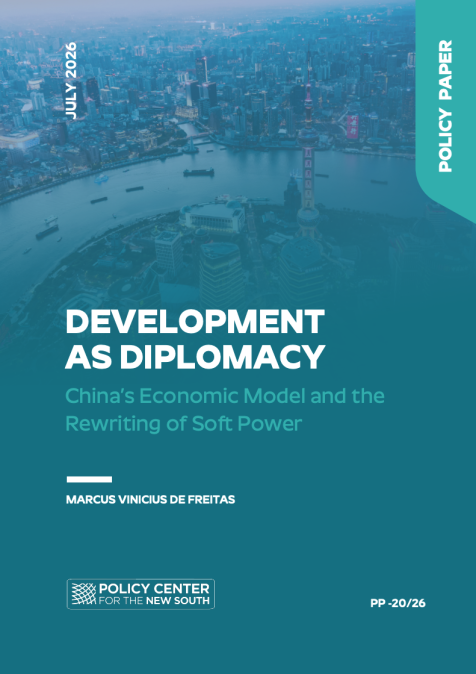
    This policy paper explores how China’s economic development model—rooted in pragmatism, long-term planning, and civilizational renewal—has become its most compelling soft power asset, particularly in the eyes of the Global South. While critically engaging with Joseph Nye’s original conception of soft power as a primarily cultural and normative force, the paper argues that China’s ability to transform itself from an impoverished postimperial state into the world’s largest trading nat ...
  • August 3, 2026
    This Opinion was originally published in Project Syndicate and republished by The Edge Malaysia, DT Next, and The Japan Times. Data from a period in which both China and India pursued deliberate industrial policies show that neither country's development route is accessible to other countries. At best, their experience can alert policymakers to structural limitations and coordination problems that will require their own homegrown solutions.RABAT—What is the most reliable develo ...
  • Authors
    July 31, 2026
    Ethiopia continues to struggle to lay the economic foundations of food security for all, more than 30 years after first adopting the East Asian Developmental State Model (EADS) under Zenawi (1911-2012), continued under Hailemariam Desalegn (2012-April 2018), and later shifting toward a neo-liberal, Washington consensus-oriented approach under Abiy Ahmed (2018-present). The achievements recorded under the EADS approach—particularly double-digit annual growth, substantial poverty ...
  • July 29, 2026
    En un siècle, le cours de l’once d’or est passé de 20 dollars à 5 300 dollars au premier trimestre 2026. Cette étude, consacrée à l’analyse de cette envolée, comporte deux parties.La première privilégie une approche historique. Elle retrace tout d’abord le changement de statut du précieux métal jaune, monétisable jusqu’en 1971 puis démonétisé par la suite. Elle rappelle ensuite que cette évolution, loin d’être linéaire, est ponctuée de phases de forte hausse, de stagnation et d ...
  • Authors
    July 28, 2026
    The term “K-shaped recovery” was introduced to describe the economic recovery from the recession triggered by the Covid-19 pandemic. It refers to the uneven and divergent growth pattern between leading industries or sectors (the upper arm of the letter K—mainly the high-technology sector) and laggards, or the rest of the economy (the lower arm—the traditional industries). Since then the term has become popular in portraying divergent growth patterns within and between countries, esp ...