Podcasts

Back

L'UE est-elle prêt pour les prochains défis migratoires ?

03
December 2019
Mathieu Tardis

Matthieu Tardis, chercheur au Centre migrations et citoyennetés de l’Ifri, discute les défis migratoires au sein de l’UE. Selon lui, l’Union européenne a certes répondu à l’arrivée massive de migrants en 2015, mais avec des mesures de court terme, et qui ont creusé les divisions entre pays membres. Elle reste aujourd’hui divisée sur l’analyse même du problème migratoire pour l’avenir, et n’a pas mis en place les dispositifs qui permettraient de répondre à de nouvelles crises. Ce sont les mécanismes de décision de l’Union, les principes mêmes de son action, ainsi que sa crédibilité internationale, qui sont ainsi mis en cause.


RELATED CONTENT

  • Authors
    April 17, 2026
    The International Court of Justice’s (ICJ) 2025 advisory opinion on climate change marks a significant expansion of international law into the governance of global public goods. By framing climate inaction as a potential violation of international law and human rights, the Court advances a progressive legal agenda that extends beyond existing political consensus and enforcement capacity. This article develops a realist critique of the ruling that avoids both legal romanticism and ni ...
  • March 27, 2026
    Human rights are central to the legitimacy of legal systems, not only through their recognition but also through the manner in which courts resolve conflicts between rights. Judicial decisions require well-founded reasoning, drawing on interrelated legal sources to ensure coherence, legitimacy, and predictability while minimizing non-legal influences. In EU law, the Court of Justice employs grammatical, contextual, comparative, and teleological methods of interpretation, alongside p ...
  • Authors
    February 13, 2026
    Le 27 janvier 2026, le gouvernement espagnol a adopté par décret royal une mesure de régularisation extraordinaire visant les personnes en situation administrative irrégulière ou engagées dans une procédure de protection internationale. Le choix du décret royal permet une mise en œuvre rapide de la mesure, sans passage par un débat parlementaire, dans un contexte politique fortement polarisé sur les questions migratoires.La régularisation concerne les personnes pouvant justifier d’u ...
  • Authors
    February 13, 2026
    On January 27, 2026, the Spanish government adopted a Royal Decree for the extraordinary regularization of persons in an irregular administrative situation or involved in an international protection procedure. The choice of a royal decree allows for the rapid implementation of the measure, without the need for parliamentary debate, in a political context that is highly polarized on migration issues.Regularization applies to people who can prove their presence on Spanish territory be ...
  • Authors
    Nizar Messari
    December 19, 2025
    The U.S. military buildup in the Caribbean—the most significant since the Cuban Missile Crisis—comes at a moment when a new world order is taking shape, its contours still unclear, and in which the U.S. seeks to be more assertive in the Western Hemisphere. This disposition toward South America and the Caribbean was underscored by the recent publication of the new U.S. National Security Strategy, in which the Monroe Doctrine is explicitly invoked. This Policy Brief situates the devel ...
  • Authors
    December 3, 2025
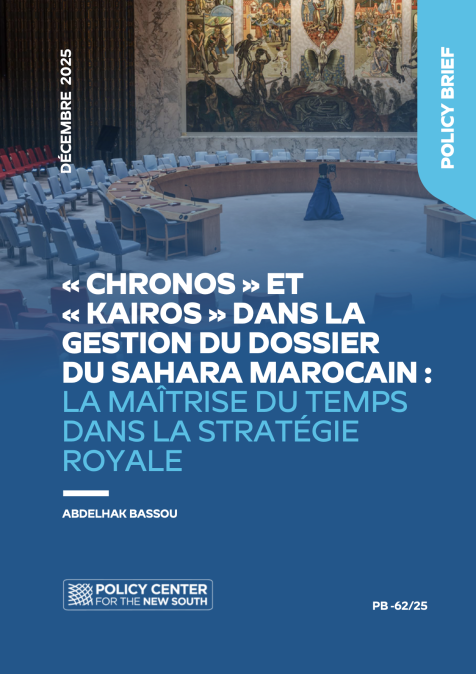
    La résolution 2797 du Conseil de sécurité des Nations Unies ne marque pas la fin d’un dossier, mais l’aboutissement d’une gestion magistrale du temps. Le Maroc n’a pas seulement gagné des appuis, il a gagné le tempo.
En combinant le Chronos de la constance et le Kairos de l’opportunité, il a démontré qu’une politique étrangère pouvait s’appuyer sur la philosophie du temps autant que sur la géopolitique.Cette diplomatie du temps maîtrisé peut aujourd’hui être considérée comme une doc ...
  • Authors
    December 3, 2025
    Resolution 2797 of the United Nations Security Council does not mark the end of an issue, but the culmination of masterful time management. Morocco has not only won support, it has won the tempo. By combining the Chronos of constancy and the Kairos of opportunity, it has demonstrated that a foreign policy can be based on the philosophy of time as much as on geopolitics.This diplomacy of controlled time can today be seen as an implicit doctrine of the Kingdom: a strategy in which pat ...
  • Authors
    November 28, 2025
    Le 17 novembre 2025, le Conseil de sécurité de l’Organisation des Nations Unies (ONU) a adopté la résolution 2803 par laquelle il fait sien le Plan d’ensemble du Président Donald Trump ayant pour objectif de mettre fin au conflit à Gaza. Contrairement à ce qu’on pourrait croire, l’initiative américaine ne date pas du 2ème mandat de l’Administration Trump. Elle a vu le jour durant son premier mandat.  Le Plan entériné par la résolution du Conseil de sécurité de l’ONU, surnommé ‘ ...
  • Authors
    November 28, 2025
    On November 17, 2025, the United Nations (UN) Security Council adopted Resolution 2803, endorsing President Donald Trump's Comprehensive Plan to end the conflict in Gaza. Contrary to popular belief, the American initiative does not date from the Trump Administration's 2nd term. It was born during his first term.The plan endorsed by the UN Security Council resolution, dubbed the ''Deal of the Century'', is in fact the heir to the initial plan, which bore the name ''Peace to Prosperit ...
  • November 4, 2025
    Cette tribune a été initialement publiée sur telos-eu.comSi un domaine est supposé devoir échapper à la « démocratie d’opinion », c’est bien la politique étrangère, surtout dans la France de la Ve République. Elle se doit d’être articulée autour d’intérêts à long terme et de calculs savants, sans reculer devant la raison d’Etat. L’opinion des Français à son propos est rarement scrutée.Elle se révèle plus construite qu’on ne croit. Telle est la leçon du sondage Toluna-Louis ...