The rise of populism in Spain with our columnist Helmut Sorge

November 22, 2019

Questions:

1/ The recent elections in Spain showed a successful right wing party “Vox’’. Is this a sign of more trouble for Europe?

2/ Do we have to fear a strong rise of populism?

3/ Is a more restrictive immigration policy a solution?

Speakers
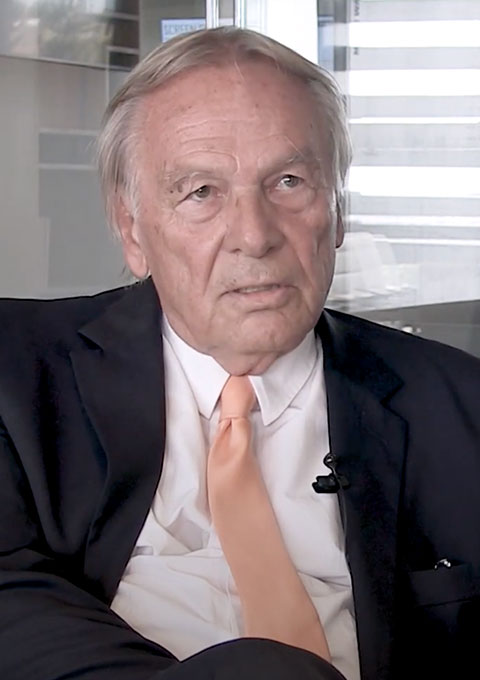
Helmut Sorge
Columnist
Helmut Sorge is a columnist at the Policy Center for the New South, where he publishes opinion pieces in the format of international press reviews of current events related to the Middle East and European affairs, and conducts interviews with high level policy makers and PCNS researchers. He is also a lecturer on journalism and the media. For over 40 years, Helmut Sorge served as a writer, former Foreign correspondent, Foreign editor, and Middle East expert for Germany's leading newsmagazine "Der Spiegel" to Washington, London, Paris and Los Angeles. He reported from Vietnam, the Middle East, wrote about safaris, nuclear accidents, visited prisoners on death row in the United States. The German weekly “Gala” summarized in 2011, when his latest book, a collection of biographies ...

  • January 6, 2026
    La création de l’Alliance des États du Sahel (AES) symbolise une rupture politique et géostratégique majeure, appuyée sur un discours souverainiste et anti-occidental. Deux ans après, Mali, Burkina Faso et Niger peinent à assurer leur intégrité territoriale, à stabiliser leur sécurité intérieure et à bâtir une gouvernance solide. L’intégrité territoriale est un problème commun aux trois États, car dans ces pays, la cohésion de l’État et le contrôle du territoire sont directement men ...
  • January 2, 2026
    Ce Policy Paper analyse les enjeux politiques, économiques et opérationnels du Fonds pour les pertes et dommages, créé pour répondre aux impacts climatiques irréversibles subis par les pays les plus vulnérables. Il clarifie d’abord la notion de pertes et dommages, qui mêle effets économiques et non économiques, et souligne les défis d’attribution liés à la superposition entre chocs climatiques et fragilités structurelles. L’analyse met ensuite en lumière les tensions d’économie poli ...
  • Authors
    Niccola Milnes
    December 30, 2025
    Fuel access has become a strategic pressure point across Mali and its neighbors. In 2025, Jama’t Nusrat al Islam wal- Muslimeen (JNIM) shifted from sporadic interdictions to a deliberate fuel-blockade strategy intended to pressure Bamako without holding territory. By selectively constraining movement along the Sikasso–Kayes–Bamako corridor, the group turned fuel scarcity into a tool of coercion, governance, and narrative control—shaping behavior in the capital while remaining largel ...
  • Authors
    December 29, 2025
    The candidate could not have been more controversial—or more celebrated. Born in Kampala, the capital of Uganda, once ruled by Idi Amin, who famously declared himself “Conqueror of the British Empire” and “King of Scotland,” Zohran Kwama Mamdani, 34, is of Indian descent. His father is an academic, a professor of anthropology at Columbia University, his mother, Mira Nair, is an influential filmmaker. Zohran arrived in the USA on a visa at age seven. No doubt the agents of the feared ...
  • Authors
    Nizar Messari
    December 19, 2025
    The U.S. military buildup in the Caribbean—the most significant since the Cuban Missile Crisis—comes at a moment when a new world order is taking shape, its contours still unclear, and in which the U.S. seeks to be more assertive in the Western Hemisphere. This disposition toward South America and the Caribbean was underscored by the recent publication of the new U.S. National Security Strategy, in which the Monroe Doctrine is explicitly invoked. This Policy Brief situates the devel ...
  • Authors
    December 18, 2025
    The return of President Donald Trump to the White House at the start of 2025 was expected to signal an American retreat from international engagement, especially in regions of traditional security interest, such as southern Europe, North Africa, and the Middle East. To the surprise of many observers around the Mediterranean, and perhaps to the dismay of some in the Trump administration’s ideological orbit, this has not happened. If anything, the second half of 2025 has seen a high d ...
  • Authors
    December 17, 2025
    I recently participated in a discussion between Israelis and Arabs, some living in the Middle East, some living abroad[1]. The discussion topic was ‘The Two State Solution’. This article presents my personal takeaways from the discussion. It does not try to describe the details, and other participants may have different takeaways.I joined the discussion thinking that the two-state solution was dead. Most of the other participants felt the same way—all very pessimistic. But I left fe ...
  • Authors
    Edited by
    Paolo Magri
    Samir Saran
    December 14, 2025
    In 2025, the global landscape became increasingly fragmented and uncertain. Great power competition intensified, regional conflicts became protracted and exacerbated, while economic nationalism reshaped the rules of trade and development. The mechanisms for conflict resolution and cooperation that have long provided a foundation for international cooperation are now under strain due to polarization and mistrust. Even longstanding alliances, bilateral and collective security architec ...