(FR) Port services in Morocco

June 15, 2026

Cette interview revient sur le rôle structurant des infrastructures portuaires dans l’industrialisation du Maroc, à travers l’exemple de Tanger Med. Elle souligne aussi l’importance de la digitalisation, de la formation et de la connexion des régions intérieures pour renforcer la compétitivité et diffuser les retombées économiques.

Speakers

Sabrine Emran
Senior Economist
Sabrine Emran is a Senior Economist at the Policy Center for the New South (PCNS).At the PCNS, Sabrine Emran conducts research on the Energy Transition, Climate Finance, and Critical Minerals, focusing on the energy priorities of developing countries in the context of sustainable development, just energy transition, and global climate commitments.Before joining the PCNS in 2022, Sabrine Emran worked as a Commodities Analyst and Risk Management Consultant, specializing in agricultural and energy commodities as well as foreign exchange risk. She also held a position at Lyxor Asset Management as Request for Proposal and Product Specialist, where she focused on alternative investment asset classes and collaborated closely with institutional investors.Sabrine Emran holds a master’s ...

Mahmoud Arbouch
Senior Economist
Mahmoud Arbouch is a Senior Economist at the Policy Center for the New South. His research focuses on macroeconomics of development, regional economics and territorial development, infrastructure and transportation economics, as well as industrial policy and international trade. Mahmoud’s work combines rigorous quantitative methods with field-based sectoral analysis and has been published in academic journals and policy platforms, including contributions to the Think20 engagement group of the G20.Mahmoud holds an engineering degree in Statistics and Applied Economics from the National Institute of Statistics and Applied Economics (INSEA, Rabat) and a PhD in Economics from the Faculty of Governance, Economics and Social Sciences at Mohammed VI Polytechnic University (FGSES-UM6P ...

RELATED CONTENT

  • June 17, 2021
    Africafé reviens ce jeudi 17 juin à 17h30 avec un nouvel épisode. Présenté par Youssef Tobi, spécialiste en relations internationales, Africafé décrypte l'actualité des organisations africaines et du continent avec des experts africains. Dans cet épisode, Youssef El Jai donne une vision...
  • May 20, 2021
    Le Policy Center lance une nouvelle émission. Africafé, le nouveau rendez-vous bimensuel présenté par Youssef Tobi, spécialiste en relations internationales, décryptera l'actualité des organisations africaines et du continent avec des experts africains. Pour ce deuxième épisode, Larabi ...
  • February 24, 2021
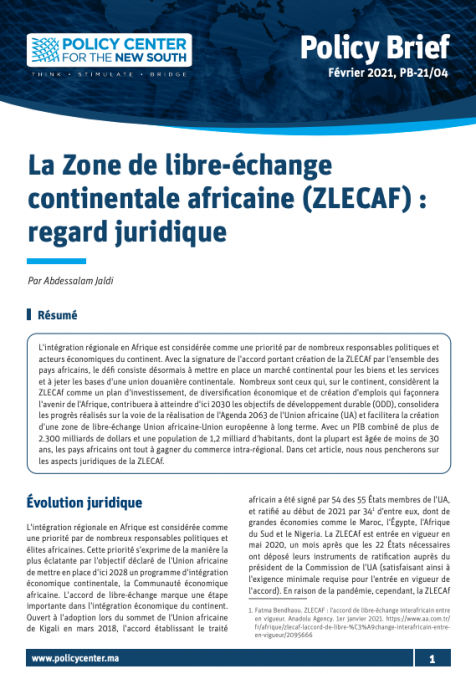
    L'intégration régionale en Afrique est considérée comme une priorité par de nombreux responsables politiques et acteurs économiques du continent. Avec la signature de l'accord portant création de la ZLECAf par l'ensemble des pays africains, le défi consiste désormais à mettre en place un marché continental pour les biens et les services et à jeter les bases d'une union douanière continentale. Nombreux sont ceux qui, sur le continent, considèrent la ZLECAf comme un plan d'investissem ...
  • Authors
    February 12, 2021
    This paper provides a preliminary assessment of COVID-19’s impact on Africa, focusing on the sub-Saharan Africa (SSA) countries, based on information available as of October 2020. We first identify the two key long-term issues of the SSA countries before the crisis: resource dependency and slow productivity growth. COVID-19 has hit SSA countries hard, causing human and economic destruction and wiping out economic progress from the last decade. Instead of growing at 2.9% in 2020, as ...
  • February 5, 2021
    Regional integration in Africa is seen as a priority by many of the continent’s policymakers and economic stakeholders. With all Africa now signed up to the African Continental Free Trade Agreement (AfCFTA), the challenge now is to implement a continental market for goods and services and establish the foundations of a continental customs union. Many on the continent see the AfCFTA as an investment, economic-diversification, and job-creation blueprint that will shape the future of A ...
  • Authors
    Sous la direction de
    December 29, 2020
    Dès les premiers cas du Coronavirus relevés en Afrique, les prédictions les plus sombres ont été faites sur la catastrophe sanitaire à venir sur le continent, en raison d’un certain nombre de caractéristiques supposées favoriser la propagation de l’épidémie. Ces prévisions ont été démenties par la rapidité des ripostes des Etats et par divers autres facteurs. La progression de la Covid-19 en Afrique n’est pas le fait d’une dynamique unique mais plutôt de multiples profils de risques ...
  • Authors
    Inácio F. Araújo
    December 18, 2020
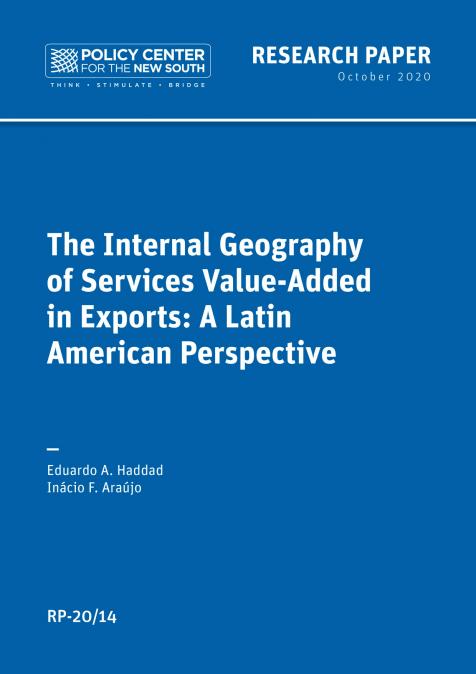
    We estimate the contents of services value-added incorporated in goods exports in different countries in Latin America, exploring the local dimension of the results. We use inter-regional input–output analysis to trace and map domestic value-added embedded in those countries' exports. We add to the discussion of global value chains the internal, within-country geography of trade in value-added, since the set of locational preferences that help understanding the spatial patterns of n ...
  • November 16, 2020
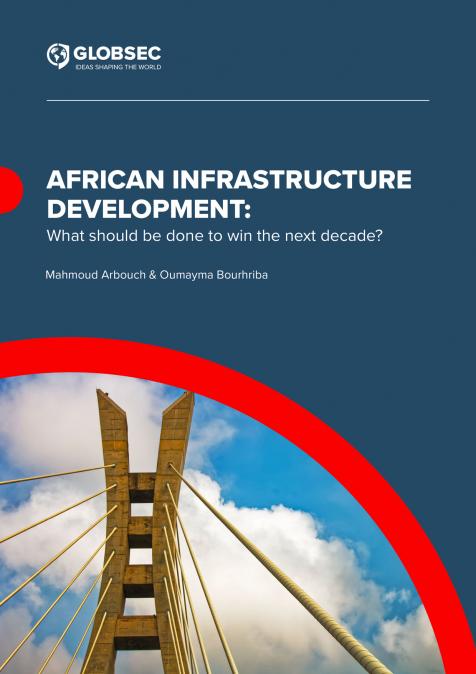
    Africa is experiencing economic growth deceleration that reached 2.9% on average between 2010 and 2018, against 5.4% between 2000 and 2010. The sectoral performance of African economies depends critically on the stock and quality of infrastructure, directly as an essential input (for example, energy and transport) and indirectly by increasing total factor productivity. African economic integration, and the hoped-for emergence, can never be fully achieved with poor infrastructure, bo ...
  • Authors
    Inácio F. Araújo
    October 27, 2020
    We estimate the contents of services value-added incorporated in goods exports in different countries in Latin America, exploring the local dimension of the results. We use inter-regional input-output analysis to trace and map domestic value-added embedded in those countries’ exports. We add to the discussion of global value chains the internal, withincountry geography of trade in value-added, since the set of locational preferences that help understanding the spatial patterns of na ...
  • Authors
    Youssef El Jai
    September 15, 2020
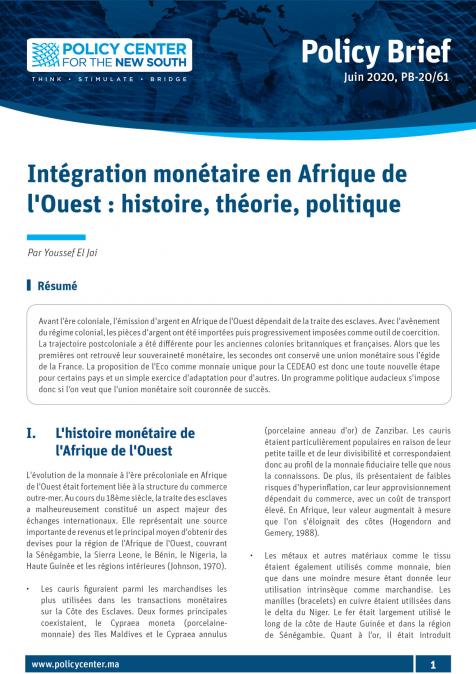
    Avant l'ère coloniale, l'émission d'argent en Afrique de l'Ouest dépendait de la traite des esclaves. Avec l'avènement du régime colonial, les pièces d'argent ont été importées puis progressivement imposées comme outil de coercition. La trajectoire postcoloniale a été différente pour les anciennes colonies britanniques et françaises. Alors que les premières ont retrouvé leur souveraineté monétaire, les secondes ont conservé une union monétaire sous l’égide de la France. La propositi ...