Publications /
Policy Brief

Back
Successful Agricultural Transformation: Selected Challenges in the Emerging Global Environment
Authors
June 8, 2020

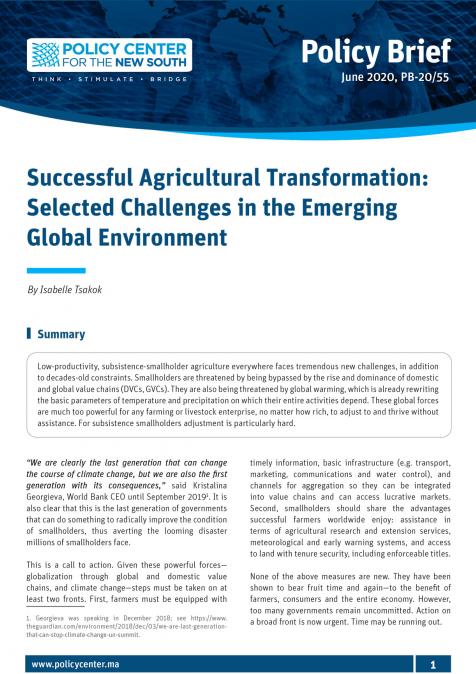
Low-productivity, subsistence-smallholder agriculture everywhere faces tremendous new challenges, in addition to decades-old constraints. Smallholders are threatened by being bypassed by the rise and dominance of domestic and global value chains (DVCs, GVCs). They are also being threatened by global warming, which is already rewriting the basic parameters of temperature and precipitation on which their entire activities depend. These global forces are much too powerful for any farming or livestock enterprise, no matter how rich, to adjust to and thrive without assistance. For subsistence smallholders adjustment is particularly hard.

RELATED CONTENT

  • Authors
    July 31, 2026
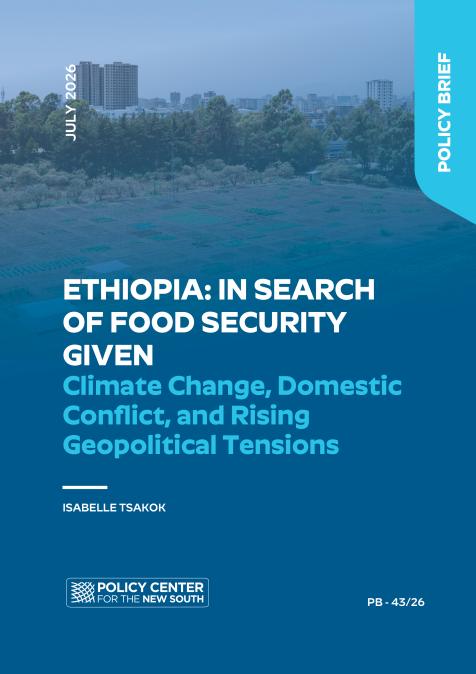
    Ethiopia continues to struggle to lay the economic foundations of food security for all, more than 30 years after first adopting the East Asian Developmental State Model (EADS) under Zenawi (1911-2012), continued under Hailemariam Desalegn (2012-April 2018), and later shifting toward a neo-liberal, Washington consensus-oriented approach under Abiy Ahmed (2018-present). The achievements recorded under the EADS approach—particularly double-digit annual growth, substantial poverty ...
  • Authors
    July 31, 2024
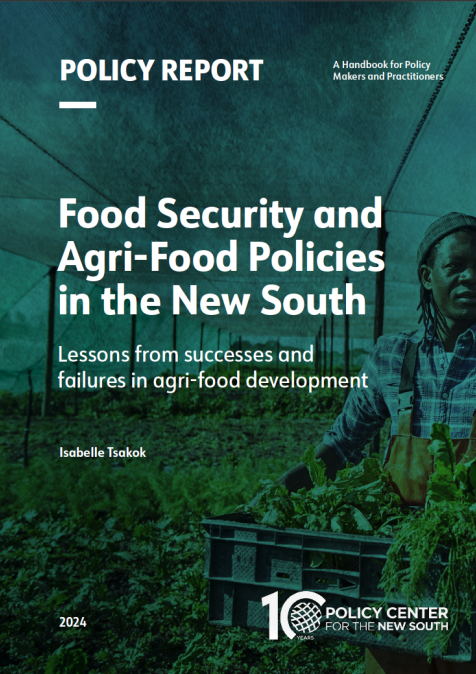
    Millions are severely malnourished in a world where there is enough for all. Hunger and malnutrition stalk more than 3.1 billion people. Yet, widespread hunger in all its forms is a problem which has been largely solved at the macro level in today’s high-income, industrialized countries. Their “escape from hunger and premature death” is a fairly recent phenomenon. It began around 300 years ago, continued for most of the 20th century and is still ongoing today. The problems faced by ...
  • August 19, 2022
    Despite some exceptions such as Rwanda, Morocco and Tunisia to some extent, about 80% of Africa still has not learnt that being dependant on others is putting your population at risk, acc ...
  • Authors
    August 24, 2021
    The transformative potential of regional market integration for a large trading bloc is well exemplified by the European Union which started integration on a modest scale. The Association of Southeast Asian Nations (ASEAN) also started on a modest scale and has delivered benefits in terms of promoting growth through greater regional market integration, both within ASEAN and in Asia more generally. ASEAN however runs on different principles to the EU (though there are some similariti ...
  • Authors
    June 8, 2020
    Low-productivity, subsistence-smallholder agriculture everywhere faces tremendous new challenges, in addition to decades-old constraints. Smallholders are threatened by being bypassed by the rise and dominance of domestic and global value chains (DVCs, GVCs). They are also being threatened by global warming, which is already rewriting the basic parameters of temperature and precipitation on which their entire activities depend. These global forces are much too powerful for any farmi ...
  • Authors
    Tharcisse Guedegbe
    September 27, 2019
    This paper is about the basic principles which should guide fertilizer policy for smallholder agriculture in sub-Saharan Africa It is not about detailed country-specific prescriptions on the “how” of policy. This important task should constitute the substance of detailed country studies. The overarching goal here is to use fertilizer to spearhead and sustain an African Green Revolution (GR). In this paper, fertilizer use is not considered as an end in itself, but as a necessary mean ...
  • Authors
    Under the direction of
    Philippe Chalmin
    April 9, 2019
    Commodity prices were once again marked by significant volatility in 2017 and 2018. While there are many economic factors to explain this, politics were also present—trade tensions between China and the United States and, more generally, a rise in uncertainties—weighing upon the global macroeconomic outlook and the ‘dynamism of the markets’. Africa, which has countries with strong growth rates, has, however, been able to show solid economic performance, and this trajectory is not li ...
  • Authors
    Hamza Rkha Chaham
    April 3, 2019
    The author is an alumnus of the 2018 Atlantic Dialogues Emerging Leaders program Arable land per capita availability has been steadily decreasing over the last decades, from 0.5 hectare per capita in 1945 to 0.2 hectares per capita in 2016. Worldwide farmers have been, more or less, addressing the intensification challenge by incorporating new technologies, products, and techniques into their farming systems. The intensification challenge also implied a consolidation ...
  • Authors
    Mouhamadou Moustapha Ly
    Tharcisse Guedegbe
    September 19, 2018
    La ville de Kigali, au Rwanda, a accueilli du 5 au 8 septembre 2018 le forum de l’AGRA, devenant ainsi la capitale de l’agriculture africaine pendant ces quatre journées. Délégations gouvernementales, partenaires techniques et financiers, chercheurs, universitaires, investisseurs, producteurs, club de réflexion, entre autres, étaient en conclave pour faire l’état des lieux du secteur et mesurer les progrès accomplis sur la route de la transformation de l’agriculture africaine.  ...
  • Authors
    Under the Supervision of
    Philippe Chalmin
    July 4, 2016
    Guinea’s bauxite, Moroccan phosphates, Nigerian Bonny Light, Zambian copper, Côte d'Ivoire’s cocoa, Ethiopian coffee or Madagascar’s vanilla: all are examples demonstrating that raw materials have a dimension that is as global as it is local. Global by the markets on which they are traded, local by their quality, a key element of their price, and their macroeconomic impact, particularly for Africa. In line with the 2016 CyclOpe report, which celebrates three decades of existence thi ...