Publications /
Paper in Academic Journals
Back
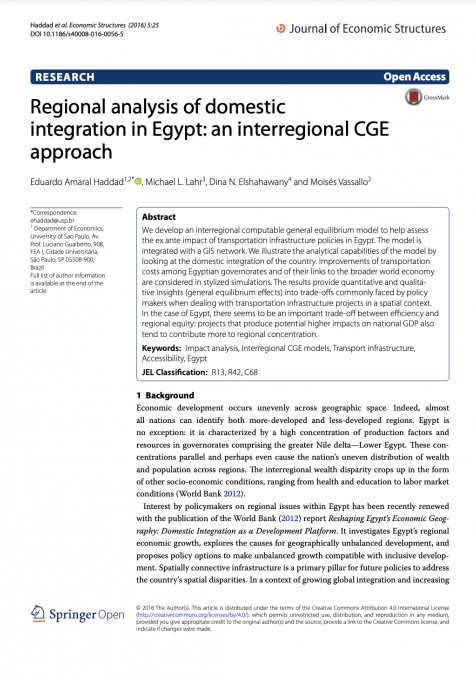
Regional analysis of domestic integration in Egypt: an interregional CGE approach
Authors
Michael L. Lahr
Dina N. Elshahawany
Moisés Vassallo
October 13, 2016

We develop an interregional computable general equilibrium model to help assess the ex ante impact of transportation infrastructure policies in Egypt. The model is integrated with a GIS network. We illustrate the analytical capabilities of the model by looking at the domestic integration of the country. Improvements of transportation costs among Egyptian governorates and of their links to the broader world economy are considered in stylized simulations. The results provide quantitative and qualitative insights (general equilibrium effects) into trade-offs commonly faced by policy makers when dealing with transportation infrastructure projects in a spatial context. In the case of Egypt, there seems to be an important trade-off between efficiency and regional equity: projects that produce potential higher impacts on national GDP also tend to contribute more to regional concentration.
RELATED CONTENT

  • March 31, 2026
    تتناول هذه الحلقة كيفية إعادة صياغة السياسة الصناعية في المغرب في ظل التحولات العالمية وإعادة تشكيل سلاسل القيمة، مع التركيز على الانتقال من موقع إنتاجي إلى فاعل صناعي استراتيجي. كما تسلط الضوء على دور قطاعات السيارات والطاقات المتجددة والصناعات التكنولوجية في تعزيز تموقع المغرب دولياً....
  • Authors
    March 12, 2026
    Historically, manufacturing has served as the primary pathway to economic development, offering strong scale economies, learning-by-doing effects, and the capacity to generate the foreign exchange necessary to import capital goods and technology. However, advances in robotization and artificial intelligence (AI) are fundamentally undermining manufacturing’s traditional role, making it increasingly skill- and capital-intensive while limiting its ability to absorb labor. Thi ...
  • Authors
    February 24, 2026
    This Paper was originally published on sciencedirect.com This paper assesses the national and regional impacts of the Marrakech–Fès highway project in Morocco using a Spatial Computable General Equilibrium (SCGE) model combined with GIS-based road network data. The analysis captures how improved connectivity alters economic performance and emissions patterns across space and time. Results show that while overall economic gains are modest, the benefits are unevenly distributed—f ...
  • January 29, 2026
    Le Mali, le Burkina Faso et le Niger, réunis au sein de l’Alliance des États du Sahel (AES), affirment l’ambition de bâtir une souveraineté nationale qui leur permettrait de s’émanciper de la domination et des influences extérieures et de se doter d’une liberté d’action dans les choix de développement politique et économique. Cependant, cette ambition se heurte à de nombreuses contraintes économiques et sécuritaires.La souveraineté ne peut se construire sans une base économique soli ...
  • Authors
    January 27, 2026
    This paper revisits Big Push industrialization theory in the context of open economies deeply integrated into global value chains (GVCs). While classical Big Push models emphasize demand complementarities and coordination failures in largely closed economies, many middle-income countries now industrialize through foreign-owned, import-intensive production networks. We develop an extended Big Push framework that incorporates GVC integration and import leakage, and show how these feat ...
  • Authors
    Ahmed Ouhnini
    December 5, 2025
    “Uberization,” a term derived from the American company Uber in the early 2010s, initially refers to an economic model based on directly matching supply and demand through digital platforms. Rapidly popularized, the concept has expanded with Airbnb in accommodation, and then to a wide range of other sectors: food delivery, home services, e-commerce, and even traditionally regulated or corporatist professions. This neologism thus reflects a transformation of economic and social relat ...
  • Authors
    Ahmed Ouhnini
    December 5, 2025
    L’« uberisation », terme né du nom de l’entreprise américaine Uber au début des années 2010, désigne initialement un modèle économique fondé sur la mise en relation directe entre offre et demande via des plateformes numériques. Rapidement popularisé, le concept s’est élargi, avec Airbnb dans l’hébergement, puis à une multitude d’autres secteurs : livraison de repas, services à domicile, commerce en ligne, voire des métiers traditionnellement régulés ou corporatistes. Ce néologisme t ...
  • December 2, 2025
    في هذه الحلقة، نحاول اكتشاف ما الذي يجعل المغرب يعيش اليوم تحولاً لافتاً في عالم المدفوعات الرقمية. كيف أصبحت التكنولوجيا المالية أحد مفاتيح الشمول المالي ومحركاً لنمو جديد؟ وكيف يغيّر الاعتماد المتزايد لوسائل الدفع الحديثة حياة التجار الصغار والمقاولات الصغيرة والمتوسطة ويخلق لهم فرصاً...