Publications /
Policy Brief

Back
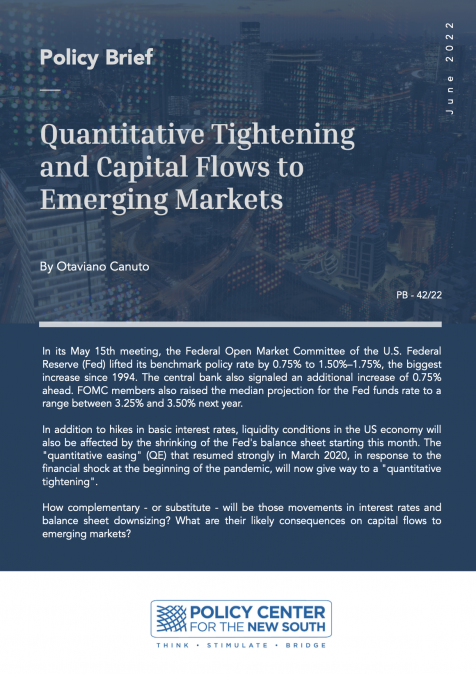
Quantitative Tightening and Capital Flows to Emerging Markets
Authors
June 24, 2022

In its May 15th meeting, the Federal Open Market Committee of the U.S. Federal Reserve (Fed) lifted its benchmark policy rate by 0.75% to 1.50%–1.75%, the biggest increase since 1994. The central bank also signaled an additional increase of 0.75% ahead. FOMC members also raised the median projection for the Fed funds rate to a range between 3.25% and 3.50% next year.

In addition to hikes in basic interest rates, liquidity conditions in the US economy will also be affected by the shrinking of the Fed's balance sheet starting this month. The "quantitative easing" (QE) that resumed strongly in March 2020, in response to the financial shock at the beginning of the pandemic, will now give way to a "quantitative tightening".

How complementary - or substitute - will be those movements in interest rates and balance sheet downsizing? What are their likely consequences on capital flows to emerging markets?
RELATED CONTENT

  • January 6, 2026
    La création de l’Alliance des États du Sahel (AES) symbolise une rupture politique et géostratégique majeure, appuyée sur un discours souverainiste et anti-occidental. Deux ans après, Mali, Burkina Faso et Niger peinent à assurer leur intégrité territoriale, à stabiliser leur sécurité intérieure et à bâtir une gouvernance solide. L’intégrité territoriale est un problème commun aux trois États, car dans ces pays, la cohésion de l’État et le contrôle du territoire sont directement men ...
  • December 22, 2025
    This paper presents the theoretical specification and current developments of a Spatial (Interprovincial) Computable General Equilibrium (SCGE) model for Morocco. The model is formulated as a Johansen-type CGE system, solved in linearized form, and is designed to analyze the regional and national impacts of policy shocks within an integrated interregional economic framework. The Moroccan economy is disaggregated into 72 provinces, 20 production sectors, multiple institutional agents ...
  • Authors
    Ahmed Ouhnini
    December 5, 2025
    “Uberization,” a term derived from the American company Uber in the early 2010s, initially refers to an economic model based on directly matching supply and demand through digital platforms. Rapidly popularized, the concept has expanded with Airbnb in accommodation, and then to a wide range of other sectors: food delivery, home services, e-commerce, and even traditionally regulated or corporatist professions. This neologism thus reflects a transformation of economic and social relat ...
  • Authors
    Ahmed Ouhnini
    December 5, 2025
    L’« uberisation », terme né du nom de l’entreprise américaine Uber au début des années 2010, désigne initialement un modèle économique fondé sur la mise en relation directe entre offre et demande via des plateformes numériques. Rapidement popularisé, le concept s’est élargi, avec Airbnb dans l’hébergement, puis à une multitude d’autres secteurs : livraison de repas, services à domicile, commerce en ligne, voire des métiers traditionnellement régulés ou corporatistes. Ce néologisme t ...
  • Authors
    December 3, 2025
     Global GDP growth has proven resilient in 2025, despite the shocks caused by the trade policies implemented by United States President Donald Trump in the first year after his return to office. The gloomy projections offered by multilateral and private institutions in the first quarter of 2025 have given way to revised levels mostly in the 2.5% to 3% range for the year. ...
  • Authors
    November 28, 2025
    The adoption of United Nations Security Council Resolution 2803 on November 17, 2025, endorsing the “Comprehensive Plan to End the Gaza Conflict,” is a step in the right direction, but it must be accompanied by the implementation of a Gaza development and post-conflict reconstruction program. Paragraph 6 of Resolution 2803 “calls upon the World Bank and other financial institutions to facilitate and provide financial resources to support the reconstruction and development of Ga ...
  • November 25, 2025
    This Policy Paper analyses the Fourth Industrial Revolution (4IR) through the critical lens of technological colonialism. It argues that the fusion of physical, digital, and biological technologies is not merely a technical phenomenon but a civilizational shift reshaping the foundations of global power. The article traces a historical continuum from previous industrial revolutions, demonstrating how patterns of inequality and extraction persist, now transposed into the digital realm ...
  • Authors
    November 21, 2025
    This report addresses the business environment in Brazil as one of the determinants responsible for the weak evolution of productivity in recent decades. After addressing this productivity performance, we define what constitutes the business environment, using as a reference the three ways in which the World Bank has been addressing the subject.Next, we highlight how the business environment affects productivity in a country. Finally, we review some recent reforms in the country's b ...