Publications /
Book / Report
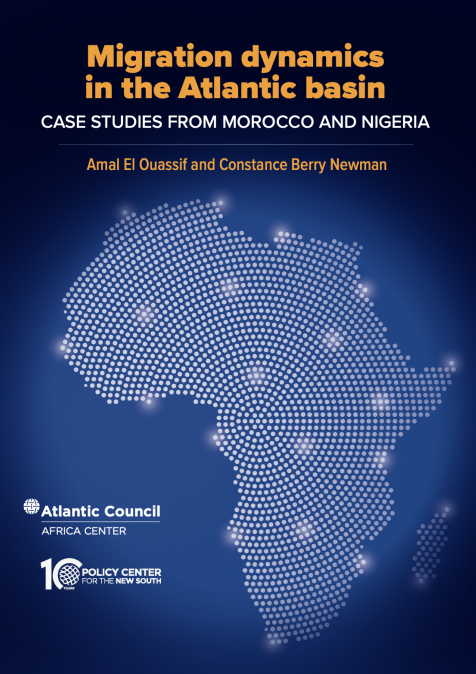
Immigration has never been without tensions. In the United States, immigration remains a contentious issue that now, more than ever, dominates election campaigns. A 727-kilometer wall has been constructed on the US-Mexico border to halt the influx of migrants from the south. In Europe, the rise of far-right parties over the past twenty years has culminated in them becoming a major political force in the European Parliament ahead of the June 2024 elections.
The tension around immigration has grown in light of the projected doubling of Africa’s population by 2050 and the prediction that African youth will make up 42 percent of the global youth population by 2030. This demographic trend is raising fears in a part of Europe that is already dealing with the tragedies of African migration in the Mediterranean. In the United States, the decline in the population identifying as white from a level of 80 percent forty years ago to 57.8 percent of the overall population, according to the 2020 census, is also the subject of heated political debate. Although the sub-Saharan African population represents only 5 percent of immigrants in the United States, it is the fastest growing segment and that is especially true of Nigerians, who stand out for their economic and political successes. Countless people of Nigerian origin play roles in the US administration, business world, and Hollywood. This is the starting point of Constance Berry Newman’s singular case study, which highlights the diversity of experiences more or less successful of Nigerian immigrants from Chicago to Johannesburg to London.
However, the attractiveness of the United States for Africans has not reduced departures to Europe because of its geographical proximity. Thus, if less than 10 percent of Moroccan immigrants go to the United States despite long-standing and dynamic relations between the United States and Morocco, it is because they prioritize Europe, especially France, as explained in the case study presented by Amal El Ouassif, who notes the differences between the “American dream” and the “French dream,” an expression that is rarely used in favor of the “republican integration model.” Even if some young Moroccans, like Nigerians in the United States or the United Kingdom, bring with them a share of African excellence to France, as evidenced by the levels of access to École Polytechnique, one of the top French universities, the report notes the long-standing and persistent difficulties of Moroccan immigrants in France.
What does African migration mean today? How has it evolved in terms of flows, nature, origins, and destinations? How are African immigrants perceived in the host countries? This report analyzes the complexity of African migration in the Atlantic basin at a time when diplomatic initiatives are multiplying around this strategic area. This analysis is all the more interesting because the two countries studied, Nigeria and Morocco, are among the most dynamic economies and the most stable countries in Africa. It also reveals that countries of origin and destination have not yet been able to fully exploit the strategic potential of these diasporas in globalization, even though remittances from immigrants have reached a higher level than official development assistance and are increasingly motivated by a desire to invest in African economies that are among the most dynamic in the world.
The report’s focus on African migration to the north should not create a false perception of these migrations as a whole. Far from prejudices about a migratory flood of Africans, Africa remains an underpopulated land compared to Europe, which has a much higher population density. Moreover, Western countries are not always the first destination for African immigrants: when they migrate, many prioritize a neighboring African country. The immigration of Africans is, first and foremost, intra-African. The African Continental Free Trade Area and domestic visa-easing policies will likely accelerate this trend. Finally, Africa is not only a continent that people leave; it is where they arrive, such as the Chinese workers who accompany China’s investment strategy in Nigeria, Zambia, or Kenya, or the Portuguese living in Angola who are much more numerous than the Angolans living in Portugal attracted by close diplomatic relations, a common language, and economic opportunities.
Karim El Aynaoui,
Executive President,
Policy Center for the New South
Rama Yade,
Senior Director,
Africa Center, Atlantic Council