Publications /
Policy Brief
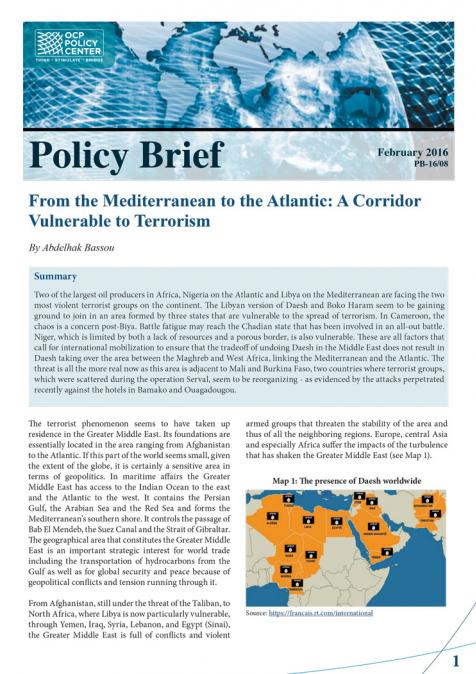
Two of the largest oil producers in Africa, Nigeria on the Atlantic and Libya on the Mediterranean are facing the two most violent terrorist groups on the continent. The Libyan version of Daesh and Boko Haram seem to be gaining ground to join in an area formed by three states that are vulnerable to the spread of terrorism. In Cameroon, the chaos is a concern post-Biya. Battle fatigue may reach the Chadian state that has been involved in an all-out battle. Niger, which is limited by both a lack of resources and a porous border, is also vulnerable. These are all factors that call for international mobilization to ensure that the tradeoff of undoing Daesh in the Middle East does not result in Daesh taking over the area between the Maghreb and West Africa, linking the Mediterranean and the Atlantic. The threat is all the more real now as this area is adjacent to Mali and Burkina Faso, two countries where terrorist groups, which were scattered during the operation Serval, seem to be reorganizing - as evidenced by the attacks perpetrated recently against the hotels in Bamako and Ouagadougou.