Publications /
Policy Brief

Back
Matchmaking Finance and Infrastructure
Authors
Aleksandra Liaplina
June 29, 2017

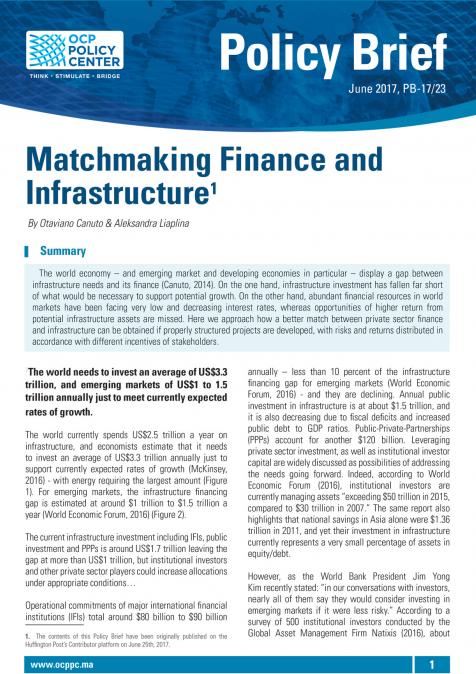
The world economy – and emerging market and developing economies in particular – display a gap between infrastructure needs and its finance (Canuto, 2014). On the one hand, infrastructure investment has fallen far short of what would be necessary to support potential growth. On the other hand, abundant financial resources in world markets have been facing very low and decreasing interest rates, whereas opportunities of higher return from potential infrastructure assets are missed. Here we approach how a better match between private sector finance and infrastructure can be obtained if properly structured projects are developed, with risks and returns distributed in accordance with different incentives of stakeholders.
RELATED CONTENT

  • Authors
    Prakash Loungani
    November 9, 2016
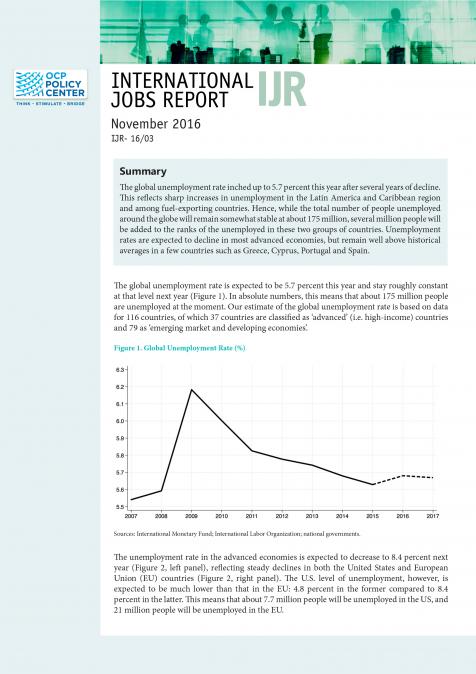
    The global unemployment rate inched up to 5.7 percent this year after several years of decline. This reflects sharp increases in unemployment in the Latin America and Caribbean region and among fuel-exporting countries. Hence, while the total number of people unemployed around the globe will remain somewhat stable at about 175 million, several million people will be added to the ranks of the unemployed in these two groups of countries. Unemployment rates are expected to decline in m ...
  • Authors
    November 7, 2016
    Despite the gloomy tone of much discussion at the just-concluded IMF and World Bank annual meetings, the global economy is not in as bad shape as many think. The concerns about “secular stagnation” in advanced countries are also overplayed, and nor are developing countries directly exposed to such risks. By contrast, the pessimism about the prospects for MENA are unfortunately largely justified. Most importantly, at the global and at the MENA level the biggest concerns are not econo ...
  • Authors
    November 4, 2016
    Discussions around large current account imbalances among systemically relevant economies as a threat to the stability of the global economy faded out in the aftermath of the global financial crisis. More recently, some signs of a possible resurgence of rising imbalances have brought back attention to the issue. We argue here that, while not a threat to global financial stability, the resurgence of these imbalances reveals a sub-par performance of the global economy in terms of fore ...
  • Authors
    October 14, 2016
    Brazil’s GDP contraction since mid-2014 has multiple non-fiscal roots - Canuto (2016a; 2014) – but it has morphed into an unsustainable fiscal trajectory (Canuto, 2016b). Dealing with the latter has become a precondition for full economic recovery and the Brazilian government has submitted to Congress a constitutional amendment bill mandating a public spending cap for the next 20 years. This piece considers how the Brazilian landscape evolved toward such a precipice and wh ...
  • Authors
    October 4, 2016
    Brazil has been suffering from anemic productivity growth. This is a major challenge because in the long run, sustained productivity increases are necessary to underpin inclusive economic growth. Without them, increases in real labor earnings tend to conflict with global competitiveness; collecting taxes in order to fund government expenditures on infrastructure and social policies becomes a heavy burden; returns to private investment becomes harder to achieve; and ultimately c ...
  • Authors
    Samuel George
    September 27, 2016
    On July 15, Turkey’s tumultuous 2016 took a shocking twist as elements within the country’s military attempted a coup against the government of President Recep Tayyip Erdogan. The putsch rapidly snapped at the seams, and a night that began with soldiers blocking bridges yielded a morning with those same soldiers flogged by civilians in the street. In the days following the attempt, Erdogan declared a three-month state of emergency and began purges of depth and breadth that extended ...
  • September 07, 2016
    Ce podcast est délivré par Moubarack Lo. Cette présentation a pour objet de définir une théorie de l’émergence économique, qui constitue une étape vers la convergence avec les pays dévelo ...
  • Authors
    Aleksandr V. Gevorkyan
    August 15, 2016
    Emerging market economies (EM) as a special class of financial assets have recently been subject to two competing tales. On the one hand, there is evidence of continued financial deepening and further integration within the global financial system, while the offer of higher yields remains hard to find elsewhere. On the other hand, there are frequent bouts of fear of systemic unwinding of positions triggered by investors “exiting” EM that exhibit signs of weak or unclear macroeconomi ...
  • Authors
    July 21, 2016
    The pace of global growth has tapered off since the crisis and the ensuing rebound. The concept of ‘secular stagnation’ was first used in 1938 by Alvin Hanson in reference to the American economy during the Great Depression. It refers to a situation where growth is slow over a protracted period, underemployment prevails and inflation is low. In such situations, the propensity to save tends to increase as a result of uncertainty and pessimism, and liquidity – which depends on interba ...