Publications /
Policy Paper

Back
Law as Provocation: the ICJ’s 2025 Advisory Opinion on the Obligations of States in Respect of Climate Change
Authors
April 17, 2026

The International Court of Justice’s (ICJ) 2025 advisory opinion on climate change marks a significant expansion of international law into the governance of global public goods. By framing climate inaction as a potential violation of international law and human rights, the Court advances a progressive legal agenda that extends beyond existing political consensus and enforcement capacity. This article develops a realist critique of the ruling that avoids both legal romanticism and nihilism. It argues that the opinion cannot compel state compliance in an anarchic system characterized by sovereignty, power asymmetries, and strategic interests, and that excessive judicial ambition may risk undermining institutional credibility. 

At the same time, the article contends that, in the context of climate change as an existential risk, normative ambition by international courts can be strategically consequential. The ICJ’s climate opinion functions less as enforceable law than as a mechanism for reshaping legitimacy, empowering litigation and civil society, and increasing the political costs of inaction. The ruling thus reveals a central paradox of international law under realism: law cannot govern without power, yet it can still influence power by redefining the terms of political contestation.

RELATED CONTENT

  • September 13, 2019
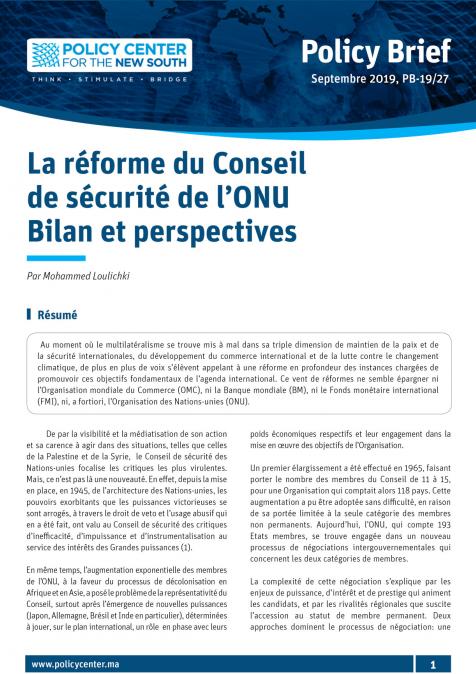
    Au moment où le multilatéralisme se trouve mis à mal dans sa triple dimension de maintien de la paix et de la sécurité internationales, du développement du commerce international et de la lutte contre le changement climatique, de plus en plus de voix s’élèvent appelant à une réforme en profondeur des instances chargées de promouvoir ces objectifs fondamentaux de l’agenda international. Ce vent de réformes ne semble épargner ni l’Organisation mondiale du Commerce (OMC), ni la Banque ...
  • Authors
    July 2, 2019
    Quelle place l’Afrique occupe-t-elle dans le système de règlement des différends de l’Organisation Mondiale du Commerce ? Les règles et procédures régulant ce système profitent-elles aussi bien aux pays en développement qu’aux pays développés, ou restent-elles l’apanage de ces derniers ? Le continent africain a-t-il les moyens de faire fonctionner un tel système ? La place marginale qu’occupe l’Afrique dans le système est-elle due à des facteurs endogènes ou à des fac ...
  • Authors
    February 27, 2019
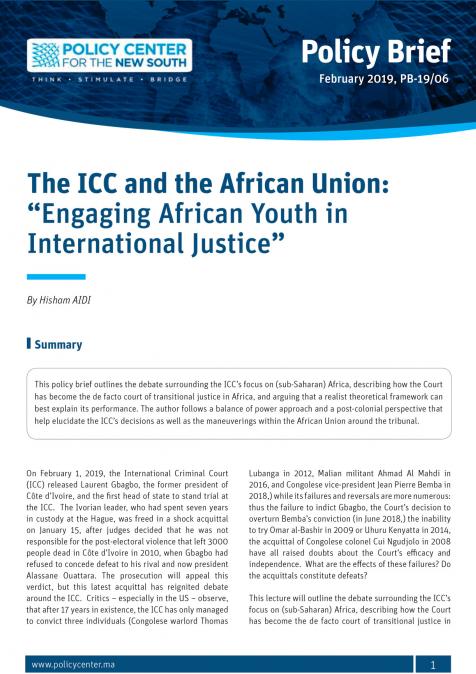
    This policy brief outlines the debate surrounding the ICC’s focus on (sub-Saharan) Africa, describing how the Court has become the de facto court of transitional justice in Africa, and arguing that a realist theoretical framework can best explain its performance. The author follows a balance of power approach and a post-colonial perspective that help elucidate the ICC’s decisions as well as the maneuverings within the African Union around the tribunal. ...
  • Authors
    March 15, 2018
    « Revise, Reboot, Rebuild : Strategies for a time of Distrust »: that was this year’s theme for the Brussels Forum, a yearly high-level conference held from March 8th to 10th by the US think tank German Marshall Fund (GMF), partner of the OCP Policy Center who attended the event through its delegation. This meeting of some 400 policymakers, academics and private sector operators is reviewing the relationship between Europe and the United States. Brexit, the Trump administration ...