Publications /
Policy Paper

Back
L’Afrique face aux defis proteiformes du cyberespace
Authors
Mourad El Manir
December 3, 2019

Le prix du meilleur roman africain de science-fiction au titre de l’année 2017 avait été remporté par Tade Thompson pour son livre intitulé «Rosewater» qui aborde l’histoire d’un agent des services de sécurité luttant contre les cyber-fraudes au Nigéria en 2066. Cette référence à un roman de science-fiction pour introduire les enjeux cybernétiques en Afrique n’est pas fortuite dans la mesure où le mot «cyberespace», inspiré du mot «cybernétique», fut utilisé, pour la première fois, en 1984, par l’auteur de romans de science-fiction William Gibson, pour désigner «Une hallucination consensuelle vécue quotidiennement, dans tous les pays, par des gosses auxquels on enseigne les concepts mathématiques.»

RELATED CONTENT

  • November 12, 2026
    The U.S. midterm elections raise questions about the future direction of American foreign policy and its implications for Africa. This discussion examines how shifting political dynamics in Washington could shape the Trump administration’s foreign policy priorities and engagement with t...
  • Authors
    Policy Center for the New South
    October 30, 2026
    The tenth edition of the African Peace and Security Annual Conference (APSACO) reflected a decade-long commitment to advancing dialogue on Africa’s evolving peace and security landscape. Bringing together senior policymakers, military officials, diplomats, scholars and practitioners, the conference provided an opportunity not only to assess the continent’s current security environment but also to reflect on the profound transformations that have reshaped Africa over the past ten yea ...
  • Authors
    Edited by Abdelhak Bassou
    October 30, 2026
    This year marks the tenth edition of the annual report on African geopolitics; for ten years now, the Policy Center for the New South has been providing a platform for Africans to reclaim the narrative about their continent. The number 10 is significant: it marks the maturity of an editorial project founded on a simple yet demanding conviction - that Africa must define itself, from within, using the analytical tools that its own people forge through engagement with reality.&nbs ...
  • October 23, 2026
    In this episode, Mehran Haghirian explores the global economic consequences of disruptions in the Strait of Hormuz, beyond oil and gas. He examines their impact on trade, fertilizer suppl ...
  • Authors
    Paul Isbell
    October 9, 2026
    In the first seven Policy Briefs of this ongoing series of analysis on Pan-Atlanticism: The Atlantic Basin in a Multipolar-Transnational World, we developed the argument that the strategic significance of the Atlantic Basin is on the rise for a range of international actors (states, regions and non-state agents) and from distinct political or ideological perspectives. In addition, in the most recently published Policy Brief -- “The U.S. and the Current International Reconfiguration: ...
  • Authors
    Lina Jaoid
    October 8, 2026
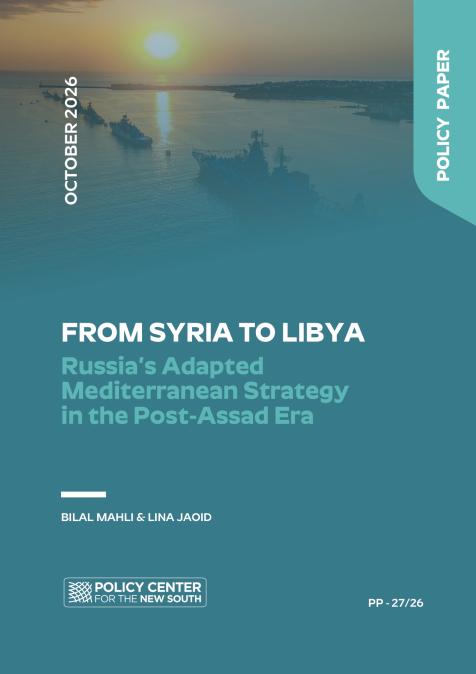
    In the two years since the fall of Bashar al-Assad in Syria, Russia has restructured its Mediterranean presence. Although Russia’s limited and increasingly conditional access to the Khmeimim and Tartus facilities in Syria has been preserved, its presence in the country has morphed from Assad’s ‘patron-client’ configuration to a more negotiated engagement. Simultaneously, Russia has upgraded its force-projection and logistical infrastructure in eastern Libya, giving it an access path ...
  • September 25, 2026
    Dans cet épisode d’Africafé, Amadou Diop analyse les défis de sécurité maritime auxquels font face les pays de l’Afrique atlantique, de la piraterie aux trafics transfrontaliers. Il souligne la nécessité de mutualiser les moyens et de partager l’information entre États. L’échange aborde...