Publications /
Policy Brief

Back
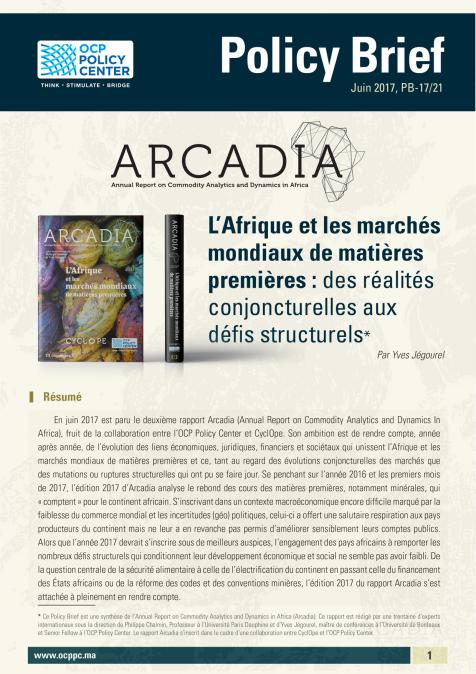
L’Afrique et les marchés mondiaux de matières premières : des réalités conjoncturelles aux défis structurels
Authors
June 9, 2017

En juin 2017 est paru le deuxième rapport Arcadia (Annual Report on Commodity Analytics and Dynamics In Africa), fruit de la collaboration entre l’OCP Policy Center et CyclOpe. Son ambition est de rendre compte, année après année, de l’évolution des liens économiques, juridiques, financiers et sociétaux qui unissent l’Afrique et les marchés mondiaux de matières premières et ce, tant au regard des évolutions conjoncturelles des marchés que des mutations ou ruptures structurelles qui ont pu se faire jour. Se penchant sur l’année 2016 et les premiers mois de 2017, l’édition 2017 d’Arcadia analyse le rebond des cours des matières premières, notamment minérales, qui « comptent » pour le continent africain. S’inscrivant dans un contexte macroéconomique encore difficile marqué par la faiblesse du commerce mondial et les incertitudes (géo) politiques, celui-ci a offert une salutaire respiration aux pays producteurs du continent mais ne leur a en revanche pas permis d’améliorer sensiblement leurs comptes publics. Alors que l’année 2017 devrait s’inscrire sous de meilleurs auspices, l’engagement des pays africains à remporter les nombreux défis structurels qui conditionnent leur développement économique et social ne semble pas avoir faibli. De la question centrale de la sécurité alimentaire à celle de l’électrification du continent en passant celle du financement des États africains ou de la réforme des codes et des conventions minières, l’édition 2017 du rapport Arcadia s’est attachée à pleinement en rendre compte.


RELATED CONTENT

  • July 3, 2026
    Morocco offers a compelling example of how a middle-income economy can navigate a more fragmented global environment, characterized by weak growth and slower convergence. Since 2022, economic activity has remained relatively strong, with growth exceeding that of many comparable economies. Non-agricultural growth has averaged 4.4% since 2022, around 1.3 percentage points above its historical average, and has accelerated to 4.8% since 2024. This performance has allowed Morocco to grad ...
  • Authors
    July 2, 2026
    Africa is facing a massive electricity deficit that is impacting its economic and social development, and its ability to catch up with the rest of the world. It is imperative that the continent increase its electricity production to connect the 600 million people who are currently without access and to improve the quality of service for the millions who are suffering from frequent blackouts and load-shedding. Economic development in the 21st century will crucially depend on the digi ...
  • Authors
    June 24, 2026
    Africa today remains far from food secure. Chronic malnutrition, widespread anemia among women of childbearing age, stunting and wasting among young children, pervasive underemployment in both rural and urban areas, and a youth bulge frustrated by high unemployment are key features of a continent that is seriously off track with respect to the SDG deadline: only 6% of SDGs have been implemented (Mo Ibrahim Forum, 2025).Despite this dismal progress, Africa can still achieve “The Afri ...
  • Authors
    Sous la direction de
    June 23, 2026
    Bientôt disponible en vente. L’Afrique atlantique émerge aujourd’hui comme un espace de réflexion stratégique majeur. Longtemps envisagée sous l’angle de sa fragmentation ou de sa marginalité relative dans les grands récits géopolitiques, cette façade maritime tend désormais à être appréhendée comme un ensemble en devenir, structuré par des dynamiques géopolitiques, économiques et sécuritaires de plus en plus intenses. C’est dans cette perspective qu’a été initié le Africa ...
  • Authors
    June 16, 2026
    Geopolitical rivalries, and especially the competition for access to critical minerals, could be an opportunity for Africa. The objective of African mineral exporters is to diversify their partners and increase processing and value addition on the continent in order to create jobs and enhance export revenues.[1] To succeed, African exporters of critical minerals need to strengthen their coordination and develop joint infrastructure projects and regional value chains. The creation of ...
  • Authors
    June 8, 2026
    The energy shock caused by the war between the United States and Israel and Iran has highlighted the need for Africa to refine more of its own crude oil. Africa is a net hydrocarbon exporter, but remains stuck in the old colonial economic model: it mostly exports raw materials and imports refined products. Africa exports about 2.6 billion barrels of crude oil every year, and imports about 1.4 billion barrels of refined products. This is a problem for two reasons. First, Africa ...
  • June 5, 2026
    Driven by its mission to reflect on and analyze the major geopolitical, economic, and societal transformations shaping the contemporary world, and with a view to contributing to knowledge-sharing and disseminating the main outcomes of its research program, the Policy Center for the New South regularly publishes collective volumes addressing issues of particular importance to Morocco, Africa, and the broader Global/New South. In this spirit, the Center has recently released two volum ...
  • May 29, 2026
    This Paper was originally published on tandfonline.com This paper examines how reductions in transportation costs reshape regional economic and environmental outcomes in Morocco. We simulate a reduction in delivered (purchasers’) costs via a transport-margin efficiency improvement – implemented as a margin-saving technical change in the transport sector – within a province-level Spatial Computable General Equilibrium (SCGE) framework. Simulating a 1% decline in transport costs, ...
  • May 5, 2026
    Gaspillage de l’eau et son mésusage : deux facteurs du stress hydriqueCe Policy Brief est consacré aux phénomènes de gaspillage et de mésusage de l’eau: deux impératifs de la lutte contre le stress hydrique, rappelés, avec insistance, par   Sa Majesté le Roi Mohammed VI dans son discours du 29 juillet 2024, à l’occasion de la célébration du 25ème anniversaire de son accession au Trône. La première partie de l’étude aborde la problématique générale du gaspillage e ...