Publications /
Opinion

Back
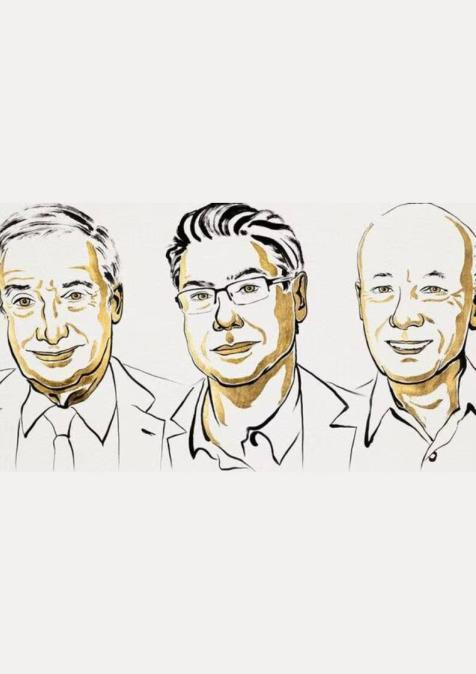
Joel Mokyr, Philippe Aghion et Peter Howitt consacrés Prix Nobel d’Économie 2025
October 15, 2025

Depuis que l’économie a été reconnue par les Nobel, en1969, c’est à cette discipline qu’il revient de clore les cérémonies annuelles d’attribution des Prix aux lauréats. Pour cette année 2025, c’est le 13 octobre que  l’Américano-Israélien, Joel Mokyr, le Français, Philippe   Aghion, et le Canadien, Peter Howitt, ont été consacrés Prix Nobel de l’Économie.

Joel Mokyr, historien de l’économie américaine, à qui a été attribuée la moitié du Prix, est Professeur à l’université Northwestern  et dont les travaux vont bien au-delà de l’analyse des chiffres et des tendances. Entre autres publications, il a à son actif un ouvrage de référence, publié en 2016 :’’ A culture of Growth :The Origins of the Modern Economy ‘’ (Princeton University Press ). Dans cet ouvrage, le lauréat postule que la révolution industrielle est le résultat des cultures et des institutions. Sa capacité à tisser des liens entre l’économie, la science et la culture s’exprime aussi dans  ‘’ the Lever of Riches ‘’ publié en1990 ( Oxford University Press) et dans ‘’ The   Gifts of Athena ‘’, publié en 2002 (Princeton University Press), ouvrages dans lesquels il développe une analyse originale des mécanismes d’innovation, mettant en lumière le rôle central des idées et des connaissances dans les révolutions industrielles. Pour Mokyr, l’histoire  économique ne saurait se limiter aux ressources et à l’accumulation du capital, soutenant que la révolution industrielle britannique est profondément ancrée dans une culture des lumières. L’Américano-israélien  soutient aussi que la fragmentation politique, que l’on retrouve en Europe avec un nombre important d’États européens, permet aux   idées hétérodoxes   de   se développer.  Leurs auteurs, si nécessaire, pouvant, en cas de nécessité, trouver refuge dans un État voisin où ils pourront continuer à les développer.  ses travaux, Joel Mokyr nous rappelle, enfin, que la prospérité ne se mesure pas seulement en PIB, mais aussi en richesse 

intellectuelle et culturelle. En distinguant Joël Mokyr, le jury Nobel a tenu à  souligner l’importance de travaux « ayant identifié les conditions nécessaires à une croissance durable par le progrès technologique », où l’optimisme l’emporte, si on veut ne pas oublier que c’est le capital culturel de l’Europe, davantage que les matières premières, qui a permis aux sociétés européennes de prendre une avance technologique sur le reste du monde.

Philippe Aghion, économiste français, et Peter Howitt, économiste canadien : deux économistes post schumpétériens distingués par le jury Nobel pour « leur théorie de la croissance soutenue par la destruction créatrice ». P. Aghion et P. Howitt, qui se partagent l’autre moitié du Prix, publient en 1992 ‘’ A Model of Growth Through Creative Destruction ‘’ (Econometrica Vol.60 N2 p.323-351), suivi, en 1998, d’un livre ‘’ The Endogenous of Gowth theory’’  (Cambridge MIT Press ). 

Leur approche, caractérisée par la prise en compte du concept schumpétérien de « destruction créative », rappelle que les innovations rendent obsolètes les anciennes technologies, créant des rentes de situation, lorsqu’elles sont trop importantes, permettant d’établir des barrières à l’entrée de nouvelles firmes sur le marché. Ce qui risque de pénaliser toute motivation, conduisant alors à un ralentissement de la croissance. C’est le paradoxe de la destruction créatrice. Paradoxe qui souligne que le progrès n’est jamais définitivement acquis, ce qui oblige la société à rester constamment ouverte au changement, à la recherche d’innovations   technologiques   majeures.  

Dès l’annonce du Prix, Philippe Aghion a tenu à rappeler que « l’ouverture est un moteur de croissance, et que tout ce qui entrave l’ouverture est un obstacle à la croissance ». À un moment où les États-Unis continuent de relever leurs droits de douane, ce rappel est aussi une mise en garde à l’Europe qui ne doit pas laisser les États-Unis et la Chine avoir le monopole des technologies majeures. C’est, aussi, un constat, celui d’une Europe qui n’a pas su, ou n’a pas pu, mettre en œuvre des innovations majeures, se contentant d’innovations technologiques moyennes. C’est, enfin, l’occasion de déplorer   un écosystème   financier européen peu propice à l’innovation.

Aujourd’hui, la mondialisation est remise en cause, le retour au protectionnisme avec des droits de douane américains disparates, atteignant des taux records en témoigne dans un monde économique de plus en plus fragmenté. C’est pourquoi, le choix des Nobel d’Économie 2025 nous paraît particulièrement pertinent.  Comme l’an dernier, ce sont   trois économistes qui ont été privilégiés. Ils ont en commun d’être diplômés d’universités nord-américaines   prestigieuses : Harvard / P ;Aghion, North western / P .Howitt, Yale /J. Mokyr. Trois chercheurs incontestés dans leur domaine et reconnus par leurs pairs, qui succèdent à : Daron Acemoglou (MIT), Simon Johnson (MIT), James A . Robinson (Université de Chicago).
 

RELATED CONTENT

  • Authors
    August 13, 2018
    The Brazilian economy pays a price in terms of productivity foregone because of its lack of trade openness. A trade opening process would bring an adjustment impact that could nonetheless be mitigated with public policies that facilitate labor mobility and job migration. Benefits from trade opening would also hinge on policy improvements in complementary areas, such as infrastructure investments, business environment and others. The Brazilian economy would benefit from opening trad ...
  • Authors
    August 6, 2018
    The IMF released last July 24 its latest assessments of the current account balances for the 30 largest economies in its External Sector Report 2018 (ESR). There was no major change in 2017 relative to previous years and the reconfiguration of surpluses and deficits that has prevailed since 2013 was essentially extended. However, there are reasons to expect more abrupt alterations ahead, as the U.S. fiscal easing under high employment conditions unfolds. Given the context ...
  • August 1, 2018
    “This article has been originally published in 'Morocco in Focus 2018,' the magazine of the Moroccan Embassy in New Delhi, India on the occasion of the Morocco National Day 2018.” Introduction In an article published last year, the author stressed the role of partnership between Morocco and India for the inclusive growth of small farmers. There is no doubt that agriculture remains a major instrument for human development both in India and in Africa. Several international reports&n ...
  • Authors
    August 1, 2018
    “A WAKE UP CALL FOR THE WORLD” For Simon Elin, chief executive of the British Recycling Association, it’s “a tough time” his industry and country are facing just now. He does not think about Brexit, Britain trying to leave the E.U., dreaming to return to glorious times as a world power, one day soon. His colleague Arnaud Brunet, head of the Bureau of International Recycling, predicted “catastrophic environmental problems.” An assessment the London Times shared: “The world ...
  • Authors
    François Gaulme
    July 20, 2018
    Cette note vise à mettre en lumière le cycle d’ajustement à la fois financier, économique et politique affectant deux pétro-États d’Afrique centrale, le Gabon et la République du Congo (Congo-Brazzaville). Unis par leur système économique de rente et leur histoire coloniale commune, ces deux pays n’en ont pas moins connu des destins politiques différents après leur indépendance, le premier conservant une relation privilégiée avec la France tandis que le second optait rapidement pour ...
  • Authors
    July 10, 2018
    Historians often offer different interpretations of the events that have shaped our destiny, yet, with respect to World War 2, the bloodiest conflict in history, they seem to concur on two points. First, that those yearning for peace underestimated the National Socialists’ determination to wage a war of conquest until it was far too late to deter them, and, second, that Nazi Germany failed to anticipate that Britain, the United States, and the Soviet Union – each of which it provok ...
  • Authors
    July 3, 2018
    The addition of a fourth US rate rise to the Federal Reserve’s 2018 dot-plot graph after the June meeting of the Federal Open Market Committee sparked a bout of portfolio outflows from emerging markets. This followed a fleeting upswing at the beginning of the month that fell short on reversing the unwinding of exposure and sell-off of assets in May (Chart 1). Country differentiation has been accentuated, with exchange rate devaluation pressures and capital outflows occurring more no ...
  • June 13, 2018
    From cryptocurrencies to blockchain to mobile money, financial technology or “fintech” is revolutionizing the basic structures of the global economy. Financial services delivered through ...
  • Authors
    June 6, 2018
    The spike in US bond yields since mid-April in tandem with the strengthening of the dollar sparked a retrenchment of capital flows to emerging markets (EM), accompanied by a sell-off of assets in some cases. Argentina and Turkey suffered from strong and potentially disruptive exchange rate depreciation pressures in May, with financial markets calming down only after bold domestic policy moves (interest rate hikes in both countries and, in the case of Argentina, a decision to seek a ...
  • Authors
    Sabine Cessou
    May 31, 2018
    What are the best ways forward to enhance the capacity, increase the impact, and ensure the long term viability of think tanks in Africa? These questions have been debated during the 2nd edition of African Think Tank Summit (ATTS) held in Rabat from May 9th to May 11th.  The African think tanks have positively evolved over the years in order to respond to the specific needs of their different countries. They operate as platforms to share knowledge and train young leaders, with ...