Publications /
Opinion

Back
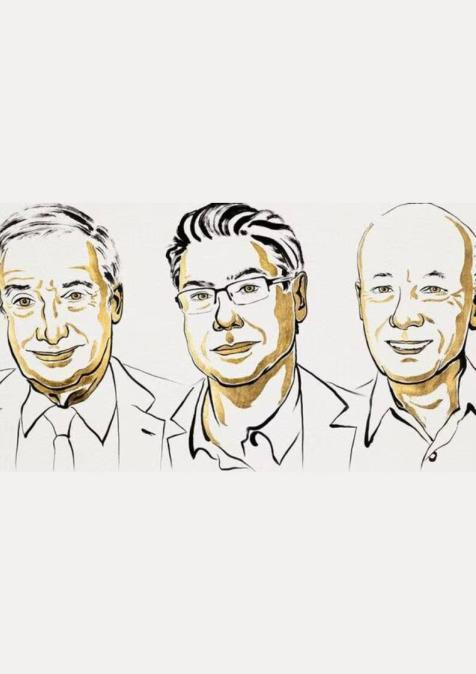
Joel Mokyr, Philippe Aghion et Peter Howitt consacrés Prix Nobel d’Économie 2025
October 15, 2025

Depuis que l’économie a été reconnue par les Nobel, en1969, c’est à cette discipline qu’il revient de clore les cérémonies annuelles d’attribution des Prix aux lauréats. Pour cette année 2025, c’est le 13 octobre que  l’Américano-Israélien, Joel Mokyr, le Français, Philippe   Aghion, et le Canadien, Peter Howitt, ont été consacrés Prix Nobel de l’Économie.

Joel Mokyr, historien de l’économie américaine, à qui a été attribuée la moitié du Prix, est Professeur à l’université Northwestern  et dont les travaux vont bien au-delà de l’analyse des chiffres et des tendances. Entre autres publications, il a à son actif un ouvrage de référence, publié en 2016 :’’ A culture of Growth :The Origins of the Modern Economy ‘’ (Princeton University Press ). Dans cet ouvrage, le lauréat postule que la révolution industrielle est le résultat des cultures et des institutions. Sa capacité à tisser des liens entre l’économie, la science et la culture s’exprime aussi dans  ‘’ the Lever of Riches ‘’ publié en1990 ( Oxford University Press) et dans ‘’ The   Gifts of Athena ‘’, publié en 2002 (Princeton University Press), ouvrages dans lesquels il développe une analyse originale des mécanismes d’innovation, mettant en lumière le rôle central des idées et des connaissances dans les révolutions industrielles. Pour Mokyr, l’histoire  économique ne saurait se limiter aux ressources et à l’accumulation du capital, soutenant que la révolution industrielle britannique est profondément ancrée dans une culture des lumières. L’Américano-israélien  soutient aussi que la fragmentation politique, que l’on retrouve en Europe avec un nombre important d’États européens, permet aux   idées hétérodoxes   de   se développer.  Leurs auteurs, si nécessaire, pouvant, en cas de nécessité, trouver refuge dans un État voisin où ils pourront continuer à les développer.  ses travaux, Joel Mokyr nous rappelle, enfin, que la prospérité ne se mesure pas seulement en PIB, mais aussi en richesse 

intellectuelle et culturelle. En distinguant Joël Mokyr, le jury Nobel a tenu à  souligner l’importance de travaux « ayant identifié les conditions nécessaires à une croissance durable par le progrès technologique », où l’optimisme l’emporte, si on veut ne pas oublier que c’est le capital culturel de l’Europe, davantage que les matières premières, qui a permis aux sociétés européennes de prendre une avance technologique sur le reste du monde.

Philippe Aghion, économiste français, et Peter Howitt, économiste canadien : deux économistes post schumpétériens distingués par le jury Nobel pour « leur théorie de la croissance soutenue par la destruction créatrice ». P. Aghion et P. Howitt, qui se partagent l’autre moitié du Prix, publient en 1992 ‘’ A Model of Growth Through Creative Destruction ‘’ (Econometrica Vol.60 N2 p.323-351), suivi, en 1998, d’un livre ‘’ The Endogenous of Gowth theory’’  (Cambridge MIT Press ). 

Leur approche, caractérisée par la prise en compte du concept schumpétérien de « destruction créative », rappelle que les innovations rendent obsolètes les anciennes technologies, créant des rentes de situation, lorsqu’elles sont trop importantes, permettant d’établir des barrières à l’entrée de nouvelles firmes sur le marché. Ce qui risque de pénaliser toute motivation, conduisant alors à un ralentissement de la croissance. C’est le paradoxe de la destruction créatrice. Paradoxe qui souligne que le progrès n’est jamais définitivement acquis, ce qui oblige la société à rester constamment ouverte au changement, à la recherche d’innovations   technologiques   majeures.  

Dès l’annonce du Prix, Philippe Aghion a tenu à rappeler que « l’ouverture est un moteur de croissance, et que tout ce qui entrave l’ouverture est un obstacle à la croissance ». À un moment où les États-Unis continuent de relever leurs droits de douane, ce rappel est aussi une mise en garde à l’Europe qui ne doit pas laisser les États-Unis et la Chine avoir le monopole des technologies majeures. C’est, aussi, un constat, celui d’une Europe qui n’a pas su, ou n’a pas pu, mettre en œuvre des innovations majeures, se contentant d’innovations technologiques moyennes. C’est, enfin, l’occasion de déplorer   un écosystème   financier européen peu propice à l’innovation.

Aujourd’hui, la mondialisation est remise en cause, le retour au protectionnisme avec des droits de douane américains disparates, atteignant des taux records en témoigne dans un monde économique de plus en plus fragmenté. C’est pourquoi, le choix des Nobel d’Économie 2025 nous paraît particulièrement pertinent.  Comme l’an dernier, ce sont   trois économistes qui ont été privilégiés. Ils ont en commun d’être diplômés d’universités nord-américaines   prestigieuses : Harvard / P ;Aghion, North western / P .Howitt, Yale /J. Mokyr. Trois chercheurs incontestés dans leur domaine et reconnus par leurs pairs, qui succèdent à : Daron Acemoglou (MIT), Simon Johnson (MIT), James A . Robinson (Université de Chicago).

 

RELATED CONTENT

  • Authors
    June 10, 2019
    This article was originally published on Center for Macroeconomics and development's website Friday night, US President Donald Trump announced by Twitter that he would suspend the implementation of tariffs on Mexican imports, which would start with 5% on Monday, June 10, to reach 25% in October. A signed agreement between the two countries, also confirmed by Twitter by Mexico’s foreign minister Marcelo Ebrard, would have included Mexican government’s commitments to t ...
  • Authors
    June 3, 2019
    In a recent brief, titled” The Crisis in World Trade”, my co-authors and I conclude that whether we still have a rules-based system a few years from now depends on the answer to three questions: Can the WTO be revitalized? Is protectionism in the United States a temporary aberration? Will China reform and fit the liberal economic order? If the answer to these three questions is yes, the system will likely endure. If the answer is no, we will return to the power based non system ...
  • Authors
    Renato Schwambach Vieira
    Miguel Stevanato Jacob
    Ana Waksberg Guerrini
    Eduardo Germani
    Fernando Barreto
    Miguel Luiz Bucalem
    Pedro Levy Sayon
    June 3, 2019
    This paper estimates the socioeconomic impacts of the emergence and expansion of e-hailing services in São Paulo, Brazil. Combining data from a major service provider, individual level data from a representative travel diary survey and a structural traffic network simulation, we evaluate the impact of e-hailing on commuters' travel time and accessibility. We then estimate the effect of these changes on workers' productivity. Finally, using a Spatial Computable General Equilibrium (S ...
  • Authors
    Mohamed Obaidy
    May 30, 2019
    This paper empirically examines the impact of exchange rate arrangements on current account imbalances within the African context. Following Friedman’s hypothesis (Friedman, 1953), we test the propositions stating that flexible exchange rate regimes limit the magnitude of real external shocks and permit smoother adjustments of external imbalances. Using a new de facto exchange rate regime classification, we employ two empirical methodologies to test this hypothesis: we first apply a ...
  • Authors
    Mouhamadou Moustapha Ly
    May 29, 2019
    The world economy has gone through several systems to determine a value between country’s currencies. After the Second World War and the so-called gold standards, major world economies engaged into a system of fixed exchange rate of currencies against the dollar and, the whole system was backed by the value of USD against gold. After the end of that mechanism known as the Bretton Wood system in the 1970s, major world economies decided to liberalize the system of international exchan ...
  • Authors
    T20 experts
    May 28, 2019
    The world trading system has been remarkably successful in many respects but is presently under tremendous strain. The causes are deep-seated and require a strategic response. The future of the system depends critically on reinvigorating the WTO and policy change in the largest trading nations. Important measures are required to sustain the multilateral trading system, and urgent action is needed to avoid a scenario where the system fragments. The worst scenarios will disrupt global ...
  • Authors
    Juliana Suess
    May 24, 2019
    On the eve of Britain’s exit from the European Union, the country is redefining its international approach. The United Kingdom has already taken action by becoming involved in new economic commitments, new trade agreements in Commonwealth countries but also from a diplomatic point of view in West Africa. While development aid remains a focal point of its intervention in Africa, it risks being undermined by the Brexit and its economic consequences. However, the United Kingdom is now ...
  • Authors
    May 22, 2019
    The trade tensions between the United States and China will cause only minor immediate damage to their giant economies. However, tariffs have important and diverse effects on individual sectors and cause heightened uncertainty. The main adverse effects on Sub-Saharan Africa will therefore be through global investor confidence, economic growth and commodity prices, and these effects could be severe if the dispute escalates further and endangers the rules-based trading system. The tra ...
  • Authors
    May 21, 2019
    Throughout my last 15 years working in multilateral institutions, many times around the world I was asked to speak about the success of poverty reduction in Brazil during the new millennium. Last week, someone who was on such an occasion in October 2013 in Nairobi asked me what my numbers had become after these recent years of precarious macroeconomic performance and high unemployment in the country. I replied that they have changed ... in part! Indeed, the fact that, even without ...