Publications /
Policy Brief
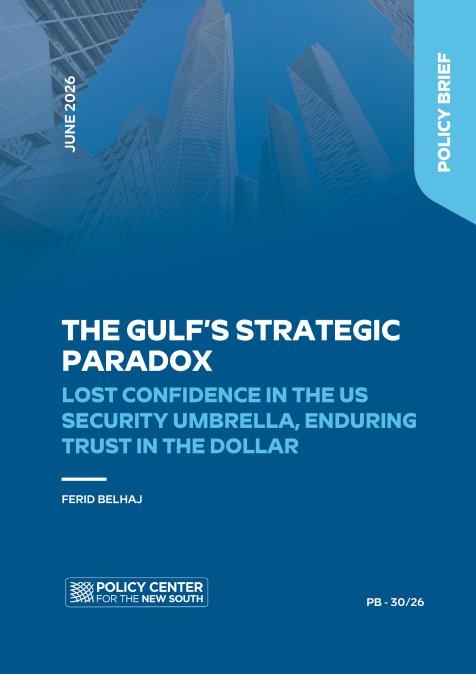
This essay argues that the current debate about the future of the international monetary system is not really about Gulf currencies, oil pricing, or de-dollarization in the narrow technical sense. It is about something deeper and more important: whether institutional trust can survive when geopolitical certainty is eroding.
The Gulf monarchies—Saudi Arabia, the United Arab Emirates, Qatar, Kuwait, Bahrain, and Oman—increasingly exist in a world where the United States no longer looks like the unquestioned guarantor of regional stability. Repeated tensions with Iran, the vulnerability of the Strait of Hormuz, attacks on Gulf infrastructure, and Washington’s cautious and calculated responses have all raised serious doubts about how far the United States would actually go to protect its Gulf partners. And yet, despite these growing doubts, the Gulf states continue to anchor their currencies overwhelmingly to the US dollar and keep the vast majority of their sovereign wealth inside American-centered financial markets.
This apparent contradiction is not a puzzle. It reflects a profound transformation in how power works in the modern world. Military dominance and institutional dominance are no longer perfectly synchronized. American geopolitical supremacy may look increasingly uncertain, selective, and constrained—but the institutional architecture built around the dollar continues to command extraordinary global confidence.
This essay develops four central arguments. First, reserve-currency systems do not rest on economic size alone; they rest on institutional credibility. Second, the Gulf crisis reveals that institutional power can outlast partial geopolitical decline. Third, China’s rise has not yet produced a genuine reserve-currency alternative, because the renminbi remains limited by capital controls, legal opacity, and uncertainty about how the Chinese system would behave in a serious crisis. Fourth, and most fundamentally, institutions are not alternatives to power. They are organized expressions of power. The enduring strength of the dollar reflects the way American power has been institutionalized through law, liquidity, operational continuity, and financial depth.
The essay concludes that the Gulf’s continued attachment to the dollar is not primarily an expression of loyalty to Washington. It is a rational response to systemic uncertainty. In a fragmented world, increasingly shaped by sanctions, maritime vulnerability, and geopolitical volatility, the rule of law itself becomes a strategic asset. The central question of the coming decades may therefore not be whether America remains geopolitically dominant—but whether any rival system can generate comparable institutional trust at a time when uncertainty has become truly existential.
Introduction: The Age of Fragmented Certainty
The world today seems caught between two competing realities that refuse to resolve themselves.
The first reality is geopolitical fragmentation. The certainties that defined the post-Cold War era are dissolving. Strategic alliances have become more transactional and less reliable. Maritime chokepoints are increasingly vulnerable to disruption. Sanctions have become normalized tools of statecraft. Energy routes, payment systems, supply chains, and technological networks are being progressively weaponized. The idea of a stable, rules-based international order, which once seemed like the natural endpoint of history after 1991, now appears quaint.
The second reality is institutional continuity. Despite all this volatility, global finance continues to revolve overwhelmingly around the dollar-centered monetary order that was constructed after the Second World War. The dollar remains the dominant currency in international trade, commodity pricing, sovereign borrowing, and central bank reserves. No serious rival has emerged to replace it.
These two realities coexist in a state of deepening tension. And nowhere is that tension more visible and more consequential than in the Gulf.
The Gulf monarchies increasingly doubt whether the United States would fully protect them in the event of prolonged regional escalation involving Iran. Yet these same states continue to preserve the overwhelming majority of their sovereign wealth within the American-centered financial system. They keep their currencies pegged to the dollar. They hold US Treasury securities as their primary reserve asset. They route their trade and financial transactions through dollar-based systems. And when geopolitical uncertainty spikes, they move more money—not less—toward dollar liquidity.
This is not an irrational contradiction. It reflects something more important: a deep transformation in the relationship between geopolitical power and institutional trust.
For much of the 20th century, military dominance, monetary dominance, and geopolitical leadership reinforced each other seamlessly. The United States embodied all three simultaneously. Today, however, these dimensions are becoming partially decoupled. American geopolitical supremacy looks increasingly contested and selective—yet the institutional ecosystem surrounding the dollar continues to command remarkable global confidence.
This distinction is central to understanding the emerging world order. The contemporary debate is not ultimately about Gulf currencies or the technical details of reserve management. It is about whether institutional trust can survive the erosion of geopolitical certainty. That question extends far beyond the Middle East. It is, in the deepest sense, a question about the durability of the international order itself.
The Gulf and the Crisis of Strategic Assurance
For decades, the Gulf monarchies operated under an implicit strategic understanding with Washington. The United States would preserve freedom of navigation through the Persian Gulf, guarantee maritime security, stabilize the regional balance of power, and ensure the uninterrupted flow of Gulf hydrocarbons to global markets. In exchange, Gulf energy would remain integrated into the broader architecture of the dollar-centered financial system. This was the foundation of the petrodollar arrangement.
That strategic bargain now looks far less certain than it once did.
The drone and missile attacks on Saudi Arabia’s Abqaiq and Khurais oil facilities in September 2019 marked a profound psychological turning point across the Gulf region. The issue was not simply the temporary disruption of oil production, though that was serious enough. It was the dawning realization that even the most critical arteries of the global energy system remained deeply vulnerable despite the overwhelming American military presence in the region. The facilities struck at Abqaiq alone process roughly 5 percent of the world’s daily oil supply. They were hit with extraordinary precision by a combination of cruise missiles and drones, apparently launched from Yemeni territory or Iranian soil, and the American response was measured and restrained.
For Gulf leaders, the message was unmistakable: the United States would not automatically respond to attacks on Gulf infrastructure with the full force of its military power.
The Strait of Hormuz further crystallizes this vulnerability. Roughly one-fifth of all globally traded oil and significant volumes of liquefied natural gas pass through this narrow maritime corridor between Iran and the Arabian Peninsula. The strait is only about 21 miles wide at its narrowest point, and it is overlooked by Iranian territory on one side. Any significant disruption—whether through naval confrontation, mining, or Iranian anti-ship missile strikes—would immediately ripple through global markets. Its effects would spread instantly and simultaneously across multiple domains:
- Global shipping insurance premiums would spike immediately, affecting all maritime trade.
- Energy futures prices would surge, triggering inflationary pressure across oil-importing economies.
- Sovereign-risk assessments for Gulf states would deteriorate, raising borrowing costs.
- Freight costs across global supply chains would rise sharply.
- Currency markets would experience turbulence, particularly in economies heavily dependent on Gulf energy.
In other words, every serious Hormuz escalation would function simultaneously as an energy shock, a logistics shock, an insurance shock, a liquidity shock, and, ultimately, a monetary shock. The Gulf monarchies have understood for years that an adversary willing to absorb the costs of disruption could impose extraordinary systemic costs without needing to match American military power in a conventional sense. Asymmetrical disruption is far cheaper to generate than it is to prevent.
This reality has produced a growing sense of strategic unease among Gulf leaders. They continue to host American military bases and maintain close security partnerships with Washington. But they have become increasingly clear-eyed about what American protection can and cannot guarantee. The Obama administration’s retrenchment tendencies, the Biden administration’s more restrained approach to Iranian provocations, and the more openly transactional logic of Trump-era diplomacy have all reinforced a single uncomfortable conclusion: American protection is valuable but no longer unconditional.
And yet, paradoxically, this very insecurity reinforces a different and perhaps surprising attachment.
When Gulf sovereign wealth funds seek safety during turbulent periods—when geopolitical anxiety peaks, when oil prices fall, when regional tensions escalate—they do not rush to allocate capital toward renminbi assets, yuan-denominated bonds, or Chinese financial markets. They move toward dollar liquidity, US Treasury securities, Western legal jurisdictions, and American-centered financial infrastructure.
This reveals the central paradox at the heart of the emerging international order. The Gulf may increasingly fear strategic abandonment by America but it still fears institutional uncertainty elsewhere even more. Understanding why requires going back to basics—to what reserve currencies actually are, why they endure, and what makes them trustworthy.
Monetary Orders and the Architecture of Trust
Contemporary discussions of de-dollarization often rest on a deceptively simple assumption: that reserve-currency status naturally and inevitably follows economic size. Since China has become the world’s largest trading nation and its dominant industrial exporter, many observers have predicted the gradual and perhaps inevitable rise of the renminbi and the corresponding decline of the dollar. The logic seems intuitive: big economies produce big currencies.
History tells a far more complicated story.
Great trading powers have frequently failed to create lasting reserve currencies. Imperial Spain dominated vast commercial networks during the 16th century, benefiting from enormous flows of silver and gold from the Americas. At its peak, Spanish silver was the closest thing the early modern world had to a global currency. Yet Spain never succeeded in building a stable and enduring monetary architecture capable of generating long-term international confidence. Repeated sovereign defaults, fiscal overextension, the failure to develop sophisticated financial institutions, and chronic political instability ultimately undermined confidence in Spanish financial power—despite the empire’s immense bullion wealth. Commercial scale without institutional depth proved insufficient.
Britain’s pound sterling followed a different and instructive trajectory. As Britain’s relative industrial and geopolitical dominance gradually declined through the first half of the 20th century, sterling retained substantial international influence long after British power had clearly peaked. This was not because investors were deluded about British power. It was because the City of London continued to embody something genuinely valuable: predictability, legal continuity, deep capital markets, and institutional sophistication accumulated over centuries. Investors and states trusted not simply British power—which was visibly declining—but the broader institutional architecture surrounding British finance. That trust proved remarkably durable, outlasting British hegemony by decades.
The broader historical lesson is fundamental and often underappreciated. Reserve currencies endure not simply because powerful states endorse them, but because dense institutional ecosystems develop around them—ecosystems capable of sustaining confidence under pressure. These ecosystems require:
- Deep and liquid capital markets capable of absorbing large flows without severe disruption.
- Operational continuity—the ability to keep financial infrastructure functioning even during crises.
- Enforceable contracts backed by independent courts and reliable legal systems.
- Transparent governance and regulatory frameworks that operate according to predictable rules.
- Credible central banks capable of managing systemic stress without arbitrary intervention.
- Predictable legal systems that protect property rights and honor financial claims regardless of political circumstances.
At its core, reserve-currency dominance is a mechanism of organized confidence. It functions because global actors—central banks, sovereign wealth funds, commercial banks, corporations, and individual investors—collectively believe that the system will continue to function reliably even when conditions deteriorate.
This confidence becomes most visible precisely when it is most tested. During the 2008 global financial crisis, investors rushed toward US Treasury securities even though the crisis itself originated within American financial markets. This was not irrational. It reflected a deeply embedded understanding that even a flawed and crisis-prone American financial system was more reliable, more liquid, and more operationally resilient than any available alternative. During the COVID-19 economic shock of 2020, global demand for dollar liquidity surged dramatically. The Federal Reserve effectively became the lender of last resort not merely for the United States, but for large portions of the international financial system—providing emergency dollar-swap lines to 14 central banks and stabilizing global liquidity at a scale no other institution could have matched.
This reveals a crucial and often overlooked distinction. States may criticize American foreign policy, contest American geopolitical decisions, and chafe against American strategic dominance, yet simultaneously continue to trust American financial infrastructure. Political disagreement and institutional trust operate on different registers. They can, and frequently do, coexist.
The Gulf monarchies have come to understand this distinction with particular clarity, because their own survival depends on navigating a world in which geopolitical fragmentation and financial concentration coexist in tension.
The Dollar as Institutionalized Power
The enduring strength of the dollar cannot be explained by any single factor. It is not simply the product of American military power, though that matters. It is not simply the result of the petrodollar arrangement, though that has been significant. It is not merely a matter of historical inertia or network effects, though both play a role. Its resilience comes from something deeper and more durable: the vast institutional architecture that was built around it over more than seven decades.
The postwar Bretton Woods system, established in 1944, was a transformative achievement. It did not merely organize international monetary relations around the dollar. It transformed American power into an organized global financial order. The International Monetary Fund and the World Bank provided multilateral frameworks for international financial governance. The Federal Reserve system developed into the world’s most important central bank. US Treasury markets grew into the deepest and most liquid sovereign bond market in history. New York’s financial ecosystem became the operational center of global capital. American legal and regulatory institutions developed a reputation for independence, predictability, and procedural reliability that few other jurisdictions could match.
When President Nixon ended the dollar’s convertibility into gold in August 1971, many observers expected the dollar-centered system to collapse. It did not. The reason is revealing: the foundations of the system were no longer based primarily on gold. They were based on liquidity, institutional continuity, legal predictability, and accumulated market confidence—foundations far more resilient than any commodity peg.
Over subsequent decades, US Treasury bonds became the world’s principal safe asset. This is not a title conferred by tradition alone. It reflects concrete operational realities. No other sovereign bond market has matched the depth, liquidity, transparency, and operational flexibility of the Treasury market. A central bank or sovereign wealth fund managing tens or hundreds of billions of dollars in reserves has essentially no alternative that offers comparable scale, reliability, and ease of transactions. During moments of uncertainty, central banks, sovereign wealth funds, pension funds, insurance companies, and global institutional investors continue to move toward Treasuries—not out of sentiment, but because they remain the most reliable and scalable store of value available.
The Federal Reserve also evolved into the world’s effective lender of last resort. During the 2008 global financial crisis, the Federal Reserve’s emergency dollar swap lines—extended to the European Central Bank, the Bank of Japan, the Bank of England, and ten other major central banks—stabilized global dollar funding markets at a moment when the international financial system appeared on the verge of seizing up entirely. No other institution possessed the capacity, the credibility, or the institutional framework to perform this function.
But the dollar’s dominance extends far beyond central bank reserves. International trade invoicing, commodity market pricing, shipping finance, sovereign bond issuance, derivatives markets, cross-border banking, and interbank clearing all continue to function largely through dollar-based systems. SWIFT messaging, correspondent banking networks, and the dollar-clearing infrastructure of the New York Federal Reserve collectively constitute something resembling a global financial operating system. Opting out of this system entirely is not simply politically inconvenient. It is operationally extraordinarily difficult.
The world economy, therefore, no longer simply uses the dollar. It operates through the dollar. The dollar has become part of the infrastructure of globalization itself—as foundational as maritime shipping lanes, submarine communications cables, or the internet.
This creates profound structural dependencies that rhetoric cannot dissolve. A Gulf sovereign wealth fund cannot de-dollarize through political statements alone. Its assets are embedded within a global financial ecosystem built around dollar-clearing systems, Treasury collateral markets, Western custodial banking networks, maritime insurance frameworks centered on London and New York, and Anglo-American legal and arbitration institutions. Exiting that ecosystem would not merely be inconvenient; it would require rebuilding, at enormous cost and over many years, an entirely parallel financial infrastructure—one that does not currently exist at remotely comparable scale.
The Gulf’s relationship with the dollar is, therefore, no longer merely monetary. It has become infrastructural. And infrastructure, once embedded deeply enough into how an economy functions, generates its own gravitational field.
China’s Rise and the Limits of Institutional Credibility
China’s rise represents the most significant redistribution of economic power since the emergence of the United States as the dominant global power in the early 20th century. The scale of China’s economic transformation over the past four decades is genuinely extraordinary. China is now the world’s largest energy importer, the central industrial exporter of the global economy, the largest trading partner for the majority of the world’s nations, and the principal commercial partner for much of the Gulf region. Its Belt and Road Initiative has extended Chinese financial and infrastructure influence across Asia, Africa, the Middle East, and parts of Europe.
At first glance, such economic weight would seem sufficient to support the renminbi’s emergence as a major international reserve currency. If trade creates demand for currency, and China is the world’s largest trading nation, should it not follow that the renminbi is destined to become a major reserve currency?
The answer, based on both historical analysis and operational reality, is that reserve currencies are not built on trade volumes alone. They are built on something more difficult to create: confident trust that power will remain predictable, rules-based, and institutionally constrained—especially during moments of crisis, when those qualities matter most.
This remains the central and structural limitation of the Chinese monetary model.
The distinction can be stated simply but carries enormous implications. The renminbi is backed by a powerful state. The dollar is backed by a powerful institutional ecosystem. Those are fundamentally different kinds of foundations. A powerful state can compel compliance within its borders, direct financial flows, and mobilize enormous resources. But global reserve-currency legitimacy requires something a powerful state cannot simply decree: voluntary and confident adoption by actors who are not subject to its authority.
China has made real and in some ways impressive progress in expanding the international use of the renminbi. It has established renminbi settlement systems for bilateral trade, negotiated currency swap agreements with dozens of central banks, developed the Cross-Border Interbank Payment System as a partial alternative to SWIFT, promoted the digital yuan for international transactions, and directed substantial Belt and Road financing through renminbi-denominated instruments. These are not trivial achievements.
And yet the deeper issue is not technological sophistication or commercial reach; it is institutional credibility. Global capital, when it seeks safety during periods of acute uncertainty, is ultimately looking for three things above all else: predictability, transparency, and contestability.
Predictability means investors can reasonably expect that the rules governing their assets will not suddenly change based on political priorities. Transparency means markets can evaluate risks through credible information flows and relatively clear regulatory processes. Contestability means economic actors believe that decisions affecting their assets can be challenged through legal or institutional mechanisms—that outcomes are not wholly dependent on political discretion.
These are precisely the dimensions where structural doubts continue to surround the Chinese system.
Capital controls in China remain extensive and can be tightened rapidly under stress. Full convertibility of the renminbi cannot be assumed during periods of systemic financial pressure. Regulatory interventions have repeatedly appeared sudden, sweeping, and politically motivated—the dramatic crackdowns on the technology sector, private education companies, and financial intermediaries between 2020 and 2022 demonstrated vividly how rapidly the regulatory landscape can shift when political priorities change. Judicial independence in cases where state interests are involved remains deeply uncertain. The boundary between political authority and financial governance is fluid and unpredictable.
The issue is, therefore, not ideological. It is not about whether Western financial models are superior to Chinese ones, or whether American values are preferable to Chinese ones. It is operational. Global investors managing fiduciary responsibilities do not merely ask whether an economy is large and powerful. They ask what would happen to their assets if conditions deteriorated sharply. Would capital be free to exit during a financial panic? Would contractual protections survive a serious geopolitical confrontation between China and the West? Would regulators act according to transparent and predictable procedures, or according to political imperatives that outside investors cannot anticipate or contest? Could investors realistically challenge state decisions through genuinely independent institutions?
These questions matter profoundly because reserve-currency legitimacy is not tested during periods of stability. It is tested precisely during crises; when the pressure to subordinate institutional rules to political imperatives is greatest.
China faces a structural dilemma that has no easy resolution. It seeks simultaneously to internationalize the renminbi and to preserve extensive state control over finance, data, capital flows, and the banking system. But history suggests clearly that global reserve currencies require a degree of openness and institutional constraint that inevitably limits discretionary state power. Openness creates systemic vulnerabilities—it allows capital to exit, creates exposure to external financial pressures, and limits the state’s ability to manage financial conditions unilaterally. But openness also generates trust, because it signals a credible commitment to operating within rules rather than above them.
Beijing has, thus far, consistently chosen control over openness. From the perspective of maintaining domestic economic and political stability, this may be entirely rational. From the perspective of reserve-currency credibility, however, it creates structural limits that commercial scale and technological sophistication cannot overcome.
The Gulf monarchies understand this distinction clearly and act on it in their reserve management decisions. China may become—and in many respects already is becoming—the Gulf’s dominant commercial partner. Chinese investment in Gulf ports, industrial zones, logistics infrastructure, refining capacity, digital networks, and petrochemical facilities is substantial and growing. The commercial relationship between China and the Gulf is deepening rapidly and is likely to continue doing so.
But becoming a dominant commercial partner is fundamentally different from becoming a monetary anchor. The latter requires something deeper, more difficult, and far slower to build than commercial centrality. It requires confident trust that the underlying system will remain transparent, predictable, and institutionally contestable even when geopolitical tensions become acute. That level of trust takes decades to accumulate through consistent institutional performance. And it can be destroyed far more quickly than it was built.
History shows, without ambiguity, that it is far easier to accumulate economic power than institutional credibility. China has not yet crossed that threshold. Whether it will, and how long it might take, remains genuinely uncertain.
The Rule of Law as Strategic Power
There is a deeper lesson embedded in all of this—one that is often obscured by the more familiar language of geopolitical competition, military balance, and economic rivalry. It is a lesson that the Gulf monarchies, operating at the intersection of energy geopolitics, monetary policy, and strategic uncertainty, have come to understand in a visceral and practical way.
Institutions are not alternatives to power. They are organized expressions of power.
The dollar system remains dominant not because American military power is unchallengeable—it is not, and is increasingly perceived as selective and constrained. It remains dominant because American power was successfully institutionalized: embedded within law, underwritten by deep liquidity, structured through market mechanisms, and sustained by operational continuity that outlasts any particular administration, policy, or geopolitical moment.
This is why global capital continues returning to the United States even amid widespread criticism of American foreign policy decisions, even amid doubts about American strategic reliability, and even amid genuine uncertainty about the direction of American domestic politics. Investors may question Washington’s geopolitical judgment. They may disagree profoundly with American foreign policy. They may be frustrated by American strategic inconsistency. But they continue to trust the institutional machinery through which American financial power operates—because that machinery has demonstrated, across multiple severe crises, that it functions even when political conditions are extremely difficult.
China, by contrast, possesses immense and still-growing state power. It has demonstrated the capacity to mobilize resources at extraordinary scale, to direct industrial policy with remarkable effectiveness, and to project economic influence across a vast geographic range. But it has not yet transformed that power into a universally trusted institutional ecosystem—one in which outside actors, not subject to Chinese state authority, would voluntarily store their wealth and anchor their financial decisions with the same degree of confidence they extend to the dollar system.
That transformation requires something extraordinarily rare in history: a credible and demonstrated commitment to constraining power through predictable rules—including, and especially, when political circumstances create strong incentives to do otherwise.
This is precisely where the rule of law becomes genuinely strategic rather than merely procedural. In a world increasingly defined by sanctions, maritime disruption, technological fragmentation, trade weaponization, and intense geopolitical rivalry, institutional predictability itself becomes a geopolitical asset of the first order. The capacity to credibly commit to rules—to signal convincingly that contracts will be honored, that capital can exit freely, that legal protections will be maintained regardless of political tensions—is not merely a technocratic virtue. It is a source of structural power that shapes the decisions of states, sovereign wealth funds, central banks, and private capital across the entire global system.
The Gulf monarchies increasingly recognize this reality because their own survival across generations depends on it. These are states managing extraordinary wealth in an environment of persistent regional instability, existential security risks, and long-term hydrocarbon transition pressures. They cannot afford to place their sovereign savings in systems where institutional predictability is uncertain. The stakes are simply too high.
This is why, when Gulf states diversify away from dollar assets—as they do and will continue to do—they diversify primarily toward other institutionally credible systems: European sovereign debt, London-listed assets, Swiss financial infrastructure, and gold, which requires no institutional trust at all. They do not, in any large or systematic way, diversify toward Chinese financial markets.
That pattern reveals more about the true nature of reserve-currency power than any volume of academic theory.
Conclusion: Can Institutional Trust Outlive Geopolitical Certainty?
History rarely moves in straight lines. And it rarely respects the neat analytical frameworks that economists, political scientists, and strategists construct to explain it.
Empires often lose strategic coherence before they lose monetary centrality. Military uncertainty can emerge long before institutional trust begins to erode. The gap between geopolitical decline and monetary decline can be measured in decades, not years, because institutional credibility, once deeply embedded, is astonishingly resistant to the ordinary pressures of geopolitical change.
The British Empire had ceased to be the world’s dominant geopolitical power well before the pound sterling finally lost its central role in international finance. Sterling survived British imperial decline not because investors were confused about Britain’s waning power, but because the institutional architecture built around it—the legal systems, the financial markets, the clearing mechanisms, the professional networks of the City of London—retained their functionality and credibility long after the imperial foundations had crumbled. The pound did not fall when British power fell. It fell when British institutions could no longer credibly maintain the framework of trust that reserve-currency status requires.
The same paradox may now be increasingly defining the trajectory of the United States.
American geopolitical dominance is visibly more contested today than it was in 1990, or even in 2000. Its alliances have become more transactional. Its strategic commitments appear more conditional. Its domestic political stability looks less certain than it once did. And in the Gulf, the United States has repeatedly demonstrated that it will not respond with unlimited force to threats against Gulf partners—even when those threats involve attacks on the infrastructure of the global energy system.
And yet the institutional architecture constructed around the dollar still commands a level of trust that no rival system has yet come close to matching. That architecture has survived crises that, on paper, should have destroyed it: the end of Bretton Woods in 1971, the inflation shocks of the 1970s, the savings-and-loan crisis, the Long-Term Capital Management collapse, the catastrophic failures of 2008, and the pandemic shock of 2020. Each time, the dollar system proved more resilient than its critics predicted, and more functional than its rivals could manage.
This is the dilemma confronting the Gulf monarchies today. They see an America whose strategic guarantees feel less absolute than they once did. They watch a China whose economic weight grows larger every year. They manage enormous sovereign wealth in an environment of accelerating geopolitical uncertainty. And they make their financial decisions accordingly.
What those decisions consistently reveal is that the Gulf does not trust American strategy unconditionally. American strategy has given them reasons not to. The Abqaiq attack, the calibrated responses to Iranian provocations, the shifting terms of American engagement with the region—all of these have planted seeds of strategic doubt that will not easily be removed. Following the unprecedented escalation involving Iran, and the US military’s limited engagement, those doubts reached a genuinely new intensity.
But the Gulf trusts institutional uncertainty elsewhere even more. It trusts the opacity and unpredictability of China’s financial governance even less than it trusts American strategic ambivalence. It trusts the absence of a genuine alternative reserve infrastructure even less than it trusts the imperfect but functional dollar system.
The contemporary debate about de-dollarization, about the Gulf’s monetary future, about the dollar’s fate in a multipolar world—all of these ultimately converge on a single question: can institutional trust survive the erosion of geopolitical certainty?
The historical evidence suggests that the answer is yes—at least for a substantial period of time, and at least as long as no alternative has demonstrated the institutional depth, the legal credibility, and the operational reliability that reserve-currency status actually requires. The dollar’s dominance does not rest on the permanence of American geopolitical supremacy; it rests on the extraordinary resilience of institutionalized trust—a trust that is difficult to build, slow to erode, and largely impossible to replicate quickly through political will or commercial scale alone.
That may ultimately prove to be the hidden durability of the dollar age. Not the permanence of American power, which no serious observer believes will last forever. But the institutional architecture that American power constructed over decades—and the extraordinary difficulty of building anything comparable from scratch in a world where trust, once lost, is almost impossible to restore.
The Gulf understands this with exceptional clarity. And in their understanding, quietly expressed through the composition of their sovereign wealth funds and the structure of their monetary arrangements, lies perhaps the most honest and most realistic assessment of the contemporary international order available.
Select References
Barry Eichengreen, Exorbitant Privilege (Oxford University Press, 2011).
Barry Eichengreen, Globalizing Capital (Princeton University Press, 2019).
Benjamin Cohen, Currency Power (Princeton University Press, 2015).
Susan Strange, States and Markets (Blackwell, 1988).
Robert Gilpin, The Political Economy of International Relations (Princeton University Press, 1987).
Hans Morgenthau, Politics Among Nations (Alfred A. Knopf, 1948).
Henry Farrell and Abraham Newman, “Weaponized Interdependence: How Global Economic Networks Shape State Coercion,” International Security (2019).
Eswar Prasad, Gaining Currency: The Rise of the Renminbi (Oxford University Press, 2016).
Adam Tooze, Crashed: How a Decade of Financial Crises Changed the World (Viking, 2018).
Charles P. Kindleberger, The World in Depression, 1929–1939 (University of California Press, 1973).
Niall Ferguson, The Cash Nexus: Money and Power in the Modern World, 1700–2000 (Basic Books, 2001).
Federal Reserve Board, The International Role of the US Dollar (2021).