Publications /
Research Paper

Back
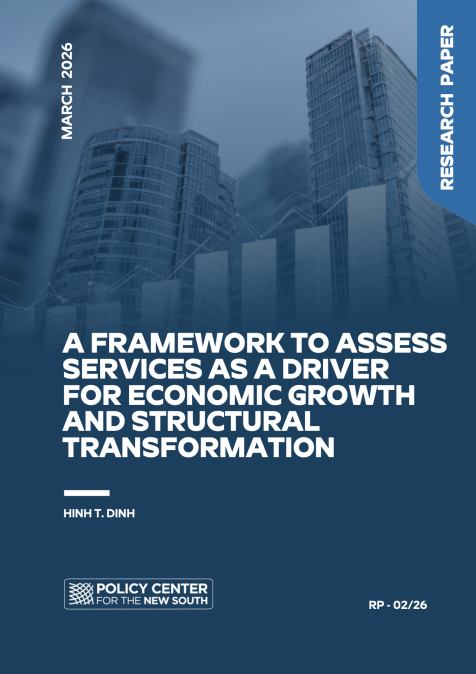
A Framework to Assess Services as a Driver for Economic Growth and Structural Transformation
Authors
March 12, 2026

Historically, manufacturing has served as the primary pathway to economic development, offering strong scale economies, learning-by-doing effects, and the capacity to generate the foreign exchange necessary to import capital goods and technology. However, advances in robotization and artificial intelligence (AI) are fundamentally undermining manufacturing’s traditional role, making it increasingly skill- and capital-intensive while limiting its ability to absorb labor. This technological transformation forces developing countries to consider service-led development strategies, but most services exhibit low productivity, limited tradability, and minimal capacity to generate foreign exchange. 

This paper is the first in a series to develop a methodology to identify and assess which specific services can serve as drivers for growth and structural transformation for the Global South. It proposes an analytical framework that classifies services into three categories: i) Knowledge Services (ICT and professional business services) which exhibit manufacturing-like characteristics such as tradability and foreign exchange generation capacity; ii) Enabling Services (transport, logistics, finance) which facilitate trade but generate limited independent value capture; and iii) Local Services (retail, hospitality, health, education, arts, and personal services) which absorb labor but cannot drive export-led growth. Critically, the paper addresses the education and health sectors separately, recognizing that, while they function as Local Services, they constitute essential foundational investments that enable the development of Knowledge Services. A companion paper applies this framework to assess the performance of the services sector of three North African countries: Egypt, Morocco, and Tunisia. 

To establish a benchmark against which developing countries can be assessed, we apply this framework empirically to EU15 economies over the period 2010–2022 using OECD Trade in Value Added (TiVA), Trade in Employment (TiM), and inter-country input-output tables, measuring performance across sectoral GDP and employment shares, productivity levels, external integration indicators, employment embodied in external demand, Hirschman-Rasmussen backward and forward linkages, and Leontief employment multipliers. The EU15 evidence shows that successful service-led development is not simply about expanding services in aggregate, but about shifting the internal composition of services toward Knowledge Services while maintaining efficient Enabling Services—precisely the pattern absent in countries that participate in GVCs without capturing significant value. 
RELATED CONTENT

  • June 17, 2021
    Africafé reviens ce jeudi 17 juin à 17h30 avec un nouvel épisode. Présenté par Youssef Tobi, spécialiste en relations internationales, Africafé décrypte l'actualité des organisations africaines et du continent avec des experts africains. Dans cet épisode, Youssef El Jai donne une vision...
  • June 11, 2021
    Inequality is nowadays one of the most important issues facing many economies around the world, not only in developing countries but also in advanced and emerging ones. Today, there is a ...
  • June 11, 2021
    For science fiction writers, the universe has no limits. They imagine spacecraft conquering the unknown, the mining of asteroids, access to solar power and room for colonization by earthlings tempted by new frontiers billions of miles and dreams away. Or worlds to conquer barred by radioactive fields, devilish storms, metallic dust, unbearable darkness leading towards black holes and hell in space, and the sun, radiating up to 15 million degrees Celsius, which suggests nothing less ...
  • June 4, 2021
    The Native Indians in Guyana are among the country’s poorest populations. The RE NEW TT project wished to address one of the major problems the country’s Native Indian community is dealing with: the lack of access to energy. RE NEW TT installed a PV solar system at the sole indigenous p...
  • Authors
    Nadia Makara
    June 3, 2021
    In an effort to spur economic growth, industrial parks were created to combine industrial activities with infrastructure, service, and commercial activities. These parks involve a collection of businesses, utilizing a combination of heavy and light manufacturing, that are located in a dedicated zone for industrial use to boost efficiency, minimize operational costs, and maximize output. Though industrial parks can contribute to economic growth and social development in a region, the ...
  • May 31, 2021
    En multipliant par deux son cours durant les trois premiers mois de l'année 2021, puis en le divisant pratiquement par deux, en quelques jours du mois d'avril 2021, le Bitcoin interroge, nous interroge. Ce Policy Brief lui est consacré, rappelant son histoire qui commence en 2009, en en faisant un enfant de la crise financière de 2008. Il insiste, aussi, sur le recours à la cryptographie dont s'inspire le Bitcoin, utilisant ses supports à travers la Blockchain et le Minage pour sécu ...
  • May 27, 2021
    En partenariat avec l’ISCAE Dans le cadre de la pandémie de COVID-19, le dialogue entre citoyens, scientifiques et décideurs politiques et la répartition de leurs rôles au sein de la société ont été un élément déterminant dans les réponses apportées à cette crise. Dans chaque pays, la c...
  • May 20, 2021
    Le Policy Center lance une nouvelle émission. Africafé, le nouveau rendez-vous bimensuel présenté par Youssef Tobi, spécialiste en relations internationales, décryptera l'actualité des organisations africaines et du continent avec des experts africains. Pour ce deuxième épisode, Larabi ...