Publications /
Policy Brief

Back
Food for Trade or Food for National Food Security: A Dilemma for Drylands
Authors
December 10, 2021

Addressing the increasing demands for water, energy, and food requires a coherent methodology to ensure that  societies have access to them and that conflict over them is avoided. For example, agriculture and food production  require water and energy; energy production also requires water and, in some instances, agricultural products.  Water distribution and treatment can be very energy intensive. Therefore, the benefits of approaching the Water- Energy-Food (WEF) nexus in an integrated way are gaining popularity. The public sector, the private sector, civil  society, combined with the geopolitical and socio-economic-climatic environment are all interactors that form a  complex web in the management of these fundamental resources. The MENA region relies heavily on international  trade to ensure national food and nutrition securities and, with world crises and changing global landscapes, this  has  created  a  concern  among  nations  as  to  whether  it  is  sustainable  or  focusing  on  creating  greater  food  self- sufficiency is a better alternative. This policy brief illustrates the use of computer decision support systems (DSS)  to aid in the understanding of the WEF nexus with a particular focus on evaluating food production for trade or  for self-sufficiency
RELATED CONTENT

  • Authors
    Under the Supervision of
    Philippe Chalmin
    July 4, 2016
    Guinea’s bauxite, Moroccan phosphates, Nigerian Bonny Light, Zambian copper, Côte d'Ivoire’s cocoa, Ethiopian coffee or Madagascar’s vanilla: all are examples demonstrating that raw materials have a dimension that is as global as it is local. Global by the markets on which they are traded, local by their quality, a key element of their price, and their macroeconomic impact, particularly for Africa. In line with the 2016 CyclOpe report, which celebrates three decades of existence thi ...
  • Authors
    May 11, 2016
    Does agriculture indeed no longer have any place in national defense strategies? If the European and OECD examples encourage an affirmative answer, the counter-example comes from the United States of America, which considers agriculture and food issues as an integral part of national security. In the US defense doctrine, food security not only concerns the food industry, but it also concerns all areas of security. ...
  • Authors
    April 15, 2016
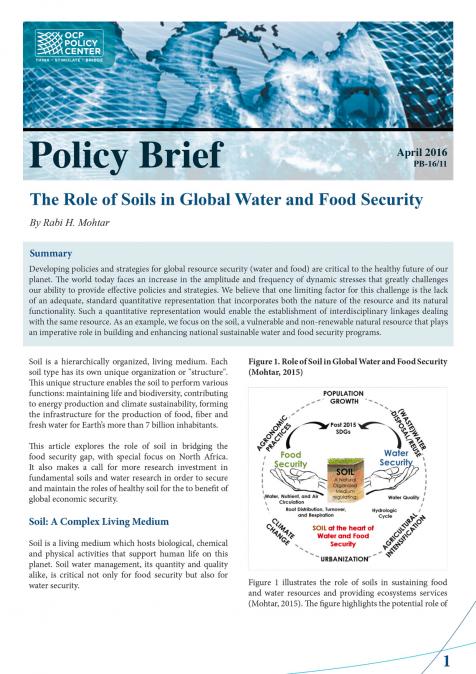
    Developing policies and strategies for global resource security (water and food) are critical to the healthy future of our planet. The world today faces an increase in the amplitude and frequency of dynamic stresses that greatly challenges our ability to provide effective policies and strategies. We believe that one limiting factor for this challenge is the lack of an adequate, standard quantitative representation that incorporates both the nature of the resource and its natural fun ...
  • July 21, 2015
    The 16th Annual Global Development Conference has been dedicated this year to the theme of ‘Agriculture for Sustainable Growth: Challenges and Opportunities for a New ‘Green Revolution’.  One of the sub-themes that has been addressed during this event is related to the design of the optimal agricultural policy supposed to lead towards development, especially in low-income countries. The objective of this blog is to cover the key elements that make an agricultural policy su ...
  • Authors
    Maria Cristina Paciello
    June 23, 2015
    Sustainable agriculture and food security are of particular concern for the countries of the Middle East andNorth Africa (MENA) region, and represent one of the biggest challenges facing the area. As a consequence of the region’s heavy reliance on food imports, the sharp increase in food prices since 2007 and the consequent world food crisis has had severe adverse effects in several countries, causing macro-economic problems (inflation, trade deficits, fiscal pressure), increased po ...
  • Authors
    Ezana Bocresion
    March 16, 2015
    Over the next couple of months, we want to explore the investing climate in Sub Saharan Africa (“SSA”) and try to understand where it is and what elements/variables are required to increase the continent’s attractiveness to institutional investors and thereby speed up the continent’s development. We will discuss the Private Equity industry in Africa and delve into the challenges faces. We will then work through how best to address them, and in particular, in the Agribusiness sector. ...