Publications /
Policy Brief

Back
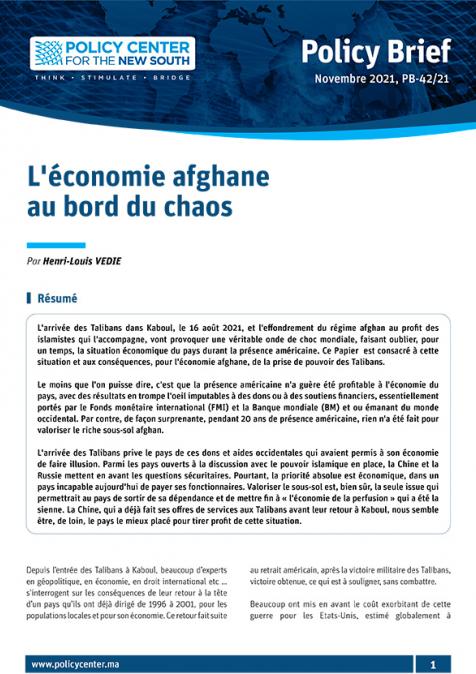
L'économie afghane au bord du chaos
November 8, 2021

 L'arrivée des Talibans dans Kaboul, le 16 août 2021, et l'effondrement du régime afghan au profit des islamistes qui l'accompagne, vont provoquer une véritable onde de choc mondiale, faisant oublier, pour un temps, la situation économique du pays durant la présence américaine. Ce Papier est consacré à cette situation et aux conséquences, pour l'économie afghane, de la prise de pouvoir des Talibans.
Le moins que l'on puisse dire, c'est que la présence américaine n'a guère été profitable à l'économie du pays, avec des résultats en trompe l'oeil imputables à des dons ou à des soutiens financiers, essentiellement portés par le Fonds monétaire international (FMI) et la Banque mondiale (BM) et ou émanant du monde occidental. Par contre, de façon surprenante, pendant 20 ans de présence américaine, rien n'a été fait pour valoriser le riche sous-sol afghan.
L'arrivée des Talibans prive le pays de ces dons et aides occidentales qui avaient permis à son économie de faire illusion. Parmi les pays ouverts à la discussion avec le pouvoir islamique en place, la Chine et la Russie mettent en avant les questions sécuritaires. Pourtant, la priorité absolue est économique, dans un pays incapable aujourd'hui de payer ses fonctionnaires. Valoriser le sous-sol est, bien sûr, la seule issue qui permettrait au pays de sortir de sa dépendance et de mettre fin à « l'économie de la perfusion » qui a été la sienne. La Chine, qui a déjà fait ses offres de services aux Talibans avant leur retour à Kaboul, nous semble être, de loin, le pays le mieux placé pour tirer profit de cette situation.

RELATED CONTENT

  • Authors
    April 20, 2026
    This paper was published as a book chapter in “The Economic Potential of Islamic Countries, Part B: Sustainability, Governance, Energy and Digital Transformation,” released by Emerald Publishing. The COVID-19 pandemic exposed significant deficiencies within social protection systems worldwide, especially in Middle Eastern and North African (MENA) countries. This underscores the urgent need to fortify these social protection schemes to ensure resilience in the face of crises (Sa ...
  • Authors
    April 8, 2026
    This report was originally published on the website of the Middle East Institute ( mei.edu) The following study discusses the role of Lebanon’s gold reserves in the establishment of a currency board and evaluates four policy options: a true currency board, constrained central bank reform, full dollarization, and a unified managed float. Gold reserves are relevant under all four. The conclusion is consistent across them: no monetary framework, however carefully designed and howe ...
  • Authors
    April 1, 2026
    We are now in the fifth week since the U.S. airstrike that killed top leaders of the Iranian regime, initiating a war involving the United States and Israel against the country. More than a month of mutual bombardments between Iran and Israel has ensued, extending to other Persian Gulf nations, U.S. military installations—and even Cyprus. From a global perspective, the impact has stemmed primarily from disruptions to regional production of goods and the blockade of the Strait of Hor ...
  • Authors
    March 13, 2026
    While acknowledging the centrality of security tensions and potential conflict in the Gulf, this essay intentionally sets aside a detailed treatment of military and hard-power dynamics, concentrating instead on the geoeconomic logics of capital, infrastructure, energy, and connectivity, through which Gulf states now articulate power in a fragmented world order.It examines the emergence of a new tripartite or three-pillar power configuration in the Gulf, arguing that Saudi Arabi ...
  • Authors
    Inácio F. Araújo
    Geoffrey J.D. Hewings
    March 6, 2026
    By mapping Iraq’s economic structure in detail, the Multiregional Social Accounting Matrix (MRSAM) sheds light on regional interdependencies and distributional dynamics, offering a critical foundation for evidence-based policy design. Key MessagesIraq is dependent on oil, but this dependence is felt unevenly. In 2013, oil accounted for nearly half of GDP, over 90% of exports, and almost all fiscal revenues, but less than 2% of jobs; benefits from oil were concentrated in Basra ...
  • Authors
    February 13, 2026
    Le 27 janvier 2026, le gouvernement espagnol a adopté par décret royal une mesure de régularisation extraordinaire visant les personnes en situation administrative irrégulière ou engagées dans une procédure de protection internationale. Le choix du décret royal permet une mise en œuvre rapide de la mesure, sans passage par un débat parlementaire, dans un contexte politique fortement polarisé sur les questions migratoires.La régularisation concerne les personnes pouvant justifier d’u ...
  • Authors
    January 23, 2026
    Introduction: COP30 as a Test of Reality, Not AmbitionCOP30 in Belém was never going to be a breakthrough. In a world marked by fiscal exhaustion, geopolitical rivalry, and eroding trust in multilateralism, expecting transformational climate cooperation bordered on denial. The choice of the Amazon as host carried symbolic weight, but symbolism does not override power, interests, or institutional capacity.The outcome of COP30 confirms a deeper truth: the global climate regime has ent ...
  • Authors
    September 2, 2025
    This paper argues that the Middle East has become the crucible of twenty-first-century imperial politics, exposing the collapse of legal universality and the resurgence of coercive empire. Through the archetypes of Hammurabi and Nebuchadnezzar, it analyzes how states invoke law rhetorically while practicing domination through siege, spectacle, and exclusion.The United States, China, Türkiye, Israel, Iran, the European Union, and the Gulf monarchies all oscillate between Hammurabian ...
  • Authors
    Zakaria Elouaourti
    August 7, 2025
    This paper was originally published on tandfonline.comYouth’s life paths have become increasingly challenging, especially for those classified as ‘Not in Education, Employment, or Training’ (NEET), who comprise 31.2% of North Africa’s youth population. This paper contributes to the growing discourse on the NEET phenomenon by exploring its structural and psychosocial dimensions in North Africa, with a specific focus on gender. Using a rich micro-level dataset of 7,815 individuals age ...