Publications /
Policy Paper

Back
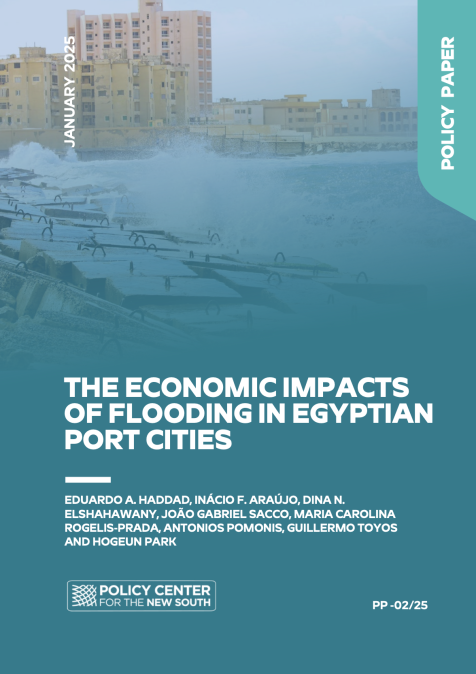
The Economic Impacts of Flooding in Egyptian Port Cities
Authors
Inácio F. Araújo
Dina N. Elshahawany
João Gabriel Sacco
Maria Carolina Rogelis-Prada
Antonios Pomonis
Guillermo Toyos
Hogeun Park
January 22, 2025

This study evaluates the economic costs for three Egyptian coastal cities of catastrophic flooding resulting from either sea-level rise or intense rainfall. Using a computable general equilibrium (CGE) framework, we assess the higher-order impacts of physical capital loss on both regional and national economies. Leveraging global flood hazard maps for various scenarios and return periods, and a 100-meter-resolution buildings-exposure model, which estimates the replacement value of residential and non-residential buildings at each floor level, we estimate the share of physical capital at risk. Our analysis covers Egypt’s main port cities on the Mediterranean Sea (Alexandria, Damietta, and Port Said), taking into account seven scenarios and three intensities of destruction. Results indicate significant variability in economic impacts, with coastal flooding due to sea-level rise posing a more substantial threat to Port Said and Damietta, whereas pluvial flooding from intense rainfall would more heavily impact Alexandria. The findings underscore the need for targeted investments in climate resilience, particularly for coastal infrastructure, to mitigate future economic losses.


RELATED CONTENT

  • December 15, 2018
    Moderator Richard Lui, Anchor, MSNBC / NBC News Speakers Laura Albornoz, Senior Fellow at the Adrienne Arsht Latin America Center, Former Minister of Women's Affairs, Chile Geraldo Alckmin, Governor of São Paulo, Brazil Alfredo G. A. Valladão, Professor at Sciences PO Paris, Senior Fell...
  • December 15, 2018
    Moderator Richard Lui, Anchor, MSNBC / NBC News Speakers Laura Albornoz, Senior Fellow at the Adrienne Arsht Latin America Center, Former Minister of Women's Affairs, Chile Geraldo Alckmin, Governor of São Paulo, Brazil Alfredo G. A. Valladão, Professor at Sciences PO Paris, Senior Fell...
  • December 15, 2018
    Moderator UDUAK AMIMO, CONSULTANT, UDUAK AMIMO CONSULTING (KENYA) Speakers André Caillé, Board Member, Junex R. Andreas Kraemer, Founder & Chairman, Ecologic Institute Josefa Sacko, Commissioner, Rural Economy and Agriculture, African Union Commission Teburoro Tito, Extraordinary an...
  • December 15, 2018
    Moderator UDUAK AMIMO, CONSULTANT, UDUAK AMIMO CONSULTING (KENYA) Speakers André Caillé, Board Member, Junex R. Andreas Kraemer, Founder & Chairman, Ecologic Institute Josefa Sacko, Commissioner, Rural Economy and Agriculture, African Union Commission Teburoro Tito, Extraordinary an...
  • December 13, 2018
    Moderator John Yearwood, Executive Board, International Press Institute Speakers Uri Dadush, Senior Fellow, Policy Center for the New South Anabel Gonzalez, Former Minister of Foreign Trade, Republic of Costa Rica Ricardo Meléndez-Ortiz, Founder and Chief Executive, International Centre...
  • December 13, 2018
    Moderator John Yearwood, Executive Board, International Press Institute Speakers Uri Dadush, Senior Fellow, Policy Center for the New South Anabel Gonzalez, Former Minister of Foreign Trade, Republic of Costa Rica Ricardo Meléndez-Ortiz, Founder and Chief Executive, International Centre...
  • Authors
    December 6, 2018
    This Policy Paper aims to provide a better understanding of the drivers of youth unemployment in the Middle East and North Africa (MENA) region by examining some common factors and then delving deeper into the case of Morocco, a relatively stable country that has historically been a source of large emigration, especially towards Europe. The MENA region has some of the highest total and youth unemployment rates in the world. High youth unemployment is especially worrisome because it ...