Publications /
Policy Paper

Back
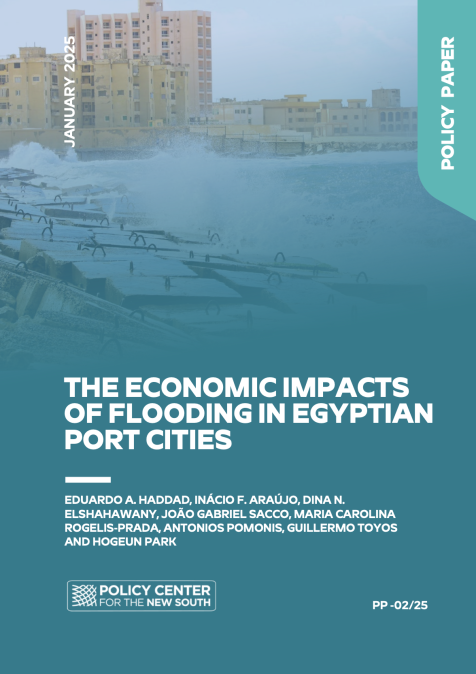
The Economic Impacts of Flooding in Egyptian Port Cities
Authors
Inácio F. Araújo
Dina N. Elshahawany
João Gabriel Sacco
Maria Carolina Rogelis-Prada
Antonios Pomonis
Guillermo Toyos
Hogeun Park
January 22, 2025

This study evaluates the economic costs for three Egyptian coastal cities of catastrophic flooding resulting from either sea-level rise or intense rainfall. Using a computable general equilibrium (CGE) framework, we assess the higher-order impacts of physical capital loss on both regional and national economies. Leveraging global flood hazard maps for various scenarios and return periods, and a 100-meter-resolution buildings-exposure model, which estimates the replacement value of residential and non-residential buildings at each floor level, we estimate the share of physical capital at risk. Our analysis covers Egypt’s main port cities on the Mediterranean Sea (Alexandria, Damietta, and Port Said), taking into account seven scenarios and three intensities of destruction. Results indicate significant variability in economic impacts, with coastal flooding due to sea-level rise posing a more substantial threat to Port Said and Damietta, whereas pluvial flooding from intense rainfall would more heavily impact Alexandria. The findings underscore the need for targeted investments in climate resilience, particularly for coastal infrastructure, to mitigate future economic losses.

RELATED CONTENT

  • December 17, 2019
    Across Africa, many rural communities still depend on manual and animal power for their farm needs, whether it is for production, harvesting or postharvest activities. In fact, in sub-Saharan Africa, engine power represents a meagre 10 per cent of all energy used on farms, compared to 50 per cent in developing regions. Without access to mechanised tools and technologies, farming is a tough, laborious and time-consuming process. Farmers are often left with small harvests, low income ...
  • December 17, 2019
    L’Inde est confrontée, aujourd’hui, à plusieurs défis énergétiques : - Assurer la sécurité énergétique du pays, en généralisant l’accès pour tous à l’électricité. Ce qui n’est pas le cas en 2019. - Le faire en réduisant sa dépendance aux énergies fossiles, afin de mieux répondre aux orientations des Conférences des parties, COP 21 et COP 22. Pour cela, les autorités gouvernementales vont mener, dès 1981, une réflexion sur les énergies renouvelables, les conduisant à privilégier l ...
  • December 14, 2019
    Moderator Alan Kasujja, Lead Presenter, Newsday, BBC News Speakers Rym Ayadi, Founder and Scientific Director, Euro-Mediterranean Network for Economic Studies – EMNES Otaviano Canuto, Senior Fellow, Policy Center for the New South Harinder Kohli, Founding Director and Chief Executive, E...
  • December 14, 2019
    Moderator Alan Kasujja, Lead Presenter, Newsday, BBC News Speakers Rym Ayadi, Founder and Scientific Director, Euro-Mediterranean Network for Economic Studies – EMNES Otaviano Canuto, Senior Fellow, Policy Center for the New South Harinder Kohli, Founding Director and Chief Executive, E...
  • December 14, 2019
    Moderator John Yearwood, President and CEO, Yearwood Media Group Speakers Uri Dadush, Senior Fellow, Policy Center for the New South Matthias Fekl, Former Minister for Foreign Trade, France Renato Flôres, Director, International Intelligence Unit, Fundação Getulio Vargas ...
  • December 14, 2019
    Moderator Alan Kasujja, Lead Presenter, Newsday, BBC News Speakers Rym Ayadi, Founder and Scientific Director, Euro-Mediterranean Network for Economic Studies – EMNES Otaviano Canuto, Senior Fellow, Policy Center for the New South Harinder Kohli, Founding Director and Chief Executive, E...
  • December 14, 2019
    Moderator John Yearwood, President and CEO, Yearwood Media Group Speakers Uri Dadush, Senior Fellow, Policy Center for the New South Matthias Fekl, Former Minister for Foreign Trade, France Renato Flôres, Director, International Intelligence Unit, Fundação Getulio Vargas ...
  • Authors
    December 11, 2019
    The Atlantic Current’s 6th edition provides overview, fresh insights, latest data, and broader analysis on the Atlantic space’s current challenges, as well as their implications for the South. Different chapters explore emerging trends and critical issues, such as the World Trade Organization reform, Brexit and the future of EU, the expansion of militancy in the Sahel and Coastal Africa, the role of cultural diplomacy and the deepening of Sino-African relations within a shifting an ...