Publications /
Policy Paper

Back
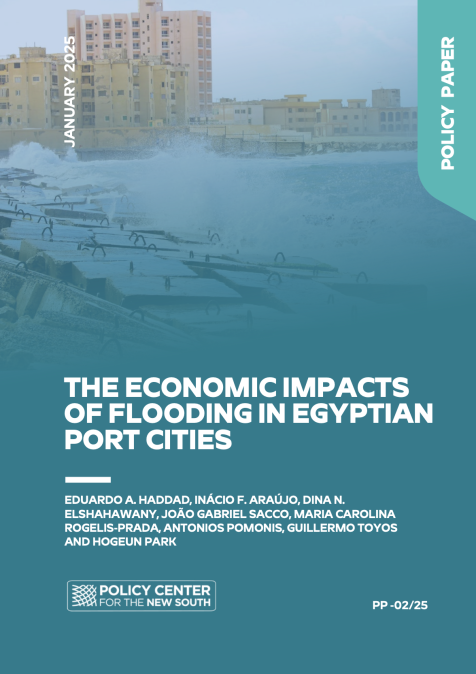
The Economic Impacts of Flooding in Egyptian Port Cities
Authors
Inácio F. Araújo
Dina N. Elshahawany
João Gabriel Sacco
Maria Carolina Rogelis-Prada
Antonios Pomonis
Guillermo Toyos
Hogeun Park
January 22, 2025

This study evaluates the economic costs for three Egyptian coastal cities of catastrophic flooding resulting from either sea-level rise or intense rainfall. Using a computable general equilibrium (CGE) framework, we assess the higher-order impacts of physical capital loss on both regional and national economies. Leveraging global flood hazard maps for various scenarios and return periods, and a 100-meter-resolution buildings-exposure model, which estimates the replacement value of residential and non-residential buildings at each floor level, we estimate the share of physical capital at risk. Our analysis covers Egypt’s main port cities on the Mediterranean Sea (Alexandria, Damietta, and Port Said), taking into account seven scenarios and three intensities of destruction. Results indicate significant variability in economic impacts, with coastal flooding due to sea-level rise posing a more substantial threat to Port Said and Damietta, whereas pluvial flooding from intense rainfall would more heavily impact Alexandria. The findings underscore the need for targeted investments in climate resilience, particularly for coastal infrastructure, to mitigate future economic losses.

RELATED CONTENT

  • Authors
    February 13, 2026
    Le 27 janvier 2026, le gouvernement espagnol a adopté par décret royal une mesure de régularisation extraordinaire visant les personnes en situation administrative irrégulière ou engagées dans une procédure de protection internationale. Le choix du décret royal permet une mise en œuvre rapide de la mesure, sans passage par un débat parlementaire, dans un contexte politique fortement polarisé sur les questions migratoires.La régularisation concerne les personnes pouvant justifier d’u ...
  • Authors
    Sofia Formigli
    February 13, 2026
    There is a story told by Václav Havel, the Czech dissident writer who later became president after the fall of communism. In his essay The Power of the Powerless, Havel describes a shopkeeper who, every morning, places a sign in his window reading: “Workers of the world, unite!” He does not believe in it. Nor do the people around him. Yet the sign remains. ...
  • Authors
    February 13, 2026
    On January 27, 2026, the Spanish government adopted a Royal Decree for the extraordinary regularization of persons in an irregular administrative situation or involved in an international protection procedure. The choice of a royal decree allows for the rapid implementation of the measure, without the need for parliamentary debate, in a political context that is highly polarized on migration issues.Regularization applies to people who can prove their presence on Spanish territory be ...
  • Authors
    February 12, 2026
    Divergent regulatory regimes for data, driven by different motivations, ranging from privacy protection in the European Union to information control in China, could eventually produce distinctively different, and possibly contradictory, bodies of data. Artificial-intelligence models trained on those datasets could produce differing and possibly even conflicting outputs. To the extent that AI outputs start to shape human perception and to influence decisions, in governments and ...
  • Authors
    February 11, 2026
    The U.S.–China technological rivalry has become a central axis of global economic and geopolitical competition. While the United States continues to lead in frontier innovation—most notably in advanced semiconductors and artificial intelligence (AI)—China has consolidated strengths in large-scale implementation, manufacturing capacity, and control over critical segments of global supply chains. These advantages are especially visible in clean energy technologies and in the processin ...