Publications /
Policy Brief

Back
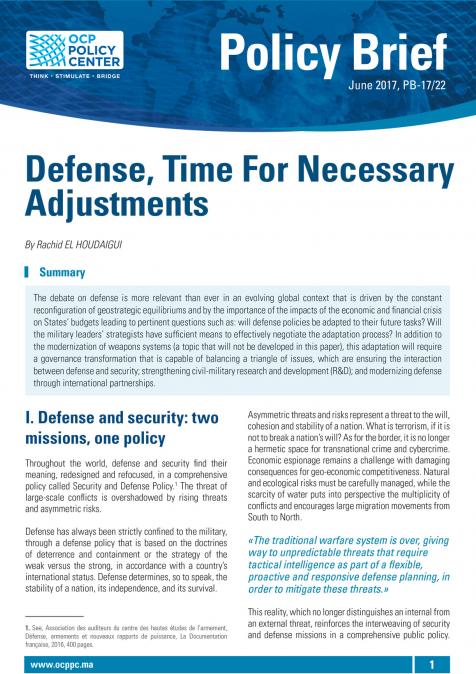
Defense, Time For Necessary Adjustments
June 14, 2017

The debate on defense is more relevant than ever in an evolving global context that is driven by the constant reconfiguration of geostrategic equilibriums and by the importance of the impacts of the economic and financial crisis on States’ budgets leading to pertinent questions such as: will defense policies be adapted to their future tasks? Will the military leaders’ strategists have sufficient means to effectively negotiate the adaptation process? In addition to the modernization of weapons systems (a topic that will not be developed in this paper), this adaptation will require a governance transformation that is capable of balancing a triangle of issues, which are ensuring the interaction between defense and security; strengthening civil-military research and development (R&D); and modernizing defense through international partnerships.
RELATED CONTENT

  • Authors
    April 1, 2026
    We are now in the fifth week since the U.S. airstrike that killed top leaders of the Iranian regime, initiating a war involving the United States and Israel against the country. More than a month of mutual bombardments between Iran and Israel has ensued, extending to other Persian Gulf nations, U.S. military installations—and even Cyprus. From a global perspective, the impact has stemmed primarily from disruptions to regional production of goods and the blockade of the Strait of Hor ...
  • March 27, 2026
    This interview analyzes how tariff wars are transforming global power dynamics, disrupting trade systems, and redefining trade policy as a geopolitical tool, while examining the risks and opportunities for emerging economies and the Global South, the repositioning of regions like Latin ...
  • February 27, 2026
    Technological and industrial capabilities have become core instruments of state power, reshaping military strategies, economic competition, and global influence. The rapid rise of AI, cyber warfare, autonomous systems, and advanced manufacturing is redefining how states project power an...
  • Authors
    February 12, 2026
    Divergent regulatory regimes for data, driven by different motivations, ranging from privacy protection in the European Union to information control in China, could eventually produce distinctively different, and possibly contradictory, bodies of data. Artificial-intelligence models trained on those datasets could produce differing and possibly even conflicting outputs. To the extent that AI outputs start to shape human perception and to influence decisions, in governments and ...
  • Authors
    February 3, 2026
    From the use of tariffs as a foreign policy instrument, to the weaponization of critical resources, and from targeted sanctions to attacks on critical infrastructure, economic security is at the forefront of international debates. The aggressive use of economic instruments for strategic purposes has become an explicit feature of international affairs, in a way not seen since the interwar period[1]. Beyond the weaponization of resources of all kinds, an increasing ‘monetization’ is u ...
  • January 30, 2026
    En 2019, Donald Trump a proposé d’acheter le Groenland, déclenchant un refus catégorique du Danemark et une tension diplomatique transatlantique. Cette initiative reflétait l’intérêt stratégique et économique des États-Unis pour l’Arctique et ses ressources. L’épisode a mis en lumière l...
  • January 29, 2026
    Le Mali, le Burkina Faso et le Niger, réunis au sein de l’Alliance des États du Sahel (AES), affirment l’ambition de bâtir une souveraineté nationale qui leur permettrait de s’émanciper de la domination et des influences extérieures et de se doter d’une liberté d’action dans les choix de développement politique et économique. Cependant, cette ambition se heurte à de nombreuses contraintes économiques et sécuritaires.La souveraineté ne peut se construire sans une base économique soli ...