Publications /
Policy Paper

Back
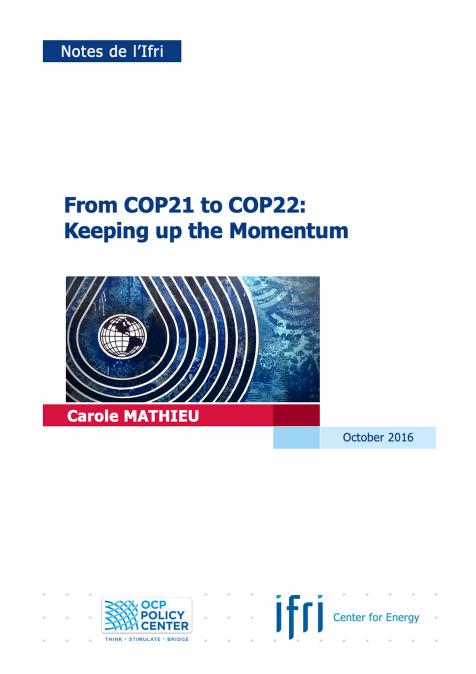
From COP21 to COP22: Keeping up the Momentum
Authors
Carole Mathieu
October 12, 2016

In December 2015, a new international climate agreement was adopted, paving the way for increased mitigation and adaptation efforts. Governments firmly expressed the need for rapid action and 2016 will put the credibility of their commitments to the test. Climate policies are actually becoming more widespread, but they are also adjusting to local constraints and needs, suggesting that the establishment of a global emission regulation model is unlikely in the near future. While the low-carbon transition is well under way, its pace and conditions still appear too uncertain to fully convince economic decision-makers of the value of carbon-free options. COP22, which will take place in Marrakesh in November 2016, will be an opportunity to leave these hesitations behind by strengthening mutual oversight, by consolidating the principle of climate justice, and by furthering the discussion about the best ways to orchestrate the transition to carbon neutrality.

RELATED CONTENT

  • October 22, 2026
    تتناول هذه الحلقة من «حديث الثلاثاء» تأثير تقلبات أسعار النفط والغاز في الأسواق العالمية على الاقتصاد المغربي، وانعكاساتها على القدرة الشرائية للأسر وتنافسية المقاولات. ونناقش مع ضيفنا السيد أمين سامي كيف تنتقل هذه التقلبات إلى أسعار السلع والخدمات، ولماذا لا تنخفض الأسعار دائمًا مع ترا...
  • October 22, 2026
    Strategic hedging is rational when it preserves a worthwhile choice at a tolerable cost while respecting existing commitments. Drawing on the literature on hedging and Latin American autonomy, this Policy Brief examines contrasting illustrations of that proposition. It distinguishes ambiguity about future alignment from uncertainty about existing obligations and explains how clearly bounded commitments can reconcile autonomy with credibility. The cases reveal different vulnerabiliti ...
  • October 09, 2026
    Can Nigeria’s Dangote refinery help strengthen Africa’s energy security amid disruptions to global supply routes? This discussion considers how expanding local refining capacity can reduc ...
  • Authors
    September 23, 2026
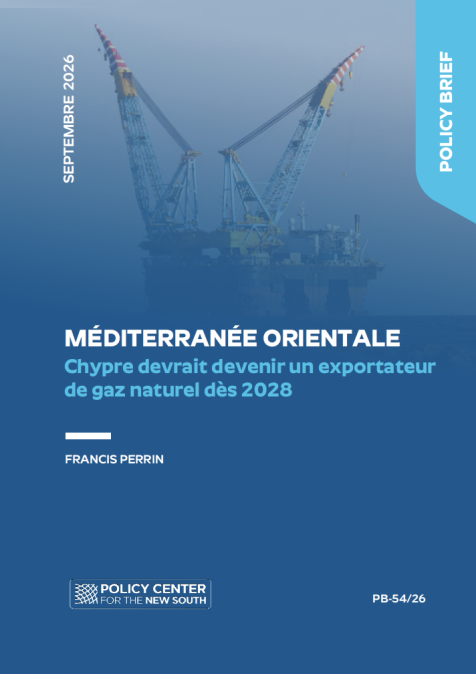
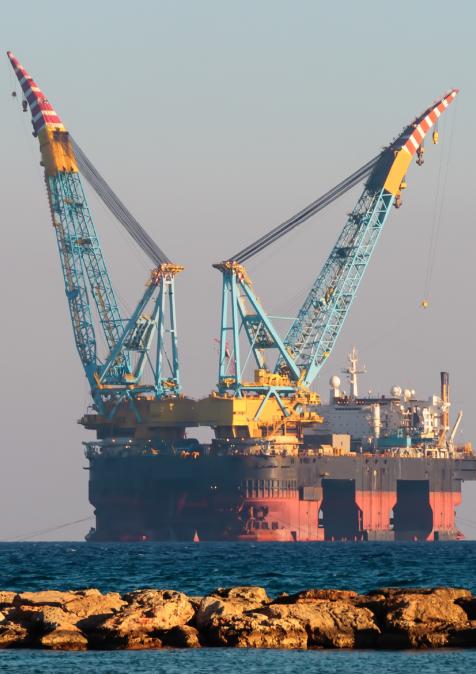
    Depuis 2010, environ, on sait que la Méditerranée orientale est une nouvelle province gazière. Des ressources gazières ont en effet été découvertes au large de quatre pays ou territoires, l’Égypte, Israël, Chypre et Gaza. Deux d’entre eux sont devenus producteurs et exportateurs de gaz naturel, l’Égypte et Israël. Au large de Gaza, le champ gazier de Gaza Marine n’a jamais été développé et il est très peu probable qu’il le soit prochainement en raison des très fortes tensions entre ...
  • Authors
    September 23, 2026
    Since around 2010, it has been known that the Eastern Mediterranean is a new gas province. Gas resources have indeed been discovered offshore four countries or territories: Egypt, Israel, Cyprus and Gaza. Two of them have become producers and exporters of natural gas, Egypt and Israel. Off the coast of Gaza, the Gaza Marine gas field has never been developed, and it is highly unlikely to be developed anytime soon given the very high tensions between the State of Israel and Hamas. By ...
  • Authors
    Pedro Henrique de Christo
    Travis Knoll
    September 18, 2026
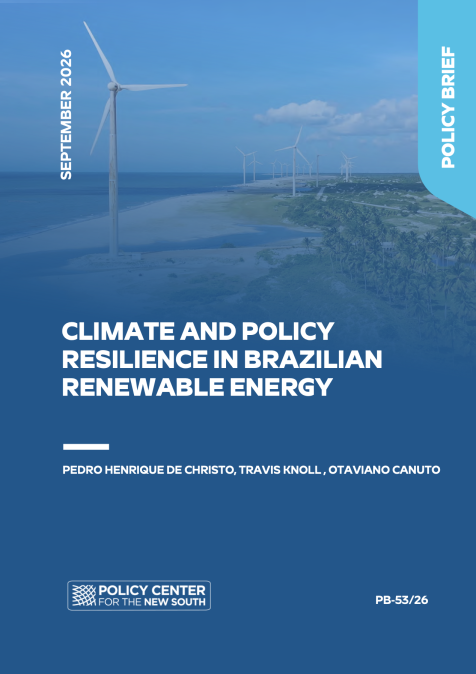
    The Brazilian context involving a clean-electricity base, a more balanced lobbying landscape, and mounting climate and social pressure, makes it more difficult for the kind of abrupt and unrestrained energy policy swing seen in Colombia. The trend in Brazil tends to be more economically viable for renewables. However, these structural conditions by themselves will not guarantee the success of the transition. Fruition will depend on whether policymakers use this window to prepare for ...
  • Authors
    September 8, 2026
    It is a biblical scene: the massive Philistine warrior Goliath, standing nine feet tall and heavily armed, faces the young shepherd David, who brings down the giant against all odds, overcoming fear and demonstrating courage in the face of brute size and raw power. This metaphor resonates with a reality unfolding in America today: high tech versus the people. ...
  • Authors
    August 13, 2026
    The renewed instability in the Middle East has exposed Africa's continued vulnerability to external energy shocks. Shipping disruptions through the Strait of Hormuz, the maritime chokepoint through which roughly one-fifth of global oil and LNG supplies transit, have once again demonstrated that African fuel security remains highly dependent on geopolitical developments beyond the continent. While many African economies have traditionally relied on refined petroleum imports from Gulf ...
  • Authors
    August 12, 2026
    La géographie mondiale des hydrocarbures n'est évidemment pas figée. De nouveaux producteurs de pétrole et/ou de gaz naturel apparaissent suite à des découvertes, le plus souvent réalisées par des compagnies pétrolières internationales. On pense notamment au Mozambique, qui produit et exporte du gaz naturel liquéfié (GNL) depuis la fin 2022, au Sénégal, qui est un producteur de pétrole offshore depuis la mi-2024, et au Sénégal et à la Mauritanie, qui sont devenus conjointement expor ...
  • Authors
    August 7, 2026
    THE END OF AN ERAThe US-Israeli war on Iran, a 'little excursion' envisaged to be over within a matter of weeks, has entered its fourth month. Shock waves ripple across the globe. This war is just one in a series of recent crises which have fractured the international community, making the decades of the 2020's among the most disruptive in recent history. Each crisis compounds the deleterious effects of those which came before. The war in Iran is no exception. It abruptly stalled ec ...