Publications /
Policy Paper

Back
The Belt and Road turns five
Authors
Michael Baltensperger
January 13, 2019

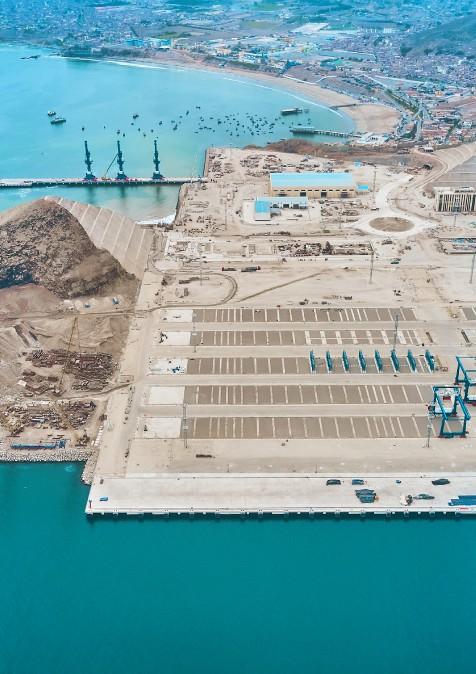
China’s Belt and Road Initiative (BRI) is an international trade and development strategy. Launched in 2013, it is one of the ways China asserts its role in world affairs and captures the opportunities of globalisation. The BRI has the potential to enhance development prospects across the world and in China, but that potential might not be realised because the BRI’s objectives are too broad and ill-defined, and its execution is too often non-transparent, lacking in due diligence and uncoordinated.

Originally published by Bruegel, the Belgium-based think-tank and partner of Policy Center for the New South, this Policy Contribution offers a reflection by Michael Baltensperger and Uri Dadush on China’s Belt and Road Initiative, five years after its launch. 

RELATED CONTENT

  • July 10, 2026
    For much of the post-war period, the Global South was framed as an object of history, defined by dependency, constrained by structural asymmetries, and confined to the margins of global decision-making. That narrative, once empirically grounded, is now no longer adequate. A profound yet uneven transformation is underway. The Global South is no longer only reacting; it is increasingly shaping rules, institutions, and narratives.This Policy Brief argues that the Global South is thus t ...
  • Authors
    Diogo Ramos Coelho
    Bruno Saraiva
    June 22, 2026
    Global imbalances are back—and this time the risks look different. The 2008 financial crisis showed how persistent current-account deficits and surpluses between major economies can fuel financial instability and trigger sudden, severe reversals of capital flows. After almost two decades, many thought that episode had been resolved. It had not. New imbalances have built up, with a familiar cast: China, Germany, Japan, and oil exporters running large surpluses, and the United States ...
  • Authors
    February 12, 2026
    Divergent regulatory regimes for data, driven by different motivations, ranging from privacy protection in the European Union to information control in China, could eventually produce distinctively different, and possibly contradictory, bodies of data. Artificial-intelligence models trained on those datasets could produce differing and possibly even conflicting outputs. To the extent that AI outputs start to shape human perception and to influence decisions, in governments and ...
  • Authors
    February 11, 2026
    The U.S.–China technological rivalry has become a central axis of global economic and geopolitical competition. While the United States continues to lead in frontier innovation—most notably in advanced semiconductors and artificial intelligence (AI)—China has consolidated strengths in large-scale implementation, manufacturing capacity, and control over critical segments of global supply chains. These advantages are especially visible in clean energy technologies and in the processin ...
  • November 18, 2025
    The meeting between Donald Trump and Xi Jinping in Busan, South Korea, was more than an exercise in diplomacy. It was an emblematic performance of a world in transformation. Behind the formalities, the cameras, and the studied smiles lay an unspoken recognition: the world is no longer unipolar. The era of American supremacy, sustained for decades through its economic reach, military presence, and ideological projection, is giving way to a more diffuse, multipolar reality. ...
  • July 9, 2025
    Developing countries have few options to deal with the ongoing tariff war amid unpredictable shifts in global supply chains. However, regional economic integration offers a strategic path of development in these uncertain and challenging times. Helped by geographical proximity and cultural familiarity, countries in a region can benefit greatly from promoting trade with one another, reaping the benefits of comparative advantages and economies of scale—if they are able to establish a ...
  • July 8, 2025
    حلقة اليوم من برنامج حديث الثلاثاء تناقش اتفاقية التبادل الحر بين المغرب وتركيا، التي وُقعت عام 2004 ودخلت حيز التنفيذ سنة 2006 بهدف تعزيز التجارة الثنائية. رغم ارتفاع حجم المبادلات، سجل الميزان التجاري عجزاً متزايداً لصالح تركيا تجاوز 3 مليارات دولار سنة 2024، رغم تعديل الاتفاقية سنة 2...
  • April 29, 2025
    At the recent World Bank and IMF Spring Meetings, heightened attention focused on the IMF’s downgraded global economic forecasts. Global growth is now projected at 2.8% for 2025 and 3% for 2026, down from 3.3% in 2024, largely due to rising trade barriers initiated by Mr. Trump’s second...