Publications /
Policy Brief
The Atlantic Basin is a very important area for the international hydrocarbon industry (oil and natural gas). It is significant in terms of oil and gas reserves, production, and exports. Moreover, its potential is far from being fully exploited, which means it will continue to play a major role in this sector for many years. The countries of the Americas within the Atlantic Basin pose a serious problem for the OPEC+ countries, a coalition of 22 oil-exporting states, which have reduced their crude production several times over the past two years to support oil prices.
The Atlantic Basin is a major region in many respects, including for the international oil and gas industry. Numerous leading oil companies have been active there for decades, and the area's prospects for this strategic sector remain very good in the short, medium and even long term. In this Policy Brief, we will focus on oil and natural gas production in the countries of the Americas, Africa and Europe surrounding the Atlantic Ocean (1).
The Atlantic Basin includes many hydrocarbon-producing countries, including several major producers. Some of them are in a position to increase their production. There are also new producers (by new producer, we mean a country that has been producing oil and/or gas for no more than five years, i.e. since the end of 2019) and exporters. It also includes countries that are on the verge of becoming hydrocarbon producers/exporters or will do so in the coming years, up to 2030, the time horizon used in this Policy Brief.
Atlantic Basin: a large number of hydrocarbon producers and exporters
As of late 2024, there are just over fifteen hydrocarbon-producing countries (2) around the Atlantic Basin. The vast majority of these are African and American countries (North and South America, but not Central America). Examples include Nigeria, Angola, Gabon, Ghana and Senegal in Africa, the United States, Canada and Mexico in North America, and Venezuela, Brazil and Argentina in South America (non-exhaustive list). Europe, an area generally poor in hydrocarbons, is only marginally represented.
The Atlantic Basin is therefore an important area for hydrocarbons given the number of producing countries. This is one reason for its importance, but far from the only one. Among these producers, several are very large producers of oil and gas.
Atlantic Basin: several large hydrocarbon producers
The leader is, of course, the United States, which is the world's leading oil producer (3). In the second quarter of 2024, U.S. oil production reached 20.3 million barrels per day (Mb/d), almost a quarter of global production, which is expected to reach 103 to 104 Mb/d in 2024 (annual average). As highlighted in a previous Policy Brief published by the Policy Center for the New South (3), never before had the United States reached such a level (4), and never before had any other country in the world produced so much. Moreover, it is certain that no other country will be able to catch up with the United States in the years leading up to 2030.
Canada is the Atlantic Basin’s second-largest oil producer, well behind the United States, with output of 5.83 Mb/d in the second quarter of 2024 (see note 4 for source). Canada is also the world's fourth-largest oil producer, after the United States, Russia and Saudi Arabia. In the Atlantic Basin, Brazil ranks third with 3.39 Mb/d, ahead of Mexico (2 Mb/d). The top four places therefore go to countries on the American continent, including the three North American countries. Nigeria and Angola rank fifth and sixth, with production of 1.28 Mb/d and 1.16 Mb/d, respectively. The next places are again occupied by countries in the Americas: Venezuela (0.88 Mb/d), Argentina (0.80 Mb/d), and Guyana (0.62 Mb/d).
The United States is also the leading natural gas producer in the Atlantic Basin and worldwide, with output of 1,035 billion cubic meters in 2023 (5). It is far ahead of Canada (190 billion cubic meters). Among other major producers are Nigeria (43.7 billion cubic meters), Argentina, Mexico, Venezuela, and Brazil. Once again, countries in the Americas dominate the ranking.
Some of these countries are increasing their oil production
The Atlantic Basin has many producers, including several major ones, as well as countries with the capacity to increase production. Around the world, production in many oil-producing countries is stagnating or declining. In the area covered by this Policy Brief, this is not the case for all countries. The United States, Canada, Brazil, Guyana, Argentina and Côte d'Ivoire are all experiencing growth in oil production. Once again, the American countries of the Atlantic Basin are very well represented. Venezuela could produce much more if it were not for the collapse of its economy over the last few years. Although it controls the world's largest proven oil reserves, ahead even of Saudi Arabia, its production has fallen considerably since the end of the previous century.
In terms of natural gas, Nigeria (via Nigeria LNG) and the Republic of Congo (via Eni) will soon be increasing their production and exports of liquefied natural gas (LNG). Thanks to the offshore discoveries of Baleine (in production) and Calao (not yet developed) by the Italian group Eni, Côte d'Ivoire will be producing more oil and gas by the end of 2024 (Baleine Phase 2), and a much larger increase is expected in a few years' time (Baleine Phase 3). Morocco, currently a very small gas producer, is expected to bring the offshore Anchois field on stream in the next few years. The consortium, comprising Energean, Chariot and the National Office of Hydrocarbons and Mines (ONHYM), has not yet taken a decision on the development of this field, located in the Lixus Offshore block.
Two new oil producers
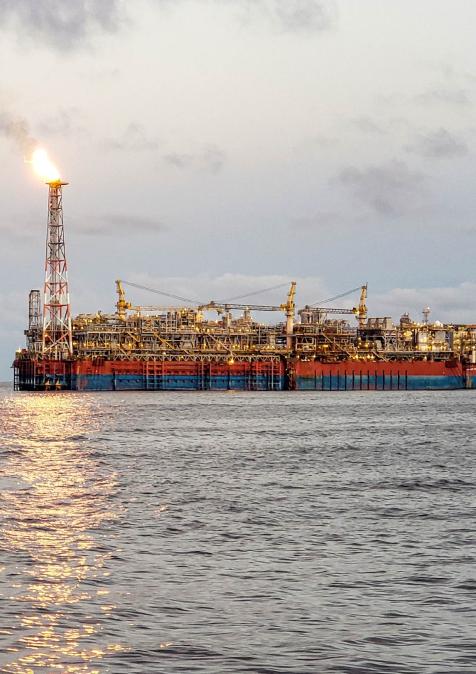
In the last five years, since the end of 2019, two Atlantic Basin countries have joined the select club of oil producers and exporters. Guyana has been an oil producer since December 2019, and Senegal since June 2024. The first of these two countries currently produces over 600,000 b/d, and production will continue to rise until the end of 2027. The increase will be considerable, with Guyana set to produce 1.3 Mb/d in just three years' time. Senegal, the world's newest oil producer, produces 100,000 b/d. In both cases, the crude comes from offshore deposits under the Atlantic Ocean. The fields are operated by foreign companies: ExxonMobil (United States) for Guyana and Woodside Energy (Australia) for Senegal.
Future producers and exporters of oil or natural gas
Some Atlantic Basin countries are on the verge of becoming hydrocarbon producers or exporters, or will do so in the next few years. Here, “the next few years” refers to the period up to 2030. For oil, these countries include Suriname, in northern South America, and Namibia, in southern Africa. There is no doubt about this prospect, as significant oil reserves have been discovered and are being or will be developed by the oil operators concerned. In Suriname, for example, the French group TotalEnergies launched an oil development project in September 2024, which should enable the country to produce 200,000 b/d from 2028 onwards. The investment cost of this project is estimated at $9 billion. In Namibia, three oil operators - Shell, TotalEnergies and Galp (Portugal) - have made very significant discoveries in three separate exploration license areas, so it is certain that Namibia will be a major oil producer in the future, even if it is too early to give precise figures. In both cases, production will be offshore from fields under the Atlantic.
For natural gas, the future producers are Senegal and Mauritania in 2025 and, perhaps, Namibia and South Africa towards the end of this decade. Next year, for the first time in their history, Senegal and Mauritania will begin exporting liquefied natural gas (LNG) as part of a major joint project called Greater Tortue Ahmeyim (GTA). The project is offshore and operated by BP. The British company’s partners are Kosmos Energy (United States), Petrosen (Senegal's national oil company) and Société Mauritanienne des Hydrocarbures (SMH), Mauritania’s national hydrocarbons company. TotalEnergies has discovered gas off South Africa’s southern coast, but the French group has withdrawn from the project and it is unclear whether these gas resources can be commercially developed and, if so, by whom, when and how. Oil and gas have been discovered off the coast of Namibia, but while it is certain that oil production will begin in the next few years, the same is not necessarily true of the gas.
OPEC+ dilemma
Comprising 22 oil-exporting countries, including the 12 members of OPEC (Organization of the Petroleum Exporting Countries), OPEC+ is facing a serious problem. To support crude oil prices, this alliance has decided on several occasions since autumn 2022 to cut production in order to reduce global oil supply and boost prices. However, despite this policy being applied by 19 of the 22 countries concerned (Iran, Libya, and Venezuela are not obliged to reduce their production), the war in Ukraine, the war in Gaza, tensions between Israel and the Islamic Republic of Iran, and the situation in Syria, Brent (North Sea) oil was barely above $74 per barrel in mid-December.
One of the main reasons for these relatively low oil prices is the fact that global oil supply has continued to increase despite OPEC+ cuts. And, if supply has increased, it is because some producing countries not part of OPEC+ have increased their production, which has more than offset the alliance's cuts. There are five such countries and they are all on the American continent and on the Atlantic coast. They are the United States, Canada, Brazil, Guyana, and Argentina. Their production is expected to continue to grow in 2025, which will contribute to an excess of global oil supply over demand and put downward pressure on prices. At its last meeting on December 5, 2024, OPEC+ had to postpone previously planned production increases by several months. To date, this coalition has not found a solution to the problem posed by these Atlantic Basin countries.
Notes
1. The oil and gas production taken into account in this note is the total production of the countries around the Atlantic and not just their offshore production (under the Atlantic, off their coasts).
2. In most cases, an oil-producing country is also a natural gas producer, but there are a few exceptions.
3. See our Policy Brief published on November 15, 2024 by the Policy Center for the New South: ''The United States: an energy superpower with or without Donald Trump.''
4. The figure of 20.3 Mb/d quoted for the United States refers to total liquids production, not crude oil alone. This includes crude as well as liquids associated with natural gas. The source of the oil production figures is the Oil Market Report (OMR), published by the International Energy Agency (IEA). www.iea.org
5. For natural gas production, the source is the Statistical Review of World Energy, published in June 2024 by The Energy Institute (London). www.energyinst.org
6. Source: Oil & Gas Journal.