Publications /
Policy Brief

Back
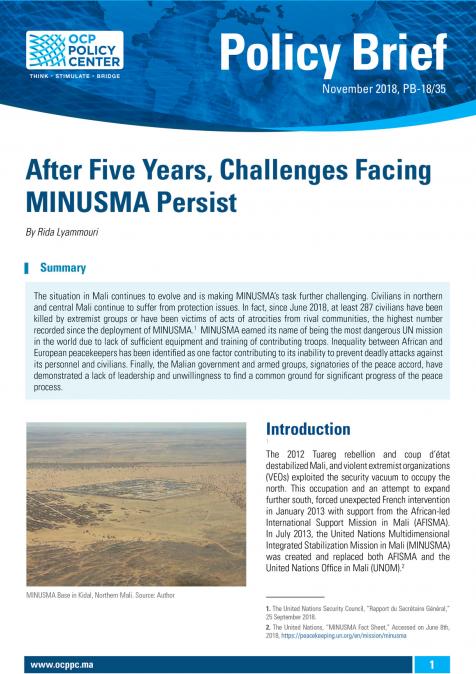
After Five Years, Challenges Facing MINUSMA Persist
Authors
November 5, 2018

The situation in Mali continues to evolve and is making MINUSMA’s task further challenging. Civilians in northern and central Mali continue to suffer from protection issues. In fact, since June 2018, at least 287 civilians have been killed by extremist groups or have been victims of acts of atrocities from rival communities, the highest number recorded since the deployment of MINUSMA.1 MINUSMA earned its name of being the most dangerous UN mission in the world due to lack of sufficient equipment and training of contributing troops. Inequality between African and European peacekeepers has been identified as one factor contributing to its inability to prevent deadly attacks against its personnel and civilians. Finally, the Malian government and armed groups, signatories of the peace accord, have demonstrated a lack of leadership and unwillingness to find a common ground for significant progress of the peace process.
RELATED CONTENT

  • April 24, 2026
    Pendant longtemps, la sécurité du Sahel reposait sur les dispositifs militaires occidentaux qui ne sont pas parvenus à juguler la menace jihadiste, démontrant ainsi les limites d’un modèle de coopération fondé sur la dépendance logistique et doctrinale envers les partenaires étrangers. Les trois États sahéliens ont décidé de rompre avec ce système et de construire « une souveraineté sécuritaire intégrée » Cette orientation s’est affirmée dans un contexte d’ouverture à de nouvea ...
  • Authors
    March 30, 2026
    This essay examines the establishment of the Board of Peace as a test case in contemporary peace governance and hegemonic experimentation. While the Board, politically activated in early 2026 and formally anchored in a resolution of the United Nations Security Council, benefits from derivative legality under the UN Charter, its legal foundation remains constitutionally fragile, its mandate ambiguously constrained, and its accountability architecture underdeveloped, notwithstand ...
  • Authors
    Nizar Messari
    December 19, 2025
    The U.S. military buildup in the Caribbean—the most significant since the Cuban Missile Crisis—comes at a moment when a new world order is taking shape, its contours still unclear, and in which the U.S. seeks to be more assertive in the Western Hemisphere. This disposition toward South America and the Caribbean was underscored by the recent publication of the new U.S. National Security Strategy, in which the Monroe Doctrine is explicitly invoked. This Policy Brief situates the devel ...
  • Authors
    December 18, 2025
    The return of President Donald Trump to the White House at the start of 2025 was expected to signal an American retreat from international engagement, especially in regions of traditional security interest, such as southern Europe, North Africa, and the Middle East. To the surprise of many observers around the Mediterranean, and perhaps to the dismay of some in the Trump administration’s ideological orbit, this has not happened. If anything, the second half of 2025 has seen a high d ...
  • Authors
    December 3, 2025
    La résolution 2797 du Conseil de sécurité des Nations Unies ne marque pas la fin d’un dossier, mais l’aboutissement d’une gestion magistrale du temps. Le Maroc n’a pas seulement gagné des appuis, il a gagné le tempo.
En combinant le Chronos de la constance et le Kairos de l’opportunité, il a démontré qu’une politique étrangère pouvait s’appuyer sur la philosophie du temps autant que sur la géopolitique.Cette diplomatie du temps maîtrisé peut aujourd’hui être considérée comme une doc ...
  • Authors
    December 3, 2025
    Resolution 2797 of the United Nations Security Council does not mark the end of an issue, but the culmination of masterful time management. Morocco has not only won support, it has won the tempo. By combining the Chronos of constancy and the Kairos of opportunity, it has demonstrated that a foreign policy can be based on the philosophy of time as much as on geopolitics.This diplomacy of controlled time can today be seen as an implicit doctrine of the Kingdom: a strategy in which pat ...
  • November 19, 2025
    بعد ثمانية عشر سنة على تقديمها إلى مجلس الأمن كمساهمة من المغرب في حل الخلاف الإقليمي حول الصحراء المغربية، حظيت مبادرة الحكم الذاتي بموجب القرار2797 المؤرخ في 31 أكتوبر2025 بتزكية مجلس الأمن بأغلبية مريحة كأساس وحيد للتفاوض من أجل حل نهائي لهذا الخلاف. وكان رد فعل المغرب على اعتماد هذا القرار سريعا، إذ مباشرة بعد التصويت، وبينما كانت وفود الدول الأعضاء في المجلس تشرح تصويتها على القرار، وجه جلالة الملك خطابا إلى الأمة مرحبا بهذا التغيير التاريخي الذي يشكل "مرحلة مفصلية ونقطة تحول ح ...
  • Authors
    November 7, 2025
    L’affaire du Sahara a connu, ce vendredi 31 octobre 2025, un virage stratégique. Par sa résolution 2797, le Conseil de sécurité a clairement consacré l’Initiative marocaine d’autonomie comme étant la base exclusive de négociations pour l’arrivée à une solution définitive au conflit régional qui plombe la région depuis un demi-siècle. Ainsi que l’a souligné Sa Majesté le Roi dans son discours adressé à la nation immédiatement après l’adoption de la nouvelle résolution, « nous vi ...
  • November 4, 2025
    This Opinon was originally published in French on telos-eu.com As Morocco celebrates the fiftieth anniversary of the Green March, which gave it control of the Western Sahara in November 1975, the UN Security Council has made a spectacular correction to its position on the issue. Its resolution of October 31, 2025 emphasizes the solution of internal autonomy for the Western Sahara within Morocco, relegating the idea of an independence referendum to second place. Autonomy rather ...