Publications /
Book / Report

Back
AFRICA, THE NEW SOUTH AND GLOBAL GOVERNANCE: Challenges and Opportunities
Authors
February 24, 2025

The Policy Center for the New South (PCNS) has for over a decade advocated for the pooling of expertise, perspectives and resources to benefit developing nations, in Africa, around the South Atlantic and across the South. The need to take inspiration from one another and share analysis and good practices with each other is as pressing as it has ever been, as countries of the South strive to accumulate knowledge, capture value added and move up the value chain. Our center has notably given particular attention to the complex endeavor of designing public policies adapted to the contexts where they are to be deployed. This includes engaging in the demanding endeavor of following through the implementation of policies through a rigorous process of evaluation and feedback. As the global economy and world order morph, this process should be conducted with increased energy and carried out with further evidence- and science-based cooperation at its core.

Our Senior Fellow Hung Tran has masterfully contributed to the ambition that has driven our Center for over a decade. He has deftly mobilized his own decades-long expertise, accumulated within the development community and other international bodies, to deliver a series of six concise and incisive policy briefs, which were published throughout 2024, and are regrouped in this book.

Hung Tran has captured the need to recalibrate the ways nations engage with each other, emphasizing how de facto, nations already use different methods and techniques to channel and reach their ambitions. In particular, he has underscored the need for Africa and the New South to astutely invest in existing formats to amplify their voices in revamped global bodies and mechanisms, such as the G20, where the African Union was admitted as a permanent member following the 2023 New Delhi Summit of the grouping. Hung has also explored how other long-standing coalitions and formats (such as the G77 and the Non-Aligned Movement) could be used for better coordination on major items figuring high on the global agenda, including growth, food security, peace, the reform of the international financial architecture, and trade.

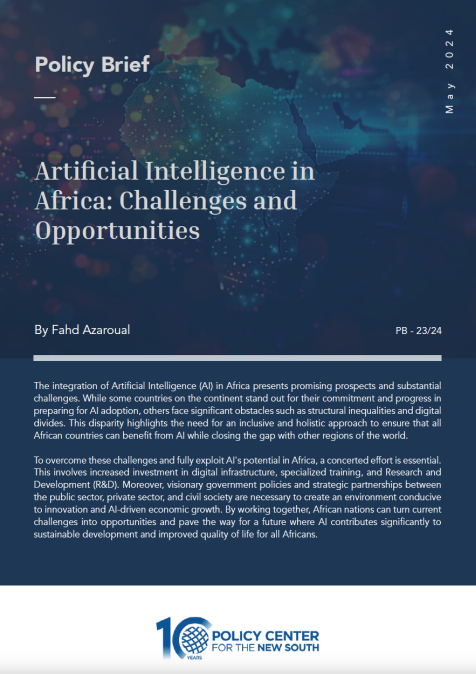
In particular, the energy transition offers possible avenues for growth in developing nations, as the global economy appears committed to a process of greening. The green industrial revolution can notably help countries in Africa and the New South become energy powerhouses with revenue generated from across the value chain, from mining to the generation of clean electricity for exports and to serve steadily increasing domestic consumption needs.

As this book goes to press, the world in general and the New South in particular are grappling with challenges which may very well be unprecedented in their scale, scope, size and speed. Adaptable, innovative and open cooperation mechanisms will be needed to build linkages, explore synergies and strengthen ties across a range of policy challenges. This book offers an informed overview of the stakes that nations of Africa and GS will need to navigate as the world navigates the quadruple climate- demographic-geopolitical-technological transition.
RELATED CONTENT

  • November 30, 2023
    In this episode, we dive into the pressing necessity for climate initiatives in Africa. Despite its minimal global emissions, Africa grapples with severe climate challenges and a substantial funding shortfall. Yet, as obstacles persist, including the disconnect between investor expectat...
  • November 30, 2023
    This Chapter was originally published on Cape Town Chronicles   The history of debt in Africa is a long and painful one. It began in the 1980s, when the public finances of most developing countries deteriorated following two episodes of oil shocks, leading to a "lost decade" of low growth, increased poverty, and political instability. The recovery from the debt crisis only became possible following initiatives in favour of heavily indebted poor countries (HIPC) and ...
  • November 28, 2023
    This Working Paper was originally published on erf.org.eg Like many developing countries, Morocco faced a significant increase in public debt following the COVID-19 pandemic. In 2022, Central government debt reached 69.6% of GDP, up from 60.3% in 2019, highlighting the need for a thorough analysis of debt sustainability. This paper examines the main trends in the Moroccan economy over the past two decades, including growth performance, monetary policy and financial condit ...
  • November 14, 2023
    This Policy brief was originally published on erf.org.eg Like many emerging and developing economies, Morocco has experienced a significant increase in public debt since the COVID-19 pandemic. Central government debt reached 69.6 percent of GDP in 2022, up from 60.3 percent in 2019, and overall public debt increased to 82.5 percent of GDP in 2022, well above the presumed critical threshold of 60 percent. Therefore, it becomes crucial to conduct a comprehensive debt sustainabil ...
  • Authors
    Touhami Abdelkhalek
    Dorothee Boccanfuso
    November 8, 2023
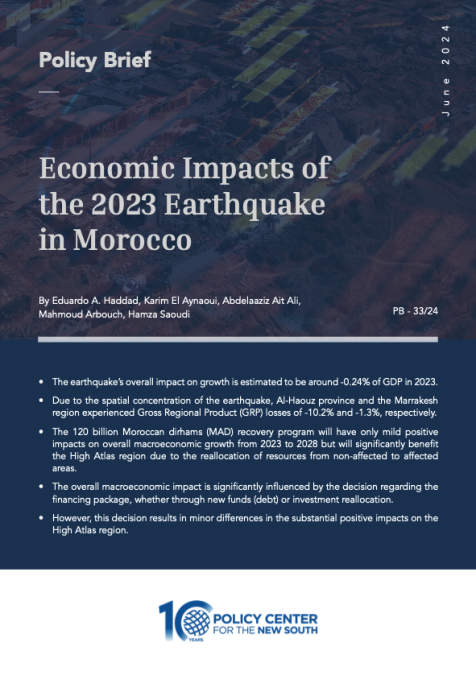
    Public policies, particularly those related to taxes and subsidies, should help to reduce poverty and inequality. However, the combination of components of these two systems, as implemented, leads sometimes to an increase in poverty and or inequality without being necessarily anticipated. In this policy brief, based on data from the 2019 wave of the Enquête Panel de Ménage from the Observatoire National du Développement Human from Morocco, we first highlight the influence of taxes ...
  • Authors
    November 2, 2023
    Le 1er octobre 2023 a marqué le début de la phase transitoire du Mécanisme d'Ajustement Carbone aux Frontières (CBAM en anglais) de l'Union européenne (UE). L'objectif de cette initiative est d'instaurer une tarification du carbone sur les biens importés qui soit équivalente à celle appliquée aux biens produits au sein de l'UE, visant ainsi à réguler les émissions de carbone. Cette démarche implique la mise en place d'un ensemble d'obligations de déclaration et de conformité pour le ...
  • Authors
    Ali Elguellab
    Elhadj Ezzahid
    November 1, 2023
    The role of the production network in shock propagation has been an issue of considerable interest since the Great Recession. However, the empirical literature has only focused on advanced and emerging countries. This paper aims to contribute to filling this gap by examining the case of Morocco, a developing country belonging to the lower-middle-income group. The question is whether its production network is a factor in amplifying idiosyncratic industry-level shocks or, conversely, ...