Publications /
Book / Report

Back
Africa Economic Symposium (AES) 3nd edition - SUMMARY REPORT
Authors
General rapporteur Mahmoud Arbouch
September 2, 2025

The Africa Economic Symposium (AES) has firmly established itself as one of the flagship annual events of the Policy Center for the New South, alongside the Atlantic Dialogues and the African Peace and Security Annual Conference (APSACO). Now in its third edition, AES continues to provide a unique platform for economists, policymakers, and academics from across the continent and beyond to exchange perspectives on the pressing macroeconomic and structural challenges facing Africa. Its mission remains to foster rigorous, evidence-based debates that inform policymaking and support long-term strategies for Africa’s development in an era of uncertainty. 

The 2025 edition, convened under the theme “Bold Moves amid Global Shifts,” explored the difficult policy trade-offs confronting African governments as they navigate a volatile global environment. The continent’s recovery from COVID-19 has been uneven, while debt pressures, supply chain disruptions, and geopolitical tensions weigh heavily on fiscal and economic resilience. Structural challenges such as persistent unemployment, low productivity, and the exclusion of Africa’s youth continue to hinder inclusive growth, even as policymakers are called upon to adapt to deep systemic uncertainty. 

The symposium underscored that many African states are increasingly resorting to short-term stabilization measures—such as accumulating reserves and postponing reforms—that may provide immediate security but risk delaying the structural transformation urgently needed. Against this backdrop, AES 2025 called for a careful balance between fiscal prudence, social investment, and the pursuit of sustainable growth, placing emphasis on reforming governance, improving macroeconomic management, and accelerating structural change. 

The discussions highlighted the urgent need to rethink Africa’s economic strategies in a shifting global order. From debt sustainability and the role of central banks to the promise of financial innovation, digital inclusion, and new instruments such as central bank digital currencies, the symposium emphasized that policy choices must align with long-term transformation goals. The debates also explored the opportunities and challenges of regional integration, trade connectivity, and development finance, all of which are essential levers for Africa’s resilience and prosperity. 

As in previous editions, the Annual Report on African Economies was launched alongside the symposium, offering an in-depth analysis of the continent’s macroeconomic dynamics and structural transformation pathways. More than just a publication, the report reflects the collective intellectual effort of leading scholars and practitioners, providing evidence-based insights to guide decision- makers. Together, the symposium and the report reinforced the Policy Center for the New South’s commitment to fostering forward-looking economic thinking that moves beyond short-term headlines to tackle Africa’s enduring challenges.

RELATED CONTENT

  • October 10, 2023
    Session d'ouverture : Remarques préliminaires des coprésidents - Montek Singh Ahluwalia, ancien vice-président de la Commission de planification de l'Inde - Karim El Aynaoui, président exécutif, Policy Center for the New South (PCNS) - Enrique Garcia, ancien président et directeur gé...
  • October 9, 2023
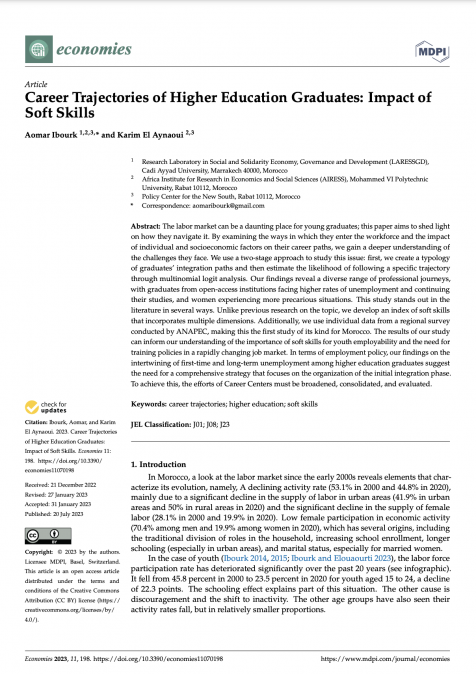
    This paper was originally published on mdpi.com   The labor market can be a daunting place for young graduates; this paper aims to shed light on how they navigate it. By examining the ways in which they enter the workforce and the impact of individual and socioeconomic factors on their career paths, we gain a deeper understanding of the challenges they face. We use a two-stage approach to study this issue: first, we create a typology of graduates’ integration paths ...
  • Authors
    Edited by Roberto Cardarelli
    Taline Koranchelian
    October 9, 2023
    This book was originally published on elibrary.imf.org   Throughout the past two decades, Morocco has faced several external and domestic shocks, including large swings in international oil prices, regional geopolitical tensions, severe droughts, and most recently the impact of the pandemic and the economic fallout from Russia’s invasion of Ukraine. Despite rough waters, the government stayed the course and remained focused not only on immediate stability, but also ...
  • October 06, 2023
    The confluence of Covid 19 and the ongoing war between Russia and Ukraine has resulted in a troublesome surge of inflation not seen for decades. Developing nations, particularly in Africa ...
  • Authors
    October 6, 2023
    This paper reviews the past performance of industrialization in Africa and identifies key considerations for policymaking. To date, African countries have lagged in industrialization compared to other continents, in spite of the determined efforts and aspirations of their leaders. However, recent evidence suggests that Africa’s de-industrialization trend began to reverse in the past decade, with some countries experiencing growth in manufacturing employment. Notably, more jobs have ...
  • October 4, 2023
    Dans ce numéro spécial de notre émission, nous explorerons les contours et les performances de l'économie africaine face aux multiples défis planétaires. La pandémie de Covid-19 continue de susciter des inquiétudes avec l'émergence de nouveaux variants, tandis que les catastrophes clima...
  • Authors
    Ademir Rocha
    Alan Leal
    João Corrêa
    September 30, 2023
    This Paper was originally published on agupubs.onlinelibrary.wiley.com   Water plays a central role in several socioeconomic and environmental nexuses. Faced with various anthropogenic pressures that act as water scarcity drivers and knowing that the unavailability of water can be a limiting factor for economic development, there is an urgent need for the design and evaluation of economic instruments that help in the management of water resources. This article presents a ...
  • Authors
    Amit Jain
    September 26, 2023
    On the day he formally took power in Nigeria, 29 May, President Bola Tinubu put an end to fuel subsidies.  It was a bold and politically difficult decision, but long overdue. Nigeria is a leading oil producer and yet its citizens struggle to put gas in their tanks. It exports crude oil but imports refined fuels. For years, the government capped the gasoline price and paid importers the difference between the higher landed cost of petrol and diesel and the lower price at th ...