Podcasts

Back

The Responsibility to Protect: To Act or Not to Act?

24
June 2022
Hala Boumaiz, Noamane Cherkaoui
Related topics: 

At the 2005 World Summit, the Responsibility to Protect (R2P) doctrine emerged as a formalized and multilateral way for states to protect populations under the threat of war crimes, crimes against humanity, or genocide. While it should be regarded as a preventative doctrine, it has been weaponized and usurped from its founding principles. In this regard, R2P's main faults lay in the implementation phase, and this podcast will discuss these dynamics and to what extent the R2P doctrine should be rethought.
RELATED CONTENT

  • January 21, 2026
    The Policy Center for the New South hosted a seminar on January 16, 2026, titled “Crisis or Opportunity? Multilateralism in a Polycentric World.”The discussion addressed the growing strain on global cooperation amid overlapping financial, climate, security, and technological shocks, occ...
  • January 8, 2026
    Dans cet épisode d’Africafé, nous abordons la désinformation électorale et ses effets sur l’intégrité des processus démocratiques, la confiance du public et l’acceptation des résultats. À travers les interventions du Professeur Mohammed Benabid et de M. Fethi Debbabi, l’épisode analyse ...
  • Authors
    Nizar Messari
    December 19, 2025
    The U.S. military buildup in the Caribbean—the most significant since the Cuban Missile Crisis—comes at a moment when a new world order is taking shape, its contours still unclear, and in which the U.S. seeks to be more assertive in the Western Hemisphere. This disposition toward South America and the Caribbean was underscored by the recent publication of the new U.S. National Security Strategy, in which the Monroe Doctrine is explicitly invoked. This Policy Brief situates the devel ...
  • Authors
    December 18, 2025
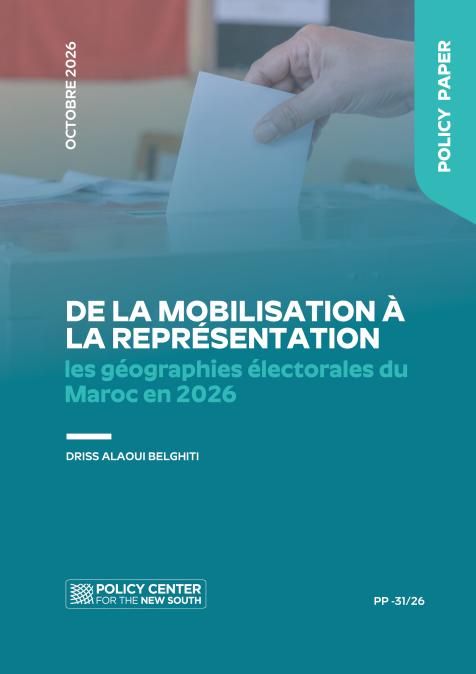
    The return of President Donald Trump to the White House at the start of 2025 was expected to signal an American retreat from international engagement, especially in regions of traditional security interest, such as southern Europe, North Africa, and the Middle East. To the surprise of many observers around the Mediterranean, and perhaps to the dismay of some in the Trump administration’s ideological orbit, this has not happened. If anything, the second half of 2025 has seen a high d ...
  • Authors
    December 17, 2025
    I recently participated in a discussion between Israelis and Arabs, some living in the Middle East, some living abroad[1]. The discussion topic was ‘The Two State Solution’. This article presents my personal takeaways from the discussion. It does not try to describe the details, and other participants may have different takeaways.I joined the discussion thinking that the two-state solution was dead. Most of the other participants felt the same way—all very pessimistic. But I left fe ...
  • Authors
    December 3, 2025
    La résolution 2797 du Conseil de sécurité des Nations Unies ne marque pas la fin d’un dossier, mais l’aboutissement d’une gestion magistrale du temps. Le Maroc n’a pas seulement gagné des appuis, il a gagné le tempo.
En combinant le Chronos de la constance et le Kairos de l’opportunité, il a démontré qu’une politique étrangère pouvait s’appuyer sur la philosophie du temps autant que sur la géopolitique.Cette diplomatie du temps maîtrisé peut aujourd’hui être considérée comme une doc ...