Podcasts

Back

Commerce et prix des matières premières agricoles

30
May 2016
Christophe Gouel
Related topics: 

Ce podcast est délivré par Christophe Gouel. La volatilité des prix des denrées alimentaires a-t-elle des répercussions sur les politiques commerciales des pays ?
Christophe Gouel est docteur en économie de l’école Polytechnique, il est économiste à l’institut national de la recherche agro économique (INRA) et au centre de recherche « CEPII ». Ces recherches portent principalement sur les problématiques liées aux politiques commerciales et aux politiques agricoles.

RELATED CONTENT

  • Authors
    Under the Supervision of
    Philippe Chalmin
    July 4, 2016
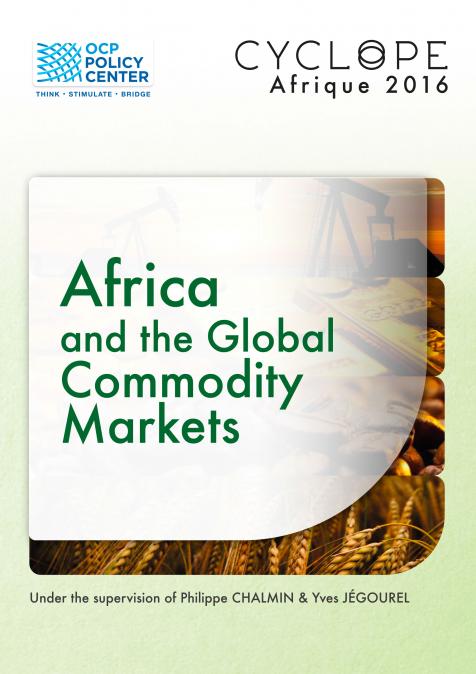
    Guinea’s bauxite, Moroccan phosphates, Nigerian Bonny Light, Zambian copper, Côte d'Ivoire’s cocoa, Ethiopian coffee or Madagascar’s vanilla: all are examples demonstrating that raw materials have a dimension that is as global as it is local. Global by the markets on which they are traded, local by their quality, a key element of their price, and their macroeconomic impact, particularly for Africa. In line with the 2016 CyclOpe report, which celebrates three decades of existence thi ...
  • May 30, 2016
    Ce podcast est délivré par Christophe Gouel. La volatilité des prix des denrées alimentaires a-t-elle des répercussions sur les politiques commerciales des pays ? Christophe Gouel est doc ...
  • Authors
    Karim EL MOKRI
    July 6, 2015
    « Les asymétries et l’instabilité du marché des matières premières dans les pays en développement : politiques et impacts sur le développement », une problématique d’un intérêt particulier pour ces pays, a fait l’objet d’un séminaire de recherche organisé par la Fondation pour les Etudes et Recherches sur le Développement International (Ferdi), les 24 et 25 juin 2015 à Clermont-Ferrand. Cet évènement a été tenu la veille du workshop co-organisé par la Ferdi et OCP Policy Center ...
  • Authors
    Ezana Bocresion
    April 23, 2015
    We finished Part I - Solving the Capital Formation Issue with a question? How should institutional investors go about looking for the best partners to help them make successful investments in Africa; and fundamentally, the real question to ask is, what are the variables required for building successful investment platforms in Africa? Whenever one meets with an allocator from an institutional investor to discuss an allocation to an Africa strategy, the first question on th ...
  • Authors
    Eckart Woertz
    April 10, 2015
    1970s : Oil and wheat are strategic commodities, their prices are skyrocketing, Arab countries declare an oil boycott against the US and the US contemplates to retaliate with a grain embargo. Gulf countries are alarmed and look into a plan to develop Sudan as an Arab breadbasket.  This plan, however, unravels by the 1980s amidst political instability, misguided project designs and alleged corruption amongst the Sudanese (Nimeiri) regime. Instead, Saudi Arabia embarks on a ...
  • Authors
    Ezana Bocresion
    March 16, 2015
    Over the next couple of months, we want to explore the investing climate in Sub Saharan Africa (“SSA”) and try to understand where it is and what elements/variables are required to increase the continent’s attractiveness to institutional investors and thereby speed up the continent’s development. We will discuss the Private Equity industry in Africa and delve into the challenges faces. We will then work through how best to address them, and in particular, in the Agribusiness sector. ...
  • From

    13
    8:30 am October 2026
     Agriculture across the Global South is undergoing a period of profound transformation. Countries are seeking new approaches to improve productivity, strengthen food and nutrition security, build climate resilience, enhance rural livelihoods, and create more inclusive and sustainable agri-food systems. In this context, South-South Cooperation (SSC) has emerged as an increasingly relevant mechanism for accelerating agricultural transformation, enabling countries to exchange technologies, policy experiences, institutional models, and locally adapted innovations. Unlike conventional models of technology transfer, South-South cooperation offers opportunities for countries to learn from solutions that have been developed and tested in contexts with similar agro-ecological, soc ...