Podcasts

Back

Bridging the Gender Gap: Women in Policy-Making

07
April 2021
Nihal El Mquirmi & Scarlett Varga (ADEL)
Related topics: 

There is no doubt that the persistent under-representation of women in politics and in decision-making, and the discrimination they face worldwide impedes them from reaching their full potential. Indeed, women are under-represented in political offices almost everywhere across the globe. While it is true that progress has been made, achieving gender parity in political life is far off. In today's episode, Scarlett Varga, Head of Development at Bruegel, co-founder of the Brussels Binder and an Atlantic Dialogues Emerging Leader alumna discusses the role of women in policy-making, the challenges they encounter and what can be done to tackle the issue gender imbalance in politics.

RELATED CONTENT

  • Authors
    August 13, 2026
    The Resolution adopted by an overwhelming majority of elected European officials in Strasbourg on June 10, 2021, on "the violation of the UN Convention on the Rights of the Child and the exploitation of minors by the authorities in the migration crisis in Ceuta" (2021/2747/RSP), could not fail to leave its mark.Decoding the ResolutionThe Resolution shocked Moroccans to such an extent that it was quickly set aside at the time, as if there were a wish to forget it as fast as possible. ...
  • June 30, 2026
    Globally, public policies for youth face a twofold challenge: addressing structural socioeconomic challenges—such as unemployment, precariousness, and regional disparities—while accommodating a growing demand for effective civic participation. (ILO, 2023; United Nations, 2020) In Africa, this challenge takes on a unique dimension given the demographic weight of the youth population and the persistent fragility of local democracies. (AfDB, 2020; Mo Ibrahim Foundation, 2023)Elections ...
  • June 30, 2026
    À l'échelle mondiale, les politiques publiques de jeunesse sont confrontées à un double enjeu : répondre à des défis socio-économiques structurels; chômage, précarité, fractures territoriales, tout en intégrant une demande croissante de participation citoyenne effective. (OIT, 2023 ; Nations Unies, 2020) En Afrique, ce défi revêt une dimension singulière compte tenu du poids démographique de la jeunesse et des fragilités persistantes des démocraties locales. (BAD, 2020 ; Mo Ibrahim ...
  • June 26, 2026
    Three years after the adoption of the first National Action Plan (NAP) on the Women, Peace and Security (WPS) Agenda, Morocco has made real institutional progress, but implementation is still inadequate. The extension of the NAP opens a window of opportunity to prepare a second, more ambitious and operational cycle.This Policy Brief identifies four persistent obstacles: a virtually stagnant female employment rate of 19.1%, less than 3% female representation in peacekeeping contingen ...
  • May 20, 2026
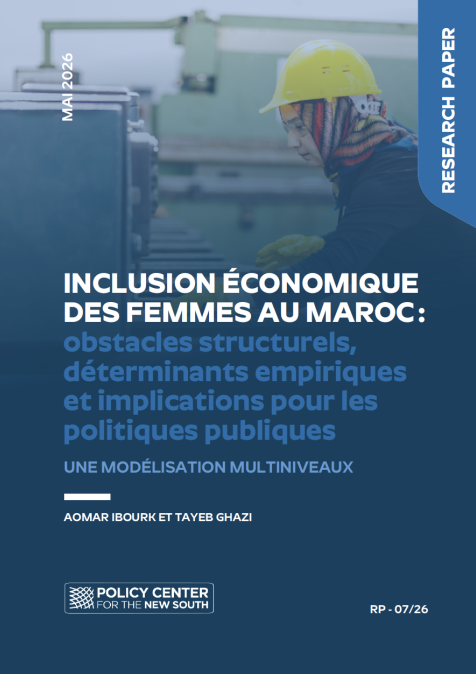
    La participation des femmes au marché du travail au Maroc demeure l'un des défis les plus structurels du développement économique et social du pays. Avec un taux d'activité féminin de seulement 19 % en 2023, contre 69 % pour les hommes (HCP, 2024), le Maroc présente l'un des écarts de genre les plus prononcés parmi les économies en développement (Banque mondiale, 2024). Ce Research Paper propose une analyse économétrique rigoureuse et multiniveaux des déterminants de cette participa ...
  • Authors
    Hajar Kabbach
    May 11, 2026
    Closing Morocco's gender employment gap could increase GDP per capita by 40-50 percent; yet female labor force participation stands at just 19 percent—among the lowest in the world and still declining. This policy paper argues that investing in the care economy is not merely a social expenditure, but a productive economic strategy with measurable returns. Drawing on international evidence from Uruguay, Mexico, Colombia, and India, the brief demonstrates that well-designed care syste ...
  • April 30, 2026
    This Africafé episode features Patience Chiradza from the African Union, discussing the critical role of African women in governance and peacebuilding.  It highlights existing frameworks like the Maputo Protocol and acknowledges progress, while emphasizing persistent barriers such ...
  • April 28, 2026
    Cet épisode met en lumière les dynamiques de genre au Maroc, en soulignant l’écart entre les avancées juridiques et leur application concrète. Il aborde la baisse de la participation des femmes au marché du travail, liée à des contraintes multiples, ainsi que la faible reconnaissance du...
  • April 13, 2026
    Cette interview met en lumière les inégalités de genre persistantes au Maroc, malgré des avancées institutionnelles notables. Elle analyse les écarts dans l’accès à l’éducation, à l’emploi, à la santé et à la participation politique. À travers l’intervention de Fatima Mourd, elle soulig...