Publications /
Opinion

Africa is experiencing a demographic boom, so as its population is expected to double by 2050 to reach 2.8 billion. The growth in Africa’s working-age population will be inevitable. The youth population will also grow to make of Africa the continent of youth ‘par excellence’, so as it will hold the largest number of young people in the globe.
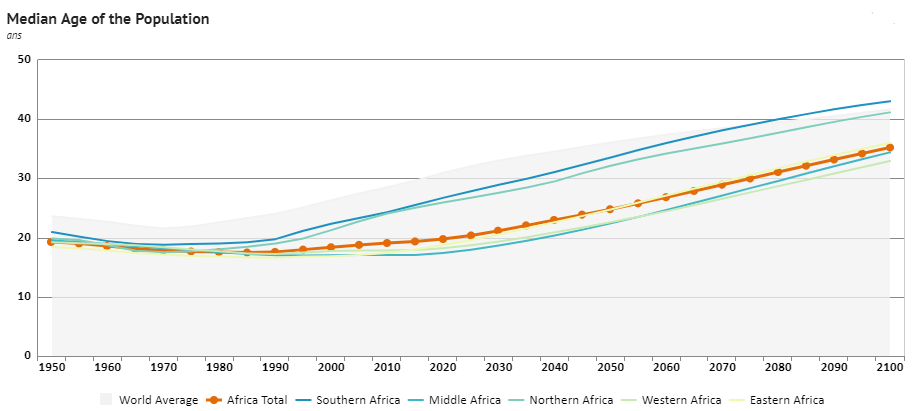
Source: UN DESA | United Nations Department of Economic and Social Affairs, 2018
Against this outlook, economic growth is essential for Africa. If economic growth fails to keep up with this booming population [mainly youth], rates of unemployment and poverty as well as other indicators of exclusion are also expected to upsurge; and this may harm well-being, social cohesion and security across the continent.
The good news is that African countries were growing at an average of about 5% during the last 15 years, before experiencing a slowdown starting 2015 from which they are still recovering.
Africa annual GDP (real, 2010 in $ billion)
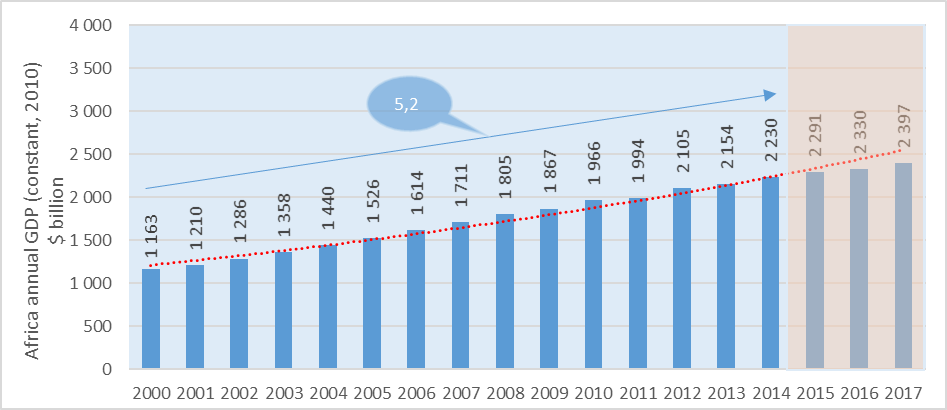
Source: the UNCTADstat, 2019
Now, Africa’s average growth is around 2.7%, higher than the 2.3% of 2017. The continent counts six of the top 10 fastest growing economies and its growth prospect is expected to be among the highest between 2019 and 2023, according to the IMF.
Despite these impressive growth figures, Africa fails to create enough jobs1, both in terms of quantity than quality, and this trend is expected to continue due to many reasons:
- The economic tissue that continues to stumble over whether, and how, to diversify; which makes it dominated by labour saving or labour competing sectors such as oil, mining, agriculture.
- The market access conditions that downcast the private initiative and prevent factors from doing business and moving to where the opportunities are. These mainly include access to finance, corruption, taxation, inadequate infrastructure, and insufficient and discontinuous electricity supply, and weak public governance and institutions including information systems (World Economic Forum, 2017).
- The lack of complementarity between the labour market need and the skills supply even the skills coming from education and training systems.
The outcomes of such situation, as we mentioned, range from high rates of unemployment [and underemployment] as well as poverty, social instability and extremism. Although the youth unemployment rate2 (10.8%) is slightly lower than the global youth unemployment rate (13.1%), it is in Africa that the working poor rate is the highest in the world - people who are employed but earn less than $2 a day. Now that about 60 per cent of the African population is under the age of 25 with an estimated 10 to 15 million young people joining the labour market every year, the creation and expansion of opportunities is inevitable for preventing deviations.
A key response relies on the education and training system design and regulation as well as the philosophies behind them. An ideal philosophy would aim to plan for tomorrow jobs while dealing with today's challenges including jobless growth. Indeed, because skills needed now are not provided3 although Africa has currently its most educated generation (ILO, 2016). Furthermore, skills that are needed now will not entirely be [needed] in the future; long-life learning is the engine in this schema.
Labour has to be employable, mobile and able to transform, and for that to happen, a lifelong learning culture is essential. Private sector involvement is key to putting in place mechanisms that can help make continued learning and training feasible -especially for African that are already part of the workforce. Africa has to progressively transition to more complex and high skilled jobs. A major effort has to be first made regarding the skills of the actual African workforce, which remain, generally, highly unqualified. Furthermore, improving access to education and the effectiveness of the actual educational system in Africa should be seeing as preliminary conditions for a long-life learning schema to succeed.
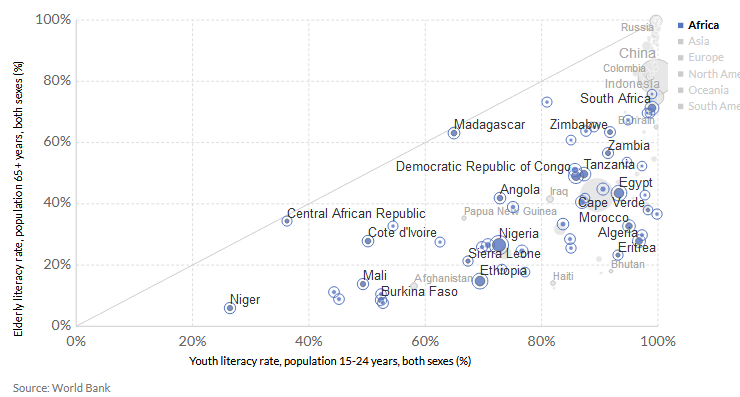
Source: World Bank, 2016
-------------
1 : El Aynaoui Karim & Ibourk Aomar (2016), Policy Lessons from Okun’s Law for African Countries. Global Labor Markets Workshop Paris, September 1-2, 2016
2 : According to International Labour Organization (ILO, 2016) data for sub-Saharan Africa, the youth unemployment rate is 10.8%. In North Africa, the incidence of youth unemployment is high at 29.3% in 2016, the second highest rate in all regions (after the Arab region).
3: Nearly half of the 10 million graduates who graduate each year from Africa's 668 universities cannot find employment (African Center for Economic Transformation, 2016).