Publications /

The global migration problem cannot be wished away; it has to be managed. Morocco provides an example of how responsibility for migration management can be handled by African states.
The latest statistics of the European Border and Coast Guard Agency (FRONTEX) identify the Western Mediterranean route from Morocco to Spain as the busiest migratory route into Europe last year, with 57,034 illegal attempts to enter the continent recorded. However, a parallel look at the Moroccan government’s data shows that over the same period of time, the Moroccan authorities prevented 88,761 attempts at irregular border crossing at Morocco’s own frontiers with other African countries, a discrepancy which speaks to a fundamental truth: irregular migration is most certainly not solely a European issue. And there are plenty of lessons to be learnt from the way a country like Morocco handles this challenge.
Notwithstanding all the alarmist reports in European media outlets, the fact remains that African migration remains confined largely within the continent, with an estimated 21 million African migrants currently living in African countries different from their own as of 2015, the latest date for which reliable statistics are available. Similarly, most of the refugees fleeing the violence in the Middle East have settled in the Middle East or surrounding states, in countries like Turkey, Lebanon and Jordan. For obvious reasons, people seek refuge in the nearest safe country before they explore further locations in response to worsening economic or security opportunities.
And the pressures of migration are only likely to intensify. According to the latest figures from the World Bank, more than half of the very poor worldwide live in sub-Saharan Africa, yet it is this same region that will be experiencing the biggest demographic boom by the end of the century. Recent statistics from the United Nations Department of Economic and Social Affairs (DESA) suggest that the population of sub-Saharan Africa will double by 2050, making it the region that will account for about 50% of world population growth by 2050. Nigeria, for instance, is expected to be the third most populated country in the world by 2050, after China and India. The conclusion is, therefore, inevitable: such trends will translate into massive movements within and outside the borders of Africa.
Figure I: World Population Growth Expectations by 2050
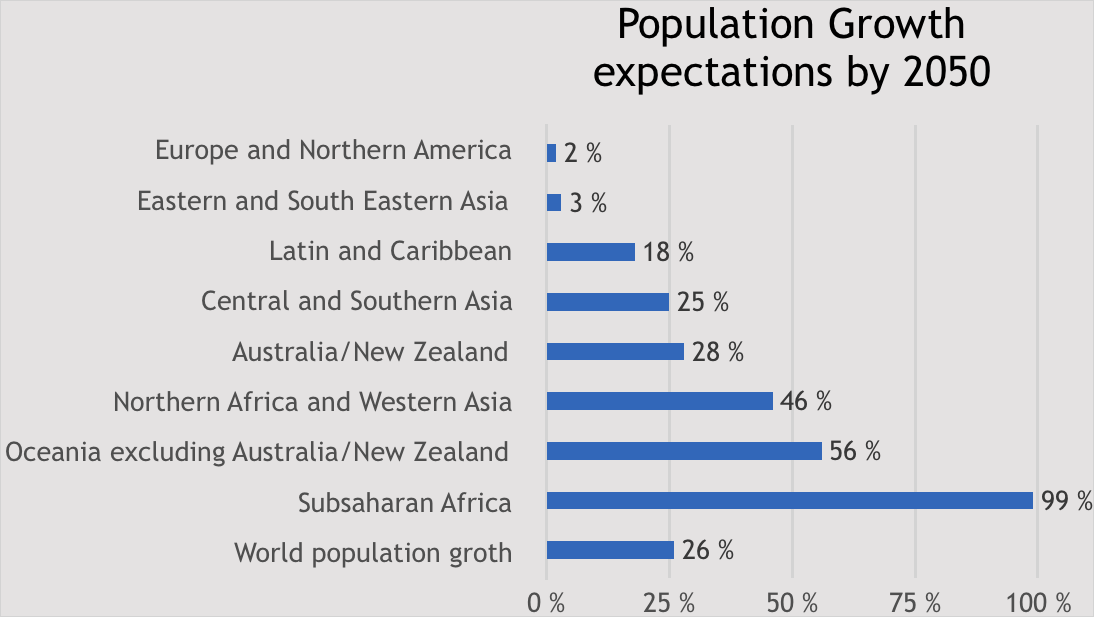 Source: Data retrieved from UN DESA/Population Division, ‘World Population Prospects 2019: Highlights’, 2019.
Pessimist observers see this African demographic boom as a drag on countries’ political stability prospects, while optimists perceive a demographic dividend that has the potential to transform the life of Africans through increased productivity and manufacturing. Either way, handling such a challenge will require time huge efforts. And until the demographic dividend is translated into real economic progress, there will be continuous population movement across African borders in search of economic opportunities. Thus, the efforts of decision-makers should go towards better management of migration, rather than concentrating on efforts to eradicate a movement which cannot be eradicated.
The Need for Success Stories: A Close Look at the Moroccan National Immigration and Asylum Strategy
As far as migration management is concerned, Morocco is an interesting example to consider. It is a case study that shows how an African country at the crossroads between Europe and Africa evolved from a generator of migration to a transit and destination country of migrants. Beginning in the 1950s, Moroccan migrants travelled to Europe, availing themselves of a variety of regulated migration schemes. Later – by the early 1990s – waves of Moroccans and other nationals of African countries resorted to irregular migration in response to the great tightening of European border procedures, and because the EU’s expansion to Central and Eastern Europe opened up opportunities for cheap labour, therefore further restricting the need for migrants from outside Europe.
Yet a decade later, Morocco became a destination country for hundreds of thousands of sub-Saharan Africans and later refugees from Syria and Iraq. All these momentous changes within less than half a century would pose a huge challenge to any middle-income country with lots of economic and social difficulties, like Morocco. Nonetheless, the response was to meet the challenge head-on.
In 2013, shortly after the events of the Arab uprising and the refugee crisis that followed, Morocco put in place its National Strategy on Immigration and Asylum, which seeks to align humanitarian principles with practical policies. This strategy resulted in the regularisation of the administrative situation of 50,000 migrants in Morocco, who obtained residence permits and access to employment and education. Additionally, in recent years Morocco has voiced its ambition to serve as a bridge between Africa and the EU in terms of migration management. Hence, at the 28th Summit of the African Union in Addis Ababa in 2017, Morocco was designated by African countries to promote the African Agenda on Migration, unveiled in more precisely detail by King Mohammed VI in a message to other African countries early last year. This translated into the creation of the African Migration Observatory in Rabat, which aims at providing better data on African mobility to enhance evidence-based policymaking. Morocco was also the host of the United Nations Conference on Migration that resulted on the adoption of the Global Compact for Safe, Orderly and Regular Migration in December last year.
To be sure, these are just preparatory steps, designed to forge a common African approach to migration management. And the continent still lacks success stories originating from Africa itself, to rebuild hope and assert the possibility that African migration can be enriching to African countries and to Europe. Still, a country like Morocco has shown that it can be a reliable partner in the migration debate not merely by acting as a ‘buffer zone’ for immigrants heading to Europe, but by adopting its own national migration integration policies, and by trying to forge an African-wide approach to the problem. Morocco has benefitted from decades of advanced cooperation with the European Union, and this experience, coupled with the determination of the highest authorities of the state, have led to the creation of a unique agenda on migration.
This vision needs to be further supported by European partners, as well as African governments. Indeed, the centre of decision-making on issues concerning African countries, like the one of migration, needs to shift towards African governments and civil society organisations in these countries. This will generate a broader sense of ownership of the problem. For, while many African countries remain mired in poor governance and deficient economic performance, there are among African nations also countries like Morocco, who can take a lead in handling the continent’s migration pressures.
Amal El Ouassif is…
Amal El Ouassif is a research assistant in International Relations and Geopolitics at the Policy Center for the New South in Morocco. Prior to this, she worked as a programme coordinator at the Westminster Foundation for Democracy and served as a consultant in the (GIZ) in Morocco. Her area of interest include Africa- Europe cooperation, security and migration.
This article was originally published by the Royal United Services Institute and has been republished here with their kind permission.