Les pays en développement / émergents et les réformes structurelles / Romain A. Duval, (FMI)

November 7, 2019

Questions : 1/ Pensez-vous que les pays en développement et émergents sont plus enclins à adopter des réformes structurelles que par le passé ? 2/ Le fait que l’impact des réformes structurelles met du temps à se concrétiser est-il de nature à encourager les pays en développement et émergents à s’y engager ? 3/ Que doit-on retenir des réformes engagées par le Maroc ?

Speakers

Romain Duval
Advisor to the Chief Economist in the IMF Research Department
Romain Duval is Advisor to the Chief Economist in the IMF Research Department, where he also leads the Structural Reforms Unit. Previously he was the Division Chief for Regional Studies of the IMF Asia Pacific Department and led the Regional Economic Outlook. Prior to joining the Fund, he was the Division Chief for Structural Policies Surveillance at the OECD Economics Department, where he was also the editor of the flagship publication Going for Growth. He has published extensively in leading academic and policy-oriented journals on a wide range of topics including the economics and political economy of labor and product market regulations, growth, productivity, trade, monetary policy, equilibrium real exchange rates, and climate change economics. Over the years his research ...

RELATED CONTENT

  • Authors
    January 23, 2015
    The year just ending disappointed economic forecasters, as did the year prior, and the one before that. The aftereffects of the Lehman crisis, now over six years old, and of the subsequent sovereign crisis in Europe, have been systematically underestimated and continue to plague us.  Although the outlook for 2015 is foggier than usual, there are significant areas of strength and many signs that the world economy continues to heal, beginning from here in the United States. &nbs ...
  • Authors
    January 14, 2015
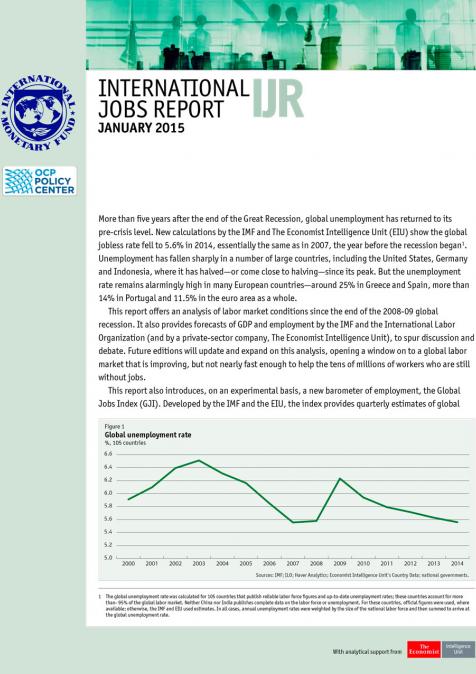
    The International Jobs Report offers an analysis of labor market conditions since the end of the 2008-09 global recession. It also provides forecasts of GDP and employment by the IMF and the International Labor Organization (and by a private-sector company, The Economist Intelligence Unit), to spur discussion and debate. Future editions will update and expand on this analysis, opening a window on to a global labor market that is improving, but not nearly fast enough to help the tens ...
  • Authors
    Abderrahmane Mebtoul
    December 1, 2013
    L’intégration du secteur informel ne peut être réalisée sans l’existence d’un Etat de droit et elle nécessite une cohérence des politiques de développement, qui s’impose plus que jamais face à l’ampleur des économies parallèles. L’intégration du secteur informel ne pourra pas se faire non plus sans une sérieuse amélioration du niveau d’éducation et une véritable réduction des inégalités hommes/femmes ...
  • From

    12
    9:30 am November 2026
    The Oxford Handbook of the Moroccan Economy propose une analyse approfondie, structurée et rigoureuse de la trajectoire économique du Maroc de 1960 à 2025. Réunissant 53 contributeurs autour de 34 chapitres, l’ouvrage se présente comme une référence académique et analytique majeure, fondée sur l’étude des tendances de long terme, des faits stylisés, des transformations sectorielles et des principaux défis de politiques publiques qui façonnent le développement économique du Royaume.Au-delà d’une lecture centrée uniquement sur les agrégats macroéconomiques ou les indicateurs de progrès social, le Handbook interroge les ressorts profonds de la transformation structurelle de l’économie marocaine : dynamiques de productivité, diversification du tissu productif, qualité de l’emploi, ...
  • From

    03
    5:00 pm November 2026
    The Oxford Handbook of the Moroccan Economy offers a comprehensive and analytically grounded assessment of Morocco’s economic trajectory from 1960 to 2025. Bringing together 53 contributors across 34 chapters, this landmark publication examines the country's economic achievements, structural transformations, and persistent development challenges. Drawing on long-term trends, empirical evidence, and sectoral analysis, the Handbook provides a valuable reference for understanding the evolution of the Moroccan economy and the policy choices shaping its future.Moving beyond traditional macroeconomic indicators and measures of social progress, the Handbook explores the underlying drivers of Morocco’s structural transformation, including productivity, economic diversification, employ ...
  • From

    08
    4:30 pm October 2026
    How do intra-African diasporas contribute to the continent’s development? This Africafé episode discusses their role in remittances, entrepreneurship, and skills circulation. The conversation addresses the administrative, financial, and institutional barriers that limit their contribution, alongside opportunities for South-South cooperation to strengthen their participation in Africa’s economic integration. ...