La région Rabat–Salé–Kénitra : Dynamiques territoriales et mobilité durable

June 3, 2026

Cet épisode d’interview est réalisé en marge de la conférence « RSK Connect : Dynamiques territoriales et opportunités d’investissement dans la mobilité durable », organisée par le Policy Center for the New South en partenariat avec le Centre Régional d’Investissement (CRI) Rabat–Salé–Kénitra. Dans un contexte de transitions climatiques, énergétiques et technologiques, la mobilité durable s’impose comme un enjeu stratégique au croisement de la compétitivité industrielle, de l’innovation et du développement territorial. Cet échange avec M. Mohcine Benjelloun, Directeur du CRI RSK, revient sur les atouts de la région, ses opportunités d’investissement et les priorités à mettre en œuvre pour accompagner la transformation du secteur. Il met également en perspective les synergies à renforcer entre acteurs publics, privés et académiques pour positionner le Maroc comme hub régional de la mobilité durable.

Speakers
Ahmed Ouhnini
Economist, Policy Center for the New South
Ahmed Ouhnini is an Economist at the Policy Center for the New South. His research area covers agricultural economics, human and social development. Previously, he has worked as a researcher at the Paris School of Economics (PSE) and has also a record of working in consulting services in Morocco. Ahmed holds an engineering Diploma in Agriculture and Rural Development from the National School of Agriculture of Meknes and a Master’s Degree in Law, Economics and Management from the Paris 1 Pantheon Sorbonne Institute of Development. ...

RELATED CONTENT

  • May 13, 2025
    تتناول هذه الحلقة موضوع تعويم نظام الصرف في المغرب وتأثيراته الاقتصادية، حيث نعرض تاريخ نظام الصرف في البلاد والأسباب التي تدفع نحو تبني هذا الخيار في 2026. نناقش تأثير التعويم على الواردات والصادرات وعلى القدرة الشرائية للمواطنين، مع التركيز على التحديات التي قد يواجهها الاقتصاد المغرب...
  • Authors
    Zakaria Elouaourti
    May 6, 2025
    This paper was originaly published on sciencedirect.com   This paper introduces a novel empirical approach, combining sigma convergence and sigma counterfactual statistics, to examine the dynamics of structural transformation in Morocco from 1990 to 2018. The findings reveal that Morocco experienced structural transformation driven by labor productivity reallocation across sectors during specific sub-periods (1991–1993, 1996–1997, and 1998–2003). However, this process ca ...
  • Authors
    Karim El Mokri
    Idriss El Abbassi
    October 23, 2024
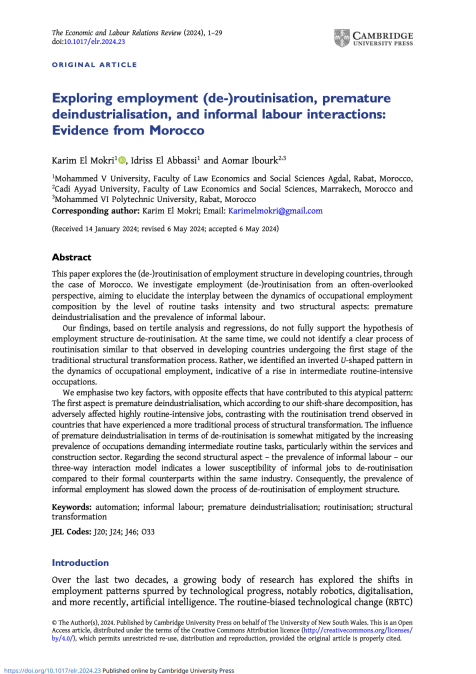
    This paper was originally published on cambridge.org   This paper explores the (de-)routinisation of employment structure in developing countries, through the case of Morocco. We investigate employment (de-)routinisation from an often-overlooked perspective, aiming to elucidate the interplay between the dynamics of occupational employment composition by the level of routine tasks intensity and two structural aspects: premature deindustrialisation and the prevalence of in ...
  • Authors
    Zakaria Elouaourti
    September 13, 2024
    This Paper was originally published on emerald.com   Purpose This paper examines the dynamics of structural transformation in Morocco since 1970 by analyzing input-output tables expressed in terms of employment and output levels across 24 sectors. Design/methodology/approach This study employs a twofold methodological approach. Firstly, it examines the evolution of sectoral employment shares over time using World Bank data. Secondly, it utilizes Input-Output analysis to ex ...
  • Authors
    Ilham Najib
    January 29, 2024
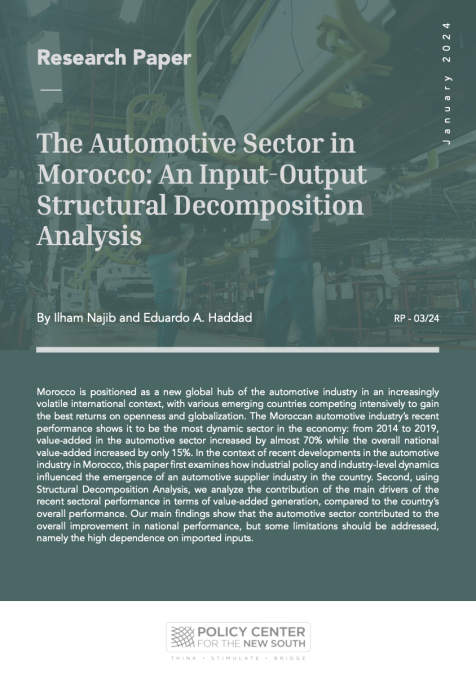
    Morocco is positioned as a new global hub of the automotive industry in an increasingly volatile international context, with various emerging countries competing intensively to gain the best returns on openness and globalization. The Moroccan automotive industry’s recent performance shows it to be the most dynamic sector in the economy: from 2014 to 2019, value-added in the automotive sector increased by almost 70% while the overall national value-added increased by only 15%. In the ...
  • Authors
    Ali Elguellab
    Elhadj Ezzahid
    November 1, 2023
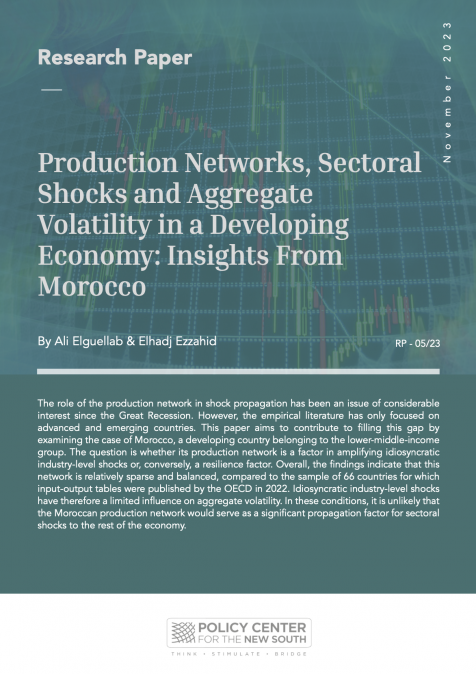
    The role of the production network in shock propagation has been an issue of considerable interest since the Great Recession. However, the empirical literature has only focused on advanced and emerging countries. This paper aims to contribute to filling this gap by examining the case of Morocco, a developing country belonging to the lower-middle-income group. The question is whether its production network is a factor in amplifying idiosyncratic industry-level shocks or, conversely, ...
  • August 28, 2023
    Le secteur informel joue un rôle crucial dans le développement économique et social du Maroc en tant que filet de sécurité pour de nombreux travailleurs. Cependant, sa concentration dans de petites entreprises qui manquent de moyens de production sophistiqués peut entraver la croissance...
  • July 18, 2023
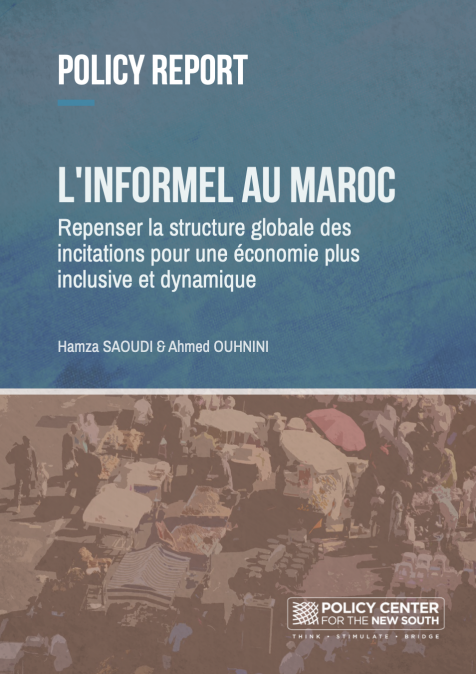
    Le secteur informel est une composante essentielle de l'économie marocaine, employant une large partie de la population, mais nuisant à la productivité, aux recettes fiscales de l’État et à la croissance économique à long terme. Sur la base de la définition adoptée dans cette étude et qui définit les travailleurs informels comme étant ceux qui ne sont pas couverts par les régimes contributifs de sécurité sociale de la Caisse nationale de sécurité sociale (CNSS) et d ...