
RELATED CONTENT
-
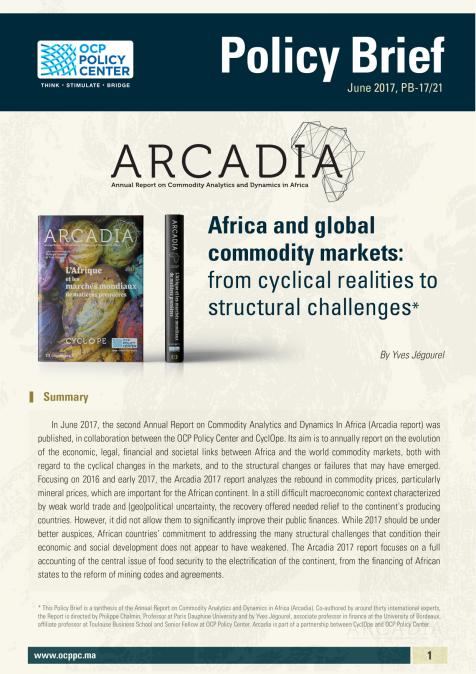 June 9, 2017In June 2017, the second Annual Report on Commodity Analytics and Dynamics In Africa (Arcadia report) was published, in collaboration between the OCP Policy Center and CyclOpe. Its aim is to annually report on the evolution of the economic, legal, financial and societal links between Africa and the world commodity markets, both with regard to the cyclical changes in the markets, and to the structural changes or failures that may have emerged. Focusing on 2016 and early 2017, the Arc ...
 -
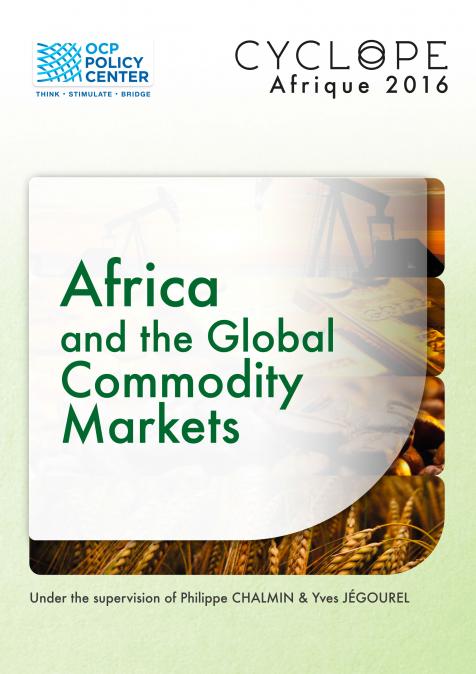 July 4, 2016Guinea’s bauxite, Moroccan phosphates, Nigerian Bonny Light, Zambian copper, Côte d'Ivoire’s cocoa, Ethiopian coffee or Madagascar’s vanilla: all are examples demonstrating that raw materials have a dimension that is as global as it is local. Global by the markets on which they are traded, local by their quality, a key element of their price, and their macroeconomic impact, particularly for Africa. In line with the 2016 CyclOpe report, which celebrates three decades of existence thi ...
 -
 November 21, 2014Eugenia ferragina, Senior researcher at the Institute of Studies on Mediterranean Societies (ISSM) of the Italian National Research Council (CNR) ...
 -
June 13, 2014Interview with Jamal Chahed - International Conference on The Water-Food-Energy Nexus in Drylands: Bridging Science and Policy 11-13 June 2014, Rabat, Morocco ...
-
June 13, 2014Interview with H.E. Miguel Angel Moratinos - International Conference on The Water-Food-Energy Nexus in Drylands: Bridging Science and Policy 11-13 June 2014, Rabat, Morocco ...
-
June 13, 2014Interview with Bassel Daher - International Conference on The Water-Food-Energy Nexus in Drylands: Bridging Science and Policy 11-13 June 2014, Rabat, Morocco ...
-
June 13, 2014Interview with Omar Aloui - International Conference on The Water-Food-Energy Nexus in Drylands: Bridging Science and Policy 11-13 June 2014, Rabat, Morocco ...
-
June 13, 2014Interview with Bodian Ansoumana - International Conference on The Water-Food-Energy Nexus in Drylands: Bridging Science and Policy 11-13 June 2014, Rabat, Morocco ...
-
June 13, 2014Interview with Caroline King - International Conference on The Water-Food-Energy Nexus in Drylands: Bridging Science and Policy 11-13 June 2014, Rabat, Morocco ...
-
June 12, 2014Interview with Rachid Doukkali - International Conference on The Water-Food-Energy Nexus in Drylands: Bridging Science and Policy 11-13 June 2014, Rabat, Morocco ...

