Innovating with Foresight: Building a Resilient Future

September 22, 2023

Foresight and innovation are the dynamic forces that propel societies and organizations towards progress and resilience. Foresight involves anticipating future trends and challenges, enabling us to make informed decisions and stay ahead of the curve. Meanwhile, innovation fuels the creation of groundbreaking solutions to address these anticipated needs, driving continuous improvement and sustainable growth. Together, foresight and innovation form a powerful symbiotic relationship, guiding us towards a brighter and more adaptable future, where we can embrace opportunities, tackle complexities, and thrive in an ever-changing world.

Speakers

Tedd Fuller
Professor of Entrepreneurship and Strategic Foresight, UNESCO
...

RELATED CONTENT

  • Authors
    Chaimae Bourjij
    October 16, 2026
    The author of this opinion, Chaimae Bourjij, is a 2019 alumna of the Atlantic Dialogues Emerging Leaders Program. An election result tells only part of a country’s political story. The rules that turn votes into seats also shape which voices reach Parliament, how local interests are represented, and whether any party can claim a clear mandate. Morocco’s 2026 vote invites this wider reading: not only who came first, but how the electoral framework distributes political ...
  • October 8, 2026
    This paper was originaly published on Higher Education Policy Journal This article critically assesses the alignment between Morocco’s public guidance schemes for international students and its national development goals. Specifically, it investigates the capacity of these mechanisms to transform student mobility from a potential ‘brain drain’ into a tangible ‘brain gain’. Employing a qualitative case study approach, we conducted a systematic content analysis of 204 mobili ...
  • Authors
    Soukaina Raoui
    October 5, 2026
    This paper was originaly published on International Journal of Educational Research Open University dropout remains a major challenge in higher education due to its academic, social, and economic consequences. This study examines the role of academic and career orientation in shaping dropout in Morocco and improving student retention. A sequential mixed-methods design is applied. The quantitative component uses APOGEE administrative data covering 55,674 students and logist ...
  • September 23, 2026
    تتناول هذه الحلقة حدود السباق المتسارع لتطوير نماذج الذكاء الاصطناعي والتحديات المرتبطة بفهم سلوكها والتحكم فيه. ويناقش الأستاذ كريم دربان، أستاذ بالمدرسة الوطنية للتجارة والتسيير بالدار البيضاء، مدى إمكانية الوثوق بهذه النماذج في اتخاذ القرار وحدود السلطة التي يمكن تفويضها لها. كما تتط...
  • Authors
    Oumaima El Azami El Hassani
    September 18, 2026
    Le vivre-ensemble suppose de partager des règles des responsabilités et des valeurs. Pourtant, la préservation de ce bien commun n’a jamais été une évidence. À travers les époques et les sociétés, l’incivisme se manifeste sous différentes formes, selon les contextes sociaux, culturels et institutionnels. ...
  • September 15, 2026
    هذه الحلقة من «حديث الثلاثاء»، نسلّط الضوء على الانتخابات التشريعية بالمغرب لسنة 2026، باعتبارها محطة مهمة ضمن المسار الانتخابي والمؤسساتي للمملكة. نتوقف عند أبرز المعطيات المرتبطة بهذا الاستحقاق، من خلال النظر في خصوصية الانتخابات التشريعية، وتركيبة الهيئة الناخبة والمرشحين واللوائح ال...
  • September 11, 2026
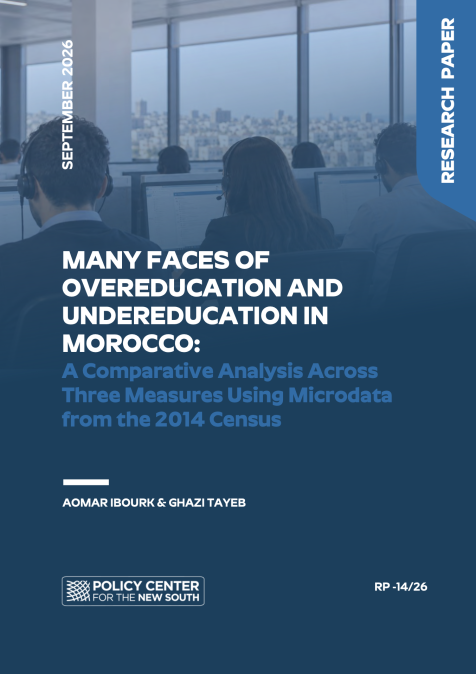
    Since the early 2000s, the Moroccan labour market has experienced continuous educational expansion that has not been matched by an equivalent transformation of the economy's productive structure, giving rise to situations of vertical mismatch between employed workers' education levels and the requirements of the jobs they hold. This study analyzes the determinants of overeducation and undereducation using anonymized microdata from the 2014 General Population and Housing Census (RGPH ...
  • September 11, 2026
    Le marché du travail marocain connaît, depuis les années 2000, une expansion continue de la scolarisation qui ne s'est pas accompagnée d'une transformation équivalente de la structure productive de l'économie, ouvrant la voie à des situations d'inadéquation verticale entre le niveau de formation des actifs occupés et les exigences des emplois qu'ils occupent. La présente étude analyse les déterminants du déclassement (sur-éducation) et du surclassement (sous- éducation) à partir des ...