Global Implications of the Tariff War: A Focus on the New South

March 27, 2026

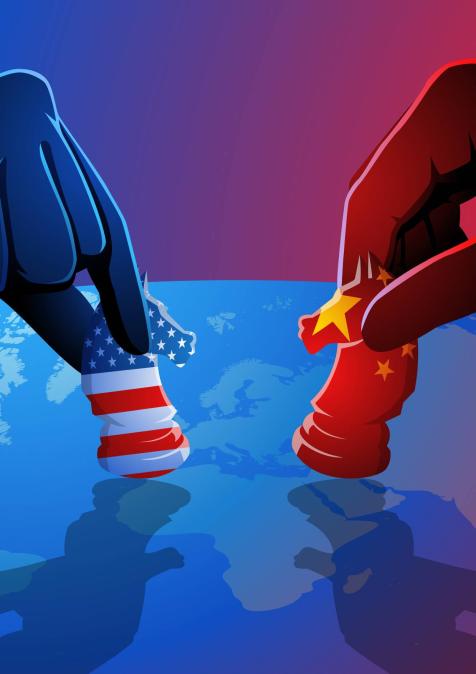
This interview analyzes how tariff wars are transforming global power dynamics, disrupting trade systems, and redefining trade policy as a geopolitical tool, while examining the risks and opportunities for emerging economies and the Global South, the repositioning of regions like Latin America and Africa within shifting supply chains, and whether these tensions mark a lasting shift toward a fragmented global trade system or a temporary phase.

Speakers

Marcus Vinicius de Freitas
Senior Fellow
Marcus Vinicius De Freitas is Senior Fellow at Policy Center for the New South, focusing on International Law, International Relations and Brazil, and is currently a Visiting Professor of International Law and International Relations at China Foreign Affairs University in Beijing, China. Previously, he was a Professor of The Armando Alvares Penteado Foundation in Sao Paulo, where he served as the coordinator of their International Relations Program from December 2012 until December 2013. He was president of the Sao Paulo Directorate of the Progressive Party, having run for vice governor of the State of Sao Paulo in 2010, where his party polled in third place with more than 1.2 million votes. He also served as the Administrative Director of the Sao Paulo Metropolitan Housing Co ...

Diego Marroquin Bitar
Fellow - Americas Program, Center for Strategic and International Studies
window.location="https://www.policycenter.ma/adelcommunity/diego-marroquin-bitar"; ...

RELATED CONTENT

  • Authors
    February 3, 2026
    From the use of tariffs as a foreign policy instrument, to the weaponization of critical resources, and from targeted sanctions to attacks on critical infrastructure, economic security is at the forefront of international debates. The aggressive use of economic instruments for strategic purposes has become an explicit feature of international affairs, in a way not seen since the interwar period[1]. Beyond the weaponization of resources of all kinds, an increasing ‘monetization’ is u ...
  • November 18, 2025
    The meeting between Donald Trump and Xi Jinping in Busan, South Korea, was more than an exercise in diplomacy. It was an emblematic performance of a world in transformation. Behind the formalities, the cameras, and the studied smiles lay an unspoken recognition: the world is no longer unipolar. The era of American supremacy, sustained for decades through its economic reach, military presence, and ideological projection, is giving way to a more diffuse, multipolar reality. ...
  • Authors
    Jorge Arbache
    October 9, 2025
    Conventional wisdom holds that the United States has undergone massive deindustrialization in recent decades, with the country's manufacturing sector supposedly withering as it lost ground to China. This narrative has fueled debates about industrial policy, economic nationalism, and the reshoring of manufacturing production. But what if this story is only partially true? What if, instead of disappearing, American industry simply changed its address?  ...
  • October 7, 2025
    Global economic growth has been more resilient than expected, as the artificial intelligence-led growth seems to be compensating for the negative impacts of trade conflicts. Overstretched asset values and slowing jobs growth may be signaling that the balanced crossing of those two paths...
  • Authors
    October 3, 2025
    Global economic growth has been more resilient than expected, as the artificial intelligence-led growth seems to be compensating for the negative impacts of trade conflicts. Overstretched asset values and slowing jobs growth may be signaling that the balanced crossing of those two paths will be challenged. ...
  • April 23, 2025
    The United States is at a critical juncture, facing a pivotal dilemma: preserving global leadership in a world it no longer fully controls. While it proclaims its primacy in the liberal international order, its actions tell a different story—one marked by tariffs, reshoring policies, and an open attempt to contain China’s rise. This strategy is driven less by long-term vision than domestic political calculus, underscoring the urgent need for strategic recalibration. ...
  • Authors
    Antonio Jorge Martins
    October 9, 2024
    The road to decarbonizing the planet runs through the energy transition, which includes the shift from fossil-fueled cars to renewable energy vehicles. This automotive transition is unfolding as a true revolution in the industry. The evolution toward electric and hybrid vehicles has come in tandem with the ascent of Chinese producers. In the current context of geopolitical and technological rivalries, the automotive transition has been marked by an intense trade war, with implicati ...