American Presidential Elections. Interview with Helmut Sorge

January 30, 2020

Questions: 1/ In the first two weeks of February, the Presidential Elections will begin in earnest. The Democrats begin to choose their candidats in the so called Primaries. Who is the favorite ? 2/ Does any of those candidats have a chance to win against Donald Trump ? 3/ Could Michael Bloomberg, one of the Democratic candidates, who entered the race late, be the surprise ?

Speakers
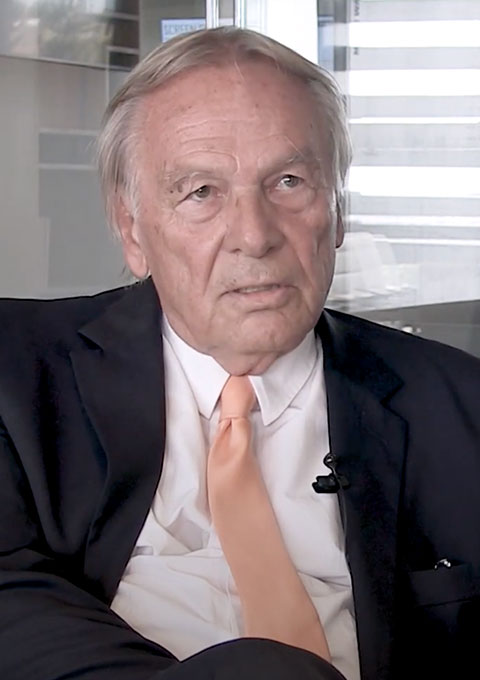
Helmut Sorge
Columnist
Helmut Sorge is a columnist at the Policy Center for the New South, where he publishes opinion pieces in the format of international press reviews of current events related to the Middle East and European affairs, and conducts interviews with high level policy makers and PCNS researchers. He is also a lecturer on journalism and the media. For over 40 years, Helmut Sorge served as a writer, former Foreign correspondent, Foreign editor, and Middle East expert for Germany's leading newsmagazine "Der Spiegel" to Washington, London, Paris and Los Angeles. He reported from Vietnam, the Middle East, wrote about safaris, nuclear accidents, visited prisoners on death row in the United States. The German weekly “Gala” summarized in 2011, when his latest book, a collection of biographies ...


RELATED CONTENT

  • January 09, 2026
    This episode explores the Trump administration’s confrontational stance toward Venezuela, including sanctions and military posturing and evaluates their effectiveness in undermining Madur ...
  • Authors
    January 5, 2026
    The candidate could not have been more controversial—or more celebrated. Born in Kampala, the capital of Uganda, once ruled by Idi Amin, who famously declared himself “Conqueror of the British Empire” and “King of Scotland,” Zohran Kwama Mamdani, 34, is of Indian descent. His father is an academic, a professor of anthropology at Columbia University, his mother, Mira Nair, is an influential filmmaker. Zohran arrived in the USA on a visa at age seven. No doubt the agents of the feared ...
  • Authors
    Nizar Messari
    December 19, 2025
    The U.S. military buildup in the Caribbean—the most significant since the Cuban Missile Crisis—comes at a moment when a new world order is taking shape, its contours still unclear, and in which the U.S. seeks to be more assertive in the Western Hemisphere. This disposition toward South America and the Caribbean was underscored by the recent publication of the new U.S. National Security Strategy, in which the Monroe Doctrine is explicitly invoked. This Policy Brief situates the devel ...
  • Authors
    December 18, 2025
    The return of President Donald Trump to the White House at the start of 2025 was expected to signal an American retreat from international engagement, especially in regions of traditional security interest, such as southern Europe, North Africa, and the Middle East. To the surprise of many observers around the Mediterranean, and perhaps to the dismay of some in the Trump administration’s ideological orbit, this has not happened. If anything, the second half of 2025 has seen a high d ...
  • November 18, 2025
    The meeting between Donald Trump and Xi Jinping in Busan, South Korea, was more than an exercise in diplomacy. It was an emblematic performance of a world in transformation. Behind the formalities, the cameras, and the studied smiles lay an unspoken recognition: the world is no longer unipolar. The era of American supremacy, sustained for decades through its economic reach, military presence, and ideological projection, is giving way to a more diffuse, multipolar reality. ...
  • Authors
    November 10, 2025
    Almost a year after President Donald Trump’s return to the White House, the United States displays little of the isolationism many of the country’s international partners anticipated, and many of Trump’s supporters desired. From economic sanctions to military intervention, Trump is proving to be something of a foreign policy president, although with distinctly unilateral instincts. This approach is particularly evident in Washington’s current approach to the ‘South’, including Latin ...