Agriculture and Food Security post Covid-19 with Isabelle Tsakok (5/5)

May 17, 2020

Retrouvez les analyses de nos expert-e-s au sujet de l'impact de la crise Covid 19 en une série de 5 entretiens

Speakers

Isabelle Tsakok
Senior Fellow
Isabelle Tsakok, development practitioner, policy analyst, researcher, and teacher, is a Senior Fellow at the Policy Center for the New South. She grew up in the Republic of Mauritius, a multi- lingual, multi-ethnic and multi-cultural society. She holds a PHD in Economics from Harvard University, and a BA in Phil/Econ from the London School of Economics. As World Bank staff and consultant, she has focused on agricultural and rural development including on issues of agricultural transformation, food security, and poverty reduction. She has worked in most regions of the developing world, including Africa –North and South of the Sahara; Asia - South, Southeast and East; and Latin America. She has taught courses on agricultural policies and institutions at the World Bank; the Scho ...

RELATED CONTENT

  • Authors
    November 11, 2026
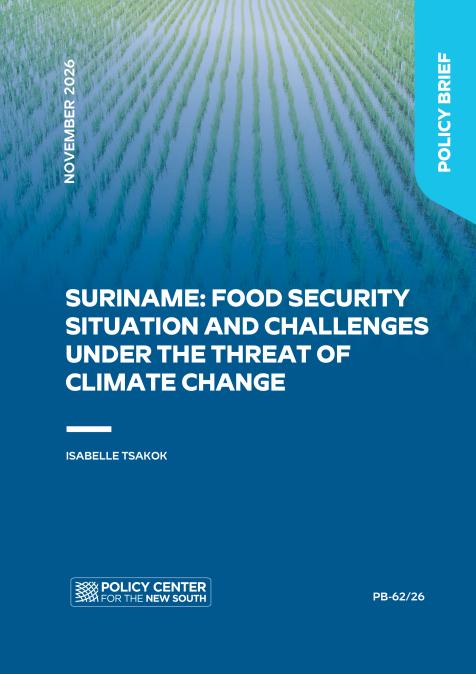
    Suriname is at a crossroads. In 2020, the country discovered extensive oil and gas reserves, presenting the new Geerlings-Simons Government with a golden opportunity to use this windfall to chart a new path of high productivity and inclusive growth, fundamentally different from the low and volatile growth of previous decades. The key question is: will it successfully do so? Success will require the current government to overcome the main constraints of the business-as-usua ...
  • Authors
    October 27, 2026
    Mozambique’s extractive-industry development model is a textbook case of how enormous FDI funds derived from its rich mineral base have not been leveraged to   promote inclusive economic growth and generate food security for all. It is a textbook case of the resource curse.  Instead, only a few have benefitted, leaving the poor and vulnerable, who constitute the vast majority, to struggle unassisted. These include smallholders in subsistence-oriented agriculture ...
  • October 23, 2026
    In this episode, Mehran Haghirian explores the global economic consequences of disruptions in the Strait of Hormuz, beyond oil and gas. He examines their impact on trade, fertilizer suppl ...
  • September 30, 2026
    تتناول هذه الحلقة ظاهرة «إل نينيو» وتأثيراتها المحتملة على المغرب، من خلال التعريف بآلياتها وانعكاساتها على درجات الحرارة والتساقطات والظواهر المناخية القصوى. كما تسلط الضوء على تداعياتها المحتملة على الموارد المائية والقطاع الفلاحي، والمناطق والقطاعات الأكثر عرضة لتأثيراتها. وتناقش الح...
  • Authors
    September 25, 2026
    The Latin America and Caribbean region has made considerable progress in poverty reduction and improving food security since COVID-19. However, the improvements have not been driven by inclusive growth.A characteristic feature of the LAC experience is that major disparities in economic performance, poverty reduction, and food security exist, e.g., among regions; between rural and urban areas; between genders. In addition to these disparities, large farmers, the minority in dualistic ...
  • Authors
    September 14, 2026
    The outbreak of the war in Iran and the closure of the Strait of Hormuz have had major consequences for a large number of global commodity markets. While media attention has understandably focused on oil and natural gas, as well as on aluminum – owing to the strong dependence of that metal’s supply on energy prices – sulfur, like helium, ethylene, propylene, or urea, has also been caught up in the fallout of this conflict. Far from being a marginal commodity, it is essential to the ...
  • Authors
    September 14, 2026
    Le déclenchement de la Guerre en Iran et le blocage du détroit d’Ormuz ont eu des conséquences majeures sur un grand nombre de marchés mondiaux de matières premières. Si l’attention médiatique s’est logiquement portée sur le pétrole et le gaz naturel, ainsi que sur l’aluminium, en raison de la forte dépendance de l’offre de ce métal aux prix de l’énergie, le soufre, comme l’hélium, l’éthylène, le propylène ou l’urée, a également été pris dans les rets de ce conflit. Loin d’être une ...
  • Authors
    August 5, 2026
    This paper addresses the persistent challenge of resource dependence in the world's poorest countries, focusing on the ten poorest African nations where natural- resource rents average 14% of income. It argues that four decades of conventional policy advice, which treated resource dependence primarily as a revenue management problem, have failed to help these countries. While stabilization funds and permanent-income frameworks aim to smooth consumption, they do not answer the fundam ...
  • Authors
    July 31, 2026
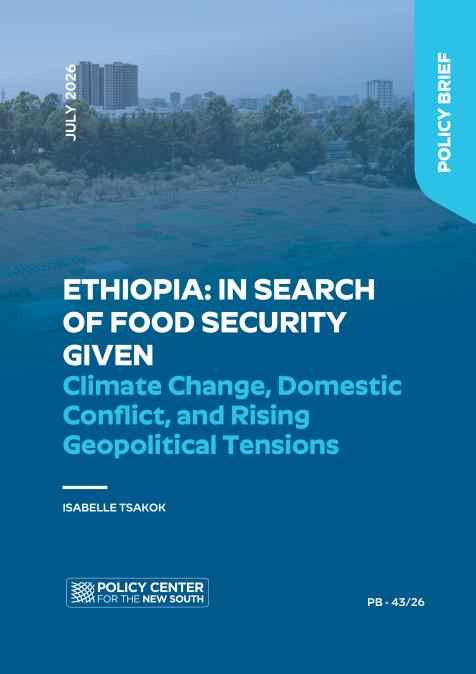
    Ethiopia continues to struggle to lay the economic foundations of food security for all, more than 30 years after first adopting the East Asian Developmental State Model (EADS) under Zenawi (1911-2012), continued under Hailemariam Desalegn (2012-April 2018), and later shifting toward a neo-liberal, Washington consensus-oriented approach under Abiy Ahmed (2018-present). The achievements recorded under the EADS approach—particularly double-digit annual growth, substantial poverty ...