Publications /
Policy Brief

Back
Traps on the Road to High Income
Authors
April 25, 2019

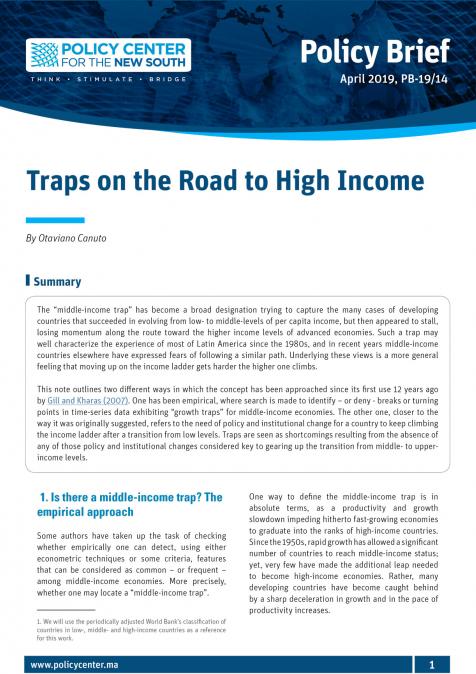
The “middle-income trap” has become a broad designation trying to capture the many cases of developing countries that succeeded in evolving from low- to middle-levels of per capita income, but then appeared to stall, losing momentum along the route toward the higher income levels of advanced economies. Such a trap may well characterize the experience of most of Latin America since the 1980s, and in recent years middle-income countries elsewhere have expressed fears of following a similar path. Underlying these views is a more general feeling that moving up on the income ladder gets harder the higher one climbs.

This note outlines two different ways in which the concept has been approached since its first use 12 years ago by Gill and Kharas (2007). One has been empirical, where search is made to identify – or deny - breaks or turning points in time-series data exhibiting “growth traps” for middle-income economies. The other one, closer to the way it was originally suggested, refers to the need of policy and institutional change for a country to keep climbing the income ladder after a transition from low levels. Traps are seen as shortcomings resulting from the absence of any of those policy and institutional changes considered key to gearing up the transition from middle- to upper-income levels. 
RELATED CONTENT

  • Authors
    May 20, 2016
    The 2015-2030 strategic vision innovates the Moroccan educational system. Unlike previous reforms, this vision addresses problems that have long been ignored. Among these problems is the quality of education. Although educational quality may have been included in previous reform programs, it is considered as one of the priorities in this new vision. The purpose of this Policy Brief is to assess the status of learning achievement, which is an integral part of educational quality, of ...
  • Authors
    Russel Dinh
    January 27, 2016
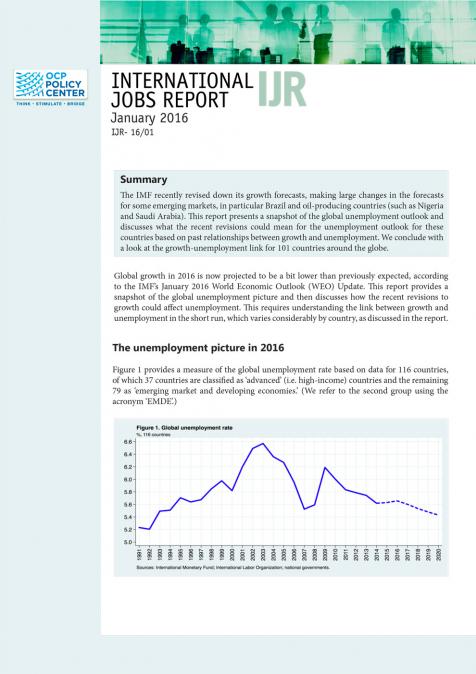
    The IMF recently revised down its growth forecasts, making large changes in the forecasts for some emerging markets, in particular Brazil and oil-producing countries (such as Nigeria and Saudi Arabia). This report presents a snapshot of the global unemployment outlook and discusses what the recent revisions could mean for the unemployment outlook for these countries based on past relationships between growth and unemployment. We conclude with a look at the growth-unemployment link f ...
  • January 27, 2016
    This podcast is performed by Prakash Loungani. He is Senior Fellow at Policy Center for the New South and Advisor in the Research Department of the International Monetary Fund, was interv ...
  • Authors
    December 8, 2015
    Trade negotiators rarely get to celebrate a victory. The United States, for example, has been negotiating over 15 bilateral free trade agreements, with none concluded since the Korea-US agreement was finalized at the end of 2010. This makes the recently finalized Trans-Pacific Partnership (TPP)agreement between the United States and 11 other countries all the more remarkable. But the TPP still faces major hurdles, not least a divisive ratification debate in the U.S. C ...
  • November 5, 2015
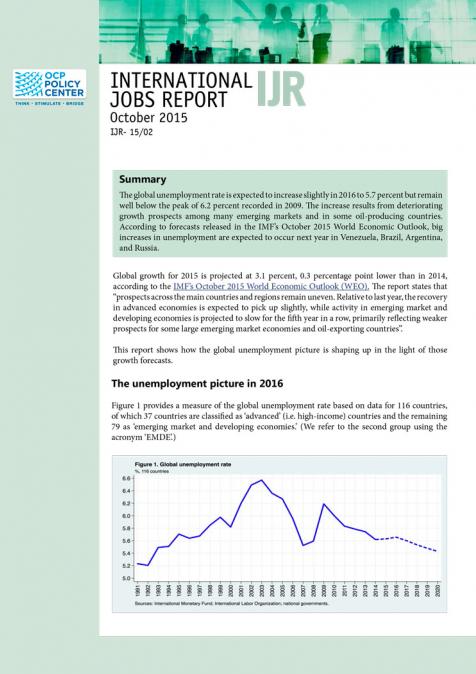
    The global unemployment rate is expected to increase slightly in 2016 to 5.7 percent but remain well below the peak of 6.2 percent recorded in 2009. The increase results from deteriorating growth prospects among many emerging markets and in some oil-producing countries. According to forecasts released in the IMF’s October 2015 World Economic Outlook, big increases in unemployment are expected to occur next year in Venezuela, Brazil, Argentina, and Russia. ...
  • Authors
    October 2, 2015
    Récemment parue parmi la série de Policy Briefs publiés par OCP Policy Center, une étude réalisée conjointement par Prakash Loungani et Saurabh Mishra a mis l’accent sur la réaction du chômage et l’emploi par rapport à la croissance économique dans les pays du G-20. L’objectif est de quantifier l’apport d’un point supplémentaire de croissance sur l’évolution du taux d’emploi, et sur le taux du chômage sur la période 1980-2014.  Sur la période 1980-2007, les ...