Publications /
Policy Paper

Back
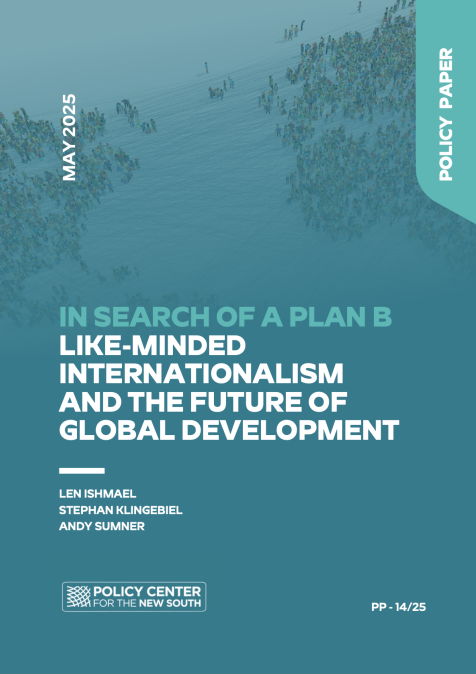
In Search of a Plan B: Like-Minded Internationalism and the Future of Global Development
Authors
Stephan Klingebiel
Andy Sumner
May 12, 2025

Though the international order has changed greatly over the past decades, the transformation now underway is significantly deeper and more profound. The post-1945 multilateral system—largely constructed under U.S. hegemony and framed by liberal values including open markets, rules-based cooperation, and a commitment to global development—is fragmenting. Over the past decade, a series of systemic shocks, including the COVID-19 pandemic, rising geopolitical tensions, and the return of great-power competition, has exposed the limitations of traditional multilateralism. The recent withdrawal of the United States from Agenda 2030 and the Sustainable Development Goals (SDGs), alongside its increasingly transactional foreign policy under the second Trump administration, marks a decisive break from the consensus that has underpinned global governance in recent decades. This development has profound implications for international cooperation, particularly in the fields of development, climate, and global public goods.

In this context, this paper develops the concept of like-minded internationalism—a form of collective action that relies on coalitions of countries and actors aligned around shared normative commitments and pragmatic objectives, rather than formal multilateral structures or hegemonic or hierarchical leadership. Like-minded coalitions, we argue, offer a viable institutional response to a more multipolar, contested, and volatile international system. Rather than seeking universal consensus, they build issue-based alliances that are flexible, pluralistic, and often innovative in form. They have the potential to achieve more than the lowest common denominator typically reached by less like-minded groups. Importantly, they reflect a shift from global governance premised on inclusion and universality, to a logic of selective cooperation driven by convergence on key goals.

The paper is structured as follows. Section 2 gives a historical perspective on the current moment, tracing the rise and partial erosion of liberal multilateralism, and the emergence of new geopolitical fault lines. Section 3 expands on the concept of like-minded internationalism. Section 4 explores two illustrative cases—UNITAID and the High Ambition Coalition—highlighting the conditions under which like-minded coalitions emerge and the political dynamics that sustain them. Drawing on a policy process framework, we analyze how these initiatives were shaped by actors and networks, context and opportunism, and narratives and evidence. The paper concludes by reflecting on the implications of like- minded internationalism for the future of global cooperation, suggesting that it represents not a retreat from multilateralism, but an adaptive response to its breakdown—one rooted in coalitional agency, institutional pluralism, and strategic pragmatism.

RELATED CONTENT

  • Authors
    Marianna Albuquerque
    September 23, 2026
    The author of this opinion, Marianna Albuquerque, is a 2022 alumna of the Atlantic Dialogues Emerging Leaders Program.As world leaders gather in New York for the 81st United Nations General Assembly, climate change returns to the center of multilateral diplomacy under markedly different circumstances. The debate is no longer confined to whether the world must decarbonize, but increasingly centers on how the transition will happen, who will bear its costs, who will capture ...
  • Authors
    September 23, 2026
    Depuis 2010, environ, on sait que la Méditerranée orientale est une nouvelle province gazière. Des ressources gazières ont en effet été découvertes au large de quatre pays ou territoires, l’Égypte, Israël, Chypre et Gaza. Deux d’entre eux sont devenus producteurs et exportateurs de gaz naturel, l’Égypte et Israël. Au large de Gaza, le champ gazier de Gaza Marine n’a jamais été développé et il est très peu probable qu’il le soit prochainement en raison des très fortes tensions entre ...
  • Authors
    Luladay Berhanu Mengistie
    Guillaume Gérout Suominen
    September 21, 2026
    The African Union Summit of February 2026 instructed the African Continental Free Trade Area (AfCFTA) Council of Ministers to negotiate a Protocol on Industrial Policy and Development. This work, handled without adequate preparation, is likely to reproduce the weaknesses it is meant to remedy. This paper is a conceptual mapping exercise, written to raise the preparatory questions before drafting begins, rather than to prescribe outcomes.It proceeds in five sections:1. It works towar ...
  • Authors
    September 17, 2026
    Various competing cross-border payment networks have become vehicles for geopolitical competition. As tensions have risen, many countries want to secure access to cross-border payment systems by joining with like-minded countries to form interoperable networks, either via tokenization or Instant Payment Systems (IPSs). Three major projects are under development, serving the strategic interests of the US, China and the Rest of the World—corresponding to the three trading spheres taki ...
  • September 16, 2026
    Much of Western debate was revealingly silent on the Shanghai Cooperation Organization (SCO) summit, which took place on August 31 and September 1 in Bishkek, Kyrgyzstan. That relative silence reflects how poorly the organization’s growing significance is still understood. The meeting has not gone unreported. Any gathering of Xi Jinping, Narendra Modi, and Vladimir Putin inevitably attracts&nbs ...
  • Authors
    Joana Ama Osei-Tutu
    September 12, 2026
    The author of this opinion, Joana Ama Osei-Tutu, is a 2017 alumna of the Atlantic Dialogues Emerging Leaders Program.South-South cooperation (SSC) is often presented as an alternative to the hierarchical relationships that have historically characterized international development. In principle, SSC means Global South countries learn from one another, share expertise and resources, and develop solutions grounded in their own experiences, rather than importing models designe ...
  • September 8, 2026
    La conférence de lancement du projet POMIRE Sud-Sud, tenue au Policy Center for the New South à Rabat les 11 et 12 février 2026, a constitué un moment fondateur. Pour la première fois, l'ensemble des acteurs institutionnels de cinq des six pays partenaires du projet — Côte d'Ivoire, Guinée, Mali, Maroc et Sénégal — se sont réunis pour poser les piliers d’une vision commune et identifier les priorités qui guideront les phases opérationnelles du projet. Quatre focus groupes thématique ...