Publications /
Policy Paper

Back
Masters of the Algorithms: The Geopolitics of the New Digital Economy from Ford to Google
May 2, 2014

The financial and economic crisis that unfolded across the globe after the 2008 sub-prime meltdown was not just another cyclical bump in the conquering advance of modern capitalism. It was — and still is — a symptom of the exhausted 20th-century way of envisioning the best path to economic growth, consumer satisfaction, and efficient production of goods. Environmental limits to our race to prosperity are just part of the story. The other, and crucial, part is the ongoing technological revolution and its impact on manufacturing processes, the organization of production value chains, and on consumption itself. The analogic mechanical conveyor-belt, so prevalent during the last century, is rapidly being superseded by a new digital computational conveyor-belt. The consequences will be huge for the world’s geographic distribution of economic activity as well as for the authority and perquisites of nation-states and governments.

Every historical social metamorphosis has its winners and losers. The new digital industrial economy will entail a new distribution of wealth and power around the world. Certainly, the old reality will not simply disappear. It will coexist with the new one but will be progressively subordinated to new logic and interests. It is amazing how in the course of a few years the likes of Google, Apple, Facebook, Amazon, and even the “old” telecom industry have overtaken the last century’s giant corporations. Moreover, new players continue to pop up and threaten the recently established positions of these first giants of the Internet. Disruptions will indeed be pervasive. The new technological dynamics are already leading to profound changes regarding the beneficiaries of corporate, social, political, and geographical value-added. The million-dollar question is: who will pocket the bulk of the benefits of this new era?


RELATED CONTENT

  • Authors
    Sabine Cessou
    October 10, 2018
    La seconde thématique des Dialogues stratégiques, dont la 6ème édition s’est tenue le 4 octobre 2018 à Paris, a porté sur les réformes en cours au sein de l’organisation panafricaine. La rencontre est d’abord revenue sur le contexte global dans lequel opère l’Union africaine (UA). La géopolitique en Afrique n’est pas seulement menée par les ex-puissances coloniales et la Chine, mais bien par les pays africains eux-mêmes, a ainsi rappelé l’ancien ministre français des Affaires étran ...
  • December 14, 2017
    Moderator: Jordi Bacaria, General Director, Barcelona Centre for International Affairs - Newai Gebre-ab, Executive Director, Ethiopian Development Research Institute, former Chief Economic Adviser to the Prime Minister of Ethiopia - Paulo Neves, President, Institute for the Promotion of...
  • Authors
    Abdelkhalek El Bikam
    Afang Ndong Zita
    Kourouma Oumar
    August 25, 2017
    The current economic, political and geo-strategic dynamics, centered on the major regional groups, announce a reconfiguration of the international order in which Africa is called to play an important role through its main continental institution which is the Union African Union (AU). The AU is increasingly emerging as the continent's platform with foreign partners, and continues to face problems of dependence, governance and leadership. Therefore, in a critical and forward-looking a ...
  • Authors
    Russel Dinh
    January 27, 2016
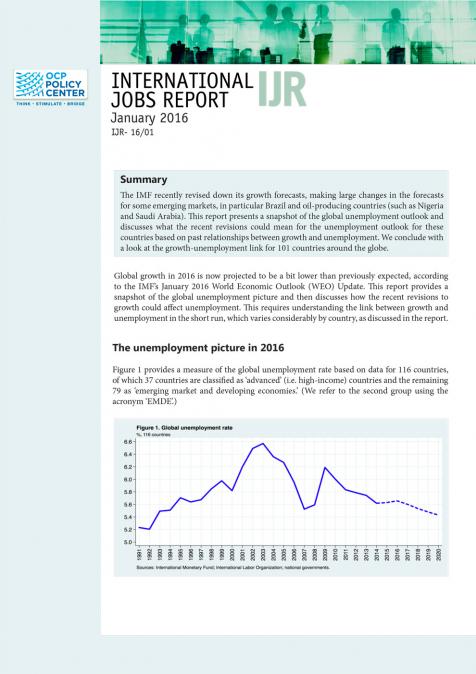
    The IMF recently revised down its growth forecasts, making large changes in the forecasts for some emerging markets, in particular Brazil and oil-producing countries (such as Nigeria and Saudi Arabia). This report presents a snapshot of the global unemployment outlook and discusses what the recent revisions could mean for the unemployment outlook for these countries based on past relationships between growth and unemployment. We conclude with a look at the growth-unemployment link f ...
  • May 2, 2014
    The financial and economic crisis that unfolded across the globe after the 2008 sub-prime meltdown was not just another cyclical bump in the conquering advance of modern capitalism. It was — and still is — a symptom of the exhausted 20th-century way of envisioning the best path to economic growth, consumer satisfaction, and efficient production of goods. Environmental limits to our race to prosperity are just part of the story. The other, and crucial, part is the ongoing technologic ...
  • From

    06
    11:00 am October 2026
    Dans un environnement international reconfiguré, les économies à revenu intermédiaire poursuivent leur processus de convergence dans des conditions plus exigeantes. La fragmentation géopolitique et la réorganisation des chaînes de valeur mondiales modifient les logiques d'insertion productive, tandis que les tensions sur le système monétaire international pèsent sur le financement des économies en développement. L'accélération des transitions technologique et énergétique redistribue par ailleurs les avantages comparatifs et exige des capacités d'adaptation que tous les pays ne peuvent mobiliser au même degré. Les moteurs classiques du rattrapage se trouvent fragilisés, et le risque d'enlisement dans le piège du revenu intermédiaire se pose de manière plus pressante.C'est dans ...