Publications /
Policy Brief

Back
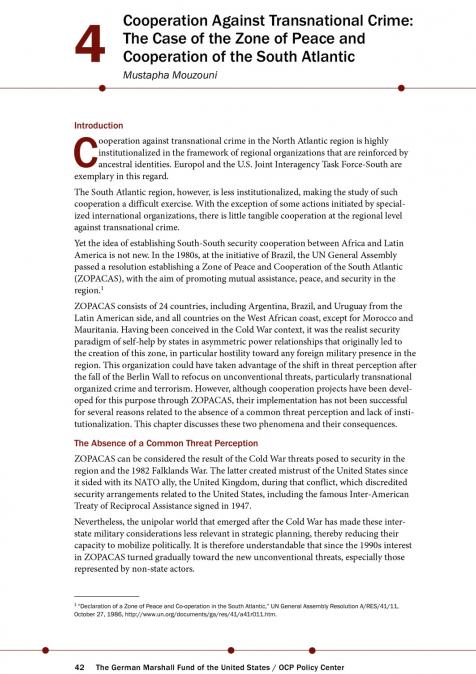
Cooperation Against Transnational Crime: The Case of the Zone of Peace and Cooperation of the South Atlantic
Authors
Mostapha Mouzouni
January 23, 2017

Cooperation against transnational crime in the North Atlantic region is highly institutionalized in the framework of regional organizations that are reinforced by ancestral identities. Europol and the U.S. Joint Interagency Task Force-South are exemplary in this regard. The South Atlantic region, however, is less institutionalized, making the study of such cooperation a difficult exercise. With the exception of some actions initiated by specialized international organizations, there is little tangible cooperation at the regional level against transnational crime. Yet the idea of establishing South-South security cooperation between Africa and Latin America is not new. In the 1980s, at the initiative of Brazil, the UN General Assembly passed a resolution establishing a Zone of Peace and Cooperation of the South Atlantic (ZOPACAS), with the aim of promoting mutual assistance, peace, and security in the region.1 ZOPACAS consists of 24 countries, including Argentina, Brazil, and Uruguay from the Latin American side, and all countries on the West African coast, except for Morocco and Mauritania. Having been conceived in the Cold War context, it was the realist security paradigm of self-help by states in asymmetric power relationships that originally led to the creation of this zone, in particular hostility toward any foreign military presence in the region. This organization could have taken advantage of the shift in threat perception after the fall of the Berlin Wall to refocus on unconventional threats, particularly transnational organized crime and terrorism. However, although cooperation projects have been developed for this purpose through ZOPACAS, their implementation has not been successful for several reasons related to the absence of a common threat perception and lack of institutionalization. This chapter discusses these two phenomena and their consequences.
RELATED CONTENT

  • Authors
    Ian Lesser
    November 18, 2013
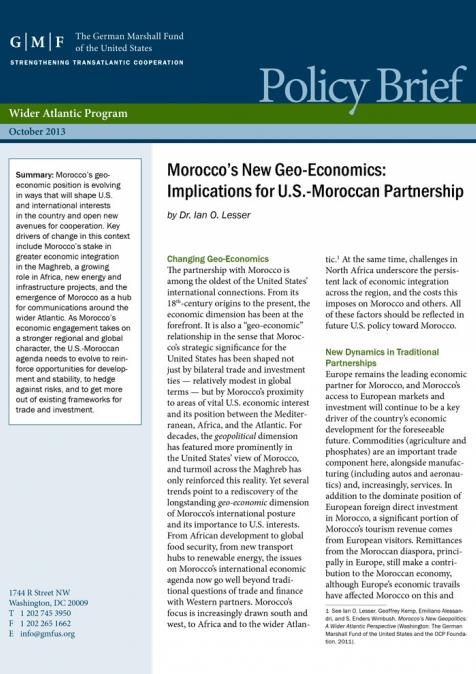
    This policy brief argues for a closer relationship between Morocco and the United States. Morocco’s geo-economic position is evolving in ways that will shape U.S. and international interests in the country and open new avenues for cooperation. Key drivers of change in this context include Morocco’s stake in greater economic integration in the Maghreb, a growing role in Africa, new energy and infrastructure projects, and the emergence of Morocco as a hub for communications around th ...
  • Authors
    Neal Peirce
    Adam Freed
    Anthony Townsend
    June 24, 2013
    This policy paper examines the importance of cities as global policy actors, innovators, and collaborators. While a global phenomenon, the authors of this paper identify specifically how the evolution of the importance of cities as global policy actors, innovators, and collaborators unfolds in the cities of the Northern Atlantic Basin versus the cities in the Southern Atlantic Basin. Despite the important differences between the cities of the Atlantic Basin, technology and the impa ...
  • Authors
    Abderrahmane Mebtoul
    April 1, 2011
    Pièce maîtresse dans la région euroméditerranéenne, le Maghreb est sollicité par l'Union européenne, et plus récemment par les Etats-Unis, dans le cadre d'une compétition entre ces deux pôles dans leur recherche d'une hégémonie économique. Plusieurs années après que l'Accord d'Association avec l'Europe est entré en vigueur, a-t-il permis une coopération économique, financière et sociale orientée vers une véritable accumulation du savoir-faire organisationnel et technologique ? Quell ...
  • Authors
    François Gemenne
    March 1, 2011
    This paper analyzes the future of migrations related to climate changes and environment degradations. He shows how the dominant public reasoning remains inappropriate for addressing these issues, because of the Western/Northern countries' misconception of the relation between migration and environmental changes, including the cultural and political biases these countries show in the solutions they propose. The discrepancy between public policies and the actual reality of climatic an ...
  • From

    15
    5:00 pm October 2026
      The Policy Center for the New South, in partnership with The Asian Network, is organizing a webinar titled “Emerging Powers and the Remaking of Global Order” to examine the growing role of emerging powers and the Global South at a time of profound transformation in the international system.As power becomes more diffuse, economic gravity shifts, multilateralism comes under pressure, and strategic competition intensifies, countries across Asia, Africa, the Gulf, and Latin America are seeking greater strategic autonomy, strengthening South-South trade and investment, advancing digital and green transitions, and calling for greater representation in global governance.These ambitions, however, unfold against significant challenges, including debt vulnerabilities, climat ...
  • From

    10
    5:30 pm September 2026
    This episode of Africafé features H.E. Abdisaid Muse Ali, former Somali Foreign Minister, discussing Somalia's federal system tensions, the decline of Western support for peacekeeping missions, the Ethiopia-Somaliland MOU dispute over Red Sea access, and the growing role of Turkey and Gulf states in the region. He calls for durable political settlement and greater African ownership of security solutions. ...
  • From

    02
    5:30 pm July 2026
    This episode explores Russia’s growing influence in Africa through media, information warfare, and anti-Western narratives. It examines how Moscow uses historical ties, social media, local influencers, and security partnerships to shape perceptions, while questioning the real scope and long-term impact of its presence on the continent. ...
  • From

    18
    5:30 pm June 2026
    The episode discusses the High Seas Treaty as a major step for global ocean governance and marine biodiversity protection. Rear Admiral Nuno Bragança highlights its importance for African countries, particularly in terms of cooperation, capacity-building, technology transfer, and marine protected areas. The conversation also underlines the challenges of implementation, from legal integration to illegal fishing and equitable access for developing countries. ...
  • From

    05
    3:00 pm April 2022
    يخصص مركز السياسات من أجل الجنوب الجديد حلقة برنامجه الأسبوعي "حديث الثلاثاء" لمستقبل العلاقات المغربية الاسبانية مع العربي الجعايدي، باحث بارز بمركز السياسات من أجل الجنوب الجديد عرفت العلاقة الثنائية المغربية الإسبانية تطوّرًا ملحوظًا مع إعلان الحكومة الإسبانية مساندتها لمبادرة الحكم الذاتي التي يطرحها المغرب لحلحلة النزاع على صحرائه وإثبات سيادة الرباط على أقاليمه الجنوبية. وأتت هذه الخطوة الاسبانية لتحسين العلاقات الثنائية مع جارها الجنوبي ولإعادة بناء العلاقة على أسس سليمة تمكّن البلدين من الانخراط المشترك في مشروع يهدف الى تحقيق علاقة استراتيجية ومتوازنة وإيجابية تتسم بالشفافية ومقاربة متوازنة. فما هي أهم الإشكاليات والتحديات التي تقف أمام تحقيق هذا الهدف؟ نعود خلال هاته الحلقة إلى أهم التحديات التي تقف أمام تحقيق هذا الهدف المنشود والذي يتمثل في تحسين العلاقات الثنا ...
  • From

    21
    9:00 am March 2022
    The Policy Center for the New South and the King Abdullah Petroleum Studies and Research Center are pleased to organize a close workshop under theme “Renewables and the Future of Geopolitics” on Monday, March 21, 2022, starting 09:00 am GMT+1. This workshop will address an increasingly salient topic that sits at the intersection between energy transition, interstate relations and global trade: how the penetration of renewable energy affects geopolitics. As the recently published article by Hatipoglu, Al Muhanna and Efird (2020) demonstrate, this topic relates to various issues of immediate interest to energy markets. For instance, electricity creates a new form of interdependency between states, where such trade also locks in carbon trade. E ...