Publications /
Policy Brief

Back
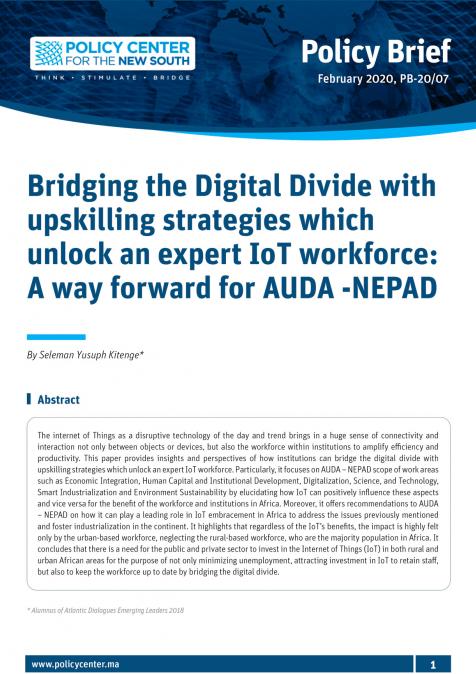
Bridging the Digital Divide with upskilling strategies which unlock an expert IoT workforce: A way forward for AUDA-NEPAD
Authors
Seleman Yusuph Kitenge
February 12, 2020

The internet of Things as a disruptive technology of the day and trend brings in a huge sense of connectivity and interaction not only between objects or devices, but also the workforce within institutions to amplify efficiency and productivity. This paper provides insights and perspectives of how institutions can bridge the digital divide with upskilling strategies which unlock an expert IoT workforce. Particularly, it focuses on AUDA – NEPAD scope of work areas such as Economic Integration, Human Capital and Institutional Development, Digitalization, Science, and Technology, Smart Industrialization and Environment Sustainability by elucidating how IoT can positively influence these aspects and vice versa for the benefit of the workforce and institutions in Africa. Moreover, it offers recommendations to AUDA – NEPAD on how it can play a leading role in IoT embracement in Africa to address the issues previously mentioned and foster industrialization in the continent. It highlights that regardless of the IoT’s benefits, the impact is highly felt only by the urban-based workforce, neglecting the rural-based workforce, who are the majority population in Africa. It concludes that there is a need for the public and private sector to invest in the Internet of Things (IoT) in both rural and urban African areas for the purpose of not only minimizing unemployment, attracting investment in IoT to retain staff, but also to keep the workforce up to date by bridging the digital divide.

*Seleman Yusuph Kitenge is Alumnus of Atlantic Dialogues Emerging Leaders 2018
RELATED CONTENT

  • Authors
    Mohamed Mouline
    January 1, 2014
    L’Afrique du Sud est une république fédérale, fondée sur une démocratie parlementaire. Avec une superficie de 1,2 million de km² et une population de 50 millions d’habitants, elle est la première puissance économique du continent africain, représentant, à elle seule, 30 % du PIB de l’Afrique Subsaharienne et 66 % de celui de l’Afrique Australe. Son PIB est de 420 milliards de dollars et son PIB par habitant est de 5 860 dollars. Ce pays est parvenu à réinsérer son économie dans les ...
  • Authors
    Mihoub Mezouaghi
    November 1, 2013
    Le discours sur la « colocalisation » est chargé de bonnes intentions à l’attention des pays du sud de la Méditerranée qui, depuis quelques années, réclament avec insistance une contrepartie à l’accès à leur marché (notamment en matière de transfert de technologie pour permettre d’accélérer leur industrialisation). La « colocalisation » est alors présentée comme une « forme avancée de la délocalisation ». Mais, ce discours s’adresse en même temps à l’opinion publique française lorsq ...
  • From

    13
    5:30 pm October 2026
     في ظل التوترات الجيوسياسية المتصاعدة، تتغير طرق التجارة العالمية وتتبدل معها موازين الممرات الاستراتيجية. تفتح هذه الحلقة من «حديث الثلاثاء» النقاش حول التقاء المسارات البحرية والبرية داخل هذه الممرات، والعوامل التي تتحكم في طبيعة السلع التي تعبرها. وتبحث كذلك في ما يمكن للمغرب أن يجنيه من موقعه، عبر موانئه وشبكاته البرية، لتعزيز اتصاله بإفريقيا وأوروبا، وفي المعايير التي يُحكم بها على نجاح هذه الممرات، بدءًا بحجم المبادلات وتقليص تكاليفها، وصولًا إلى القيمة المضافة التي تعود على الدول والمناطق التي تمر منها.  ...
  • From

    08
    5:30 pm October 2026
    How do intra-African diasporas contribute to the continent’s development? This Africafé episode discusses their role in remittances, entrepreneurship, and skills circulation. The conversation addresses the administrative, financial, and institutional barriers that limit their contribution, alongside opportunities for South-South cooperation to strengthen their participation in Africa’s economic integration. ...
  • From

    24
    5:30 pm September 2026
    Dans cet épisode d’Africafé, Amadou Diop analyse les défis de sécurité maritime auxquels font face les pays de l’Afrique atlantique, de la piraterie aux trafics transfrontaliers. Il souligne la nécessité de mutualiser les moyens et de partager l’information entre États. L’échange aborde aussi le potentiel économique de cet espace et les conditions d’une coopération maritime plus cohérente, notamment dans le cadre de l’Initiative atlantique du Maroc. ...